
Key Points: AI SEO is how contractors get recommended by ChatGPT, Google’s AI Overviews, and other AI tools when homeowners search for services. This guide covers exactly how AI search works and what you need to do to show up before your competitors do.
What Is AI SEO for Contractors?
AI SEO is the practice of optimizing your online presence so that artificial intelligence tools recommend your contracting business when someone asks them for help finding a service provider.
Traditional search shows users a list of links to click. AI search is different. When a homeowner types “who is the best roofer in Harrisburg PA” into ChatGPT or asks Google’s AI Overview “what should I look for in an HVAC company,” they get a direct answer. Sometimes that answer includes specific business recommendations. AI SEO is what determines whether your business gets mentioned in that answer.
The Opportunity Most Contractors Are Missing
Most contractors have not started working on AI SEO yet. That is a significant competitive advantage for the ones who act now.
Think about where traditional SEO was in 2010. The contractors who invested early built authority that competitors spent years trying to catch up to. AI SEO is in that same early window right now.
The window is still open. But it will not stay open forever.
How AI Search Actually Works for Contractors
Before you can optimize for AI search, you need to understand how these tools make decisions.
AI tools like ChatGPT, Google Gemini, and Perplexity do not crawl the web and rank pages the way Google does. They are trained on massive amounts of text data and then pull from live sources to generate answers. When someone asks for a contractor recommendation, the AI is essentially synthesizing everything it can find about businesses in that space and surfacing the ones it considers most credible and relevant.
That means AI recommendations are driven by:
- How consistently your business information appears across the web. If your name, address, services, and reputation show up the same way in multiple trusted places, AI tools recognize your business as real and established.
- The quality and depth of content on your website. AI tools pull from web pages, blog posts, and FAQ sections when generating answers. Thin content gets skipped. Detailed, helpful content gets cited.
- Your review volume and sentiment. AI tools read reviews. A contractor with 75 recent five-star reviews and responses to every single one signals trustworthiness in a way that a contractor with 8 reviews from three years ago does not.
- How well you demonstrate real expertise. Certifications, years in business, completed project counts, and named team members all contribute to what AI tools understand about your credibility.
The contractors who show up in AI results are not doing anything exotic. They are doing the fundamentals exceptionally well.
How to Check If You Are Showing Up in AI Results
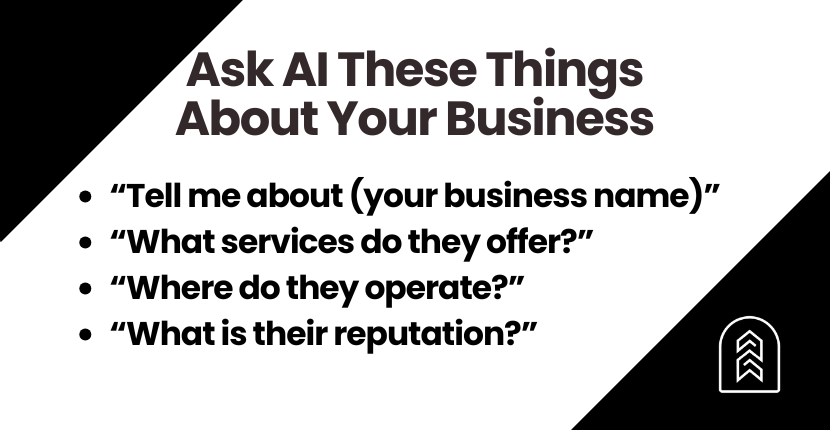
Before you start optimizing, take five minutes to run this test.
Open ChatGPT or Google Gemini and type your business name into the prompt. Ask: “Tell me about [Your Business Name]. What services do they offer, where do they operate, and what is their reputation?”
Then pay attention to three things:
- Accuracy. Does the AI describe your business correctly? Does it know your service area, your primary trade, and what sets you apart?
- Completeness. Does the AI have enough information to give a real answer, or does it say it cannot find details about your business?
- Sentiment. Does it reflect your reputation positively? Does it mention your reviews or any recognition you have received?
If the AI cannot find you, says inaccurate things, or gives a thin response, that is a clear signal your AI SEO foundation needs work.
Next, run a competitor test. Ask the AI: “Who are the top [your trade] companies in [your city]?” See who shows up. If your competitors appear and you do not, that tells you exactly what is at stake.
Traditional SEO vs. AEO vs. GEO: What Is the Difference?
You will hear three terms used when people talk about AI SEO. Here is what each one means for contractors and why all three matter.
Traditional SEO is what most contractors think of when they hear the word SEO. It focuses on ranking your website in Google’s organic blue link results for specific keywords. It is driven by content, backlinks, technical setup, and on-page optimization.
AEO (Answer Engine Optimization) focuses on getting your content cited when AI tools generate direct answers to questions. When a homeowner asks “how much does a new roof cost in York PA,” AEO is what makes your content the source the AI pulls from to answer that question.
GEO (Generative Engine Optimization) focuses on getting your business recommended in AI-generated lists and suggestions. When someone asks ChatGPT to recommend a flooring company in Lancaster, GEO is what puts your business in that response.
The good news for contractors is that all three build on the same foundation. Strong content, consistent business information, and a trustworthy reputation benefit your traditional SEO, your AEO, and your GEO at the same time.
5 AI SEO Strategies for Contractors
1. Build FAQ Content Around Real Customer Questions
AI tools are essentially answer machines. They are designed to respond to questions with the most helpful, specific answer they can find. If your website answers the questions homeowners are actually asking, your content becomes a candidate for those AI responses.
The key is specificity. Generic FAQ content does not cut it. Think about the actual questions your customers ask before, during, and after a job.
Examples worth building content around:
- “How much does a bathroom remodel cost in Harrisburg PA?”
- “How long does it take to install hardwood floors in a 1,500 square foot home?”
- “What questions should I ask before hiring a roofing contractor?”
- “How do I know if my electrical panel needs to be replaced?”
Each of these is a real question a homeowner types into Google or asks an AI tool. A page or blog post that answers it thoroughly and specifically is exactly what AI tools are looking for when they generate responses.
According to HubSpot, long-form content that comprehensively covers a topic consistently outperforms thin content in AI-driven search environments. Depth signals credibility.
2. Demonstrate E-E-A-T on Every Page
E-E-A-T stands for Experience, Expertise, Authoritativeness, and Trustworthiness. Google introduced this framework to evaluate content quality, and AI tools use similar signals when deciding which businesses and content sources to trust.
For contractors, demonstrating E-E-A-T means making your real-world credentials visible and easy to find:
- List your licenses, certifications, and insurance on your website
- Include a named author or team member on every blog post and page
- Feature completed project counts, years in business, and service area specifics
- Publish case studies that show real results from real jobs with before and after photos
- Display awards, accreditations, or media mentions prominently
An AI tool deciding between two roofing companies will lean toward the one whose website clearly demonstrates who they are, how long they have been operating, what credentials they hold, and what results they have delivered for customers.
According to Search Engine Journal, content that clearly signals author expertise is significantly more likely to be cited in AI-generated responses than anonymous or generic content.
3. Implement Schema Markup on Your Website
Schema markup is code you add to your website that tells search engines and AI tools exactly what your content means, not just what it says.
Without schema, an AI tool reading your website has to interpret your content and make inferences about your business. With schema, you are giving it structured, machine-readable data that is much easier to process and trust.
The schema types that matter most for contractors are:
- LocalBusiness schema: Your business name, address, phone number, hours, and service area in a format AI tools can read cleanly
- Service schema: A structured list of the specific services you offer
- Review schema: Your star rating and review count displayed in a way AI tools can surface
- FAQPage schema: Your FAQ content marked up so AI tools can pull specific question-and-answer pairs directly
Most WordPress SEO plugins like Yoast handle basic schema automatically. Service and FAQ schema typically require additional setup, but the investment is worth it.
4. Show Up Consistently Across Online Entities
AI tools do not rely on a single source to form an opinion about your business. They pull from dozens of places across the web and synthesize what they find into a picture of who you are, what you do, and whether you are worth recommending.
If your information appears differently from one platform to the next, that picture is inconsistent. That inconsistency hurts your AI visibility.
Make sure your business name, address, phone number, service area, and services are described the same way across every place your business appears online:
- Your Google Business Profile
- Yelp, Angi, HomeAdvisor, and BBB
- Industry-specific directories relevant to your trade
- Your website, social media profiles, and any press or sponsorship mentions
Every place your business appears is a data point. The more data points that tell a consistent story, the more confidently an AI tool will recommend you.
5. Build a Review Presence That AI Tools Trust
Reviews are one of the most powerful AI SEO signals for contractors. AI tools read review content, not just star ratings. They look at how many reviews you have, how recent they are, and what specific services and locations customers mention.
A contractor whose reviews mention “great roofing job in York PA” and “fastest response to our plumbing emergency in Harrisburg” is giving AI tools explicit service and location signals they can use to recommend that business for relevant queries.
Practical steps to build a review presence that influences AI results:
- Ask every satisfied customer to mention the specific service and city in their review
- Send a direct review link via text immediately after job completion
- Respond to every review by name, referencing the specific job or service
- Build reviews across multiple platforms including Google, Yelp, Angi, and the BBB
According to Ahrefs, businesses with consistent, high-volume review profiles across multiple platforms are significantly more likely to appear in AI-generated recommendations than those with reviews on a single platform only.
AI SEO Checklist for Contractors
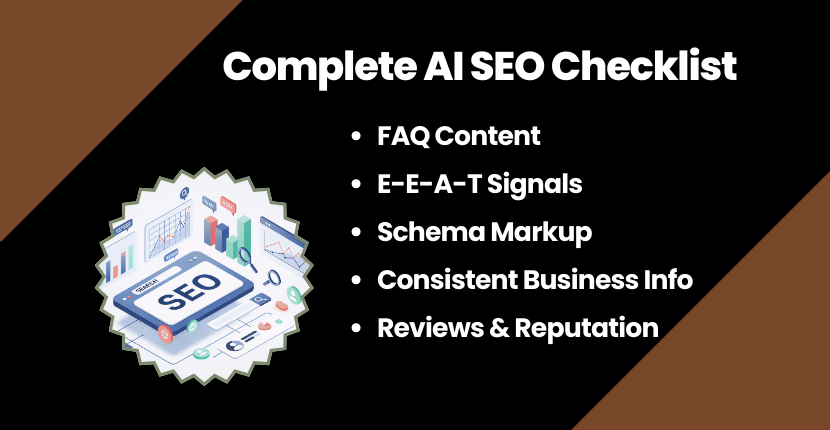
FAQ Content:
- FAQ pages built around specific questions customers actually ask
- Service pages written in natural, conversational language
- Author bios on every post and page with credentials listed
- Case studies with real project details and outcomes
- Blog content that answers “how much,” “how long,” and “how do I” questions
E-E-A-T Signals:
- Licenses and certifications listed on your website
- Years in business and project volume stated clearly
- Named team members with photos and bios
- Awards, press mentions, or accreditations displayed
Schema Markup:
- LocalBusiness schema implemented
- Service schema for each trade you offer
- FAQPage schema on all FAQ content
- Review schema displaying star ratings
- Site loads under 3 seconds on mobile
Consistent Business Info:
- Business name, address, and phone number identical across all platforms
- Services described consistently across website and directories
- Service area clearly defined on website and Google Business Profile
Reviews & Reputation:
- Reviews collected across Google, Yelp, Angi, and BBB
- Customers encouraged to mention service type and city in reviews
- Every review responded to within 48 hours
- Review volume growing consistently month over month
AI SEO for Contractors FAQ
How is AI SEO different from traditional SEO for contractors?
Traditional SEO focuses on ranking your website in Google’s blue link results. AI SEO focuses on getting your business recommended or cited in AI-generated answers from tools like ChatGPT, Gemini, and Perplexity. The mechanics are different, but the foundation is the same: credible content, consistent business information, and a trustworthy reputation. Contractors who invest in both will have the strongest overall search presence.
Which AI tools should contractors focus on?
The three most important right now are Google’s AI Overviews, ChatGPT, and Perplexity. Google’s AI Overviews appear directly in Google search results, which makes them the highest-impact for contractors who rely on local search. ChatGPT has hundreds of millions of users and is increasingly used for local service recommendations. Perplexity is growing quickly and tends to cite sources directly, which makes content quality especially important there.
How long does it take to see results from AI SEO?
Results vary depending on how established your online presence already is. Contractors who already have strong reviews, a complete Google Business Profile, and solid website content may start seeing AI visibility within a few months of focused optimization. Contractors starting from a thinner foundation should expect six to nine months before seeing consistent AI-driven leads. The earlier you start, the stronger your position becomes.
Do I need to be doing traditional SEO and AI SEO at the same time?
Yes. AI SEO does not replace traditional or local SEO. Most homeowners still use Google to search for contractors, and local SEO remains the most reliable lead source for location-based services. AI SEO layers on top of that foundation and captures a growing segment of searchers who are using AI tools instead of or alongside traditional search. Our SEO services are built to cover all three.
Can AI SEO help contractors get leads right now?
It is already happening. Homeowners are using ChatGPT and AI Overviews to research contractors, compare options, and ask for recommendations. Contractors who have invested in their content, reviews, and online credibility are showing up in those responses today. The window to get ahead of competitors on this is still open, but it is closing as more contractors become aware of it.
What types of contractors benefit most from AI SEO?
Every trade benefits, but contractors in competitive local markets benefit the most. Roofers, HVAC companies, plumbers, electricians, home remodelers, landscapers, and flooring companies are all in industries where homeowners actively search with AI tools. The more high-consideration the purchase, the more likely a homeowner is to use AI to research before calling.
Ready to Show Up Where Your Customers Are Searching?
AI search is not a future trend for contractors. It is happening right now, and the contractors who optimize for it today will have a significant advantage over those who wait.
At Four Arrows Marketing, we are the top digital marketing agency for contractors. We help septic companies, tree service companies, metal fabricators, and every trade in between build the kind of online presence that shows up in traditional search, local search, and AI results.
You deserve to work with an agency that values your business and gets you a return on your investment. Monthly strategy calls, weekly updates, and reporting that shows you exactly what your investment is producing. Our SEO services and PPC services are built around one belief: relationships and results.
Schedule a call today and let’s build an AI SEO strategy that keeps your phone ringing.
–
Written by Adam Gante, Founder of Four Arrows Marketing. Last updated January 2026.
–
Further Reading