
Key Points: PPC gives contractors immediate visibility at the top of Google the moment a campaign goes live. When managed correctly, it generates a consistent, predictable flow of qualified leads so your schedule stays full and you are never waiting on the next job to come in.
What Is PPC for Contractors?
PPC stands for Pay-Per-Click advertising. It is a digital marketing model where you pay each time someone clicks on your ad.
For contractors, this primarily means running ads on Google that appear when homeowners search for services like “roof replacement near me” or “emergency HVAC repair in Harrisburg.” Your ad shows at the very top of the search results, above all the organic listings, and you only pay when someone clicks.
The result is immediate visibility to homeowners who are actively looking to hire right now.
PPC is the fastest way to put your business in front of a homeowner the moment they decide they need your services.
Why Most Contractors Struggle With PPC
Most contractors who try PPC on their own end up frustrated. They spend a few hundred dollars, get a handful of irrelevant clicks, and conclude that PPC does not work. The problem is rarely PPC itself. The problem is how the campaign was set up and managed.
Running a profitable campaign requires keyword research, negative keyword management, landing page optimization, call tracking, and ongoing bid adjustments. Without the right setup, budget gets wasted on clicks that never convert. Most contractors are leaving thousands of dollars on the table with PPC.
The other challenge is finding an agency that actually understands contracting. Most agencies work with everyone from dentists to car dealerships. When you hire a generalist, you get a generic strategy that was not built for how homeowners search for contractors or how contractor jobs are sold.
Four Arrows Marketing works specifically with contractors. We already know which keywords convert for roofers, HVAC companies, and plumbers. You should not have to pay an agency to learn your industry on your dime.
How PPC Actually Works for Contractors
When a homeowner searches “electrician near me,” Google runs an auction in milliseconds. Two things determine where your ad ranks: your bid and your Quality Score. Quality Score is Google’s rating of how relevant your ad and landing page are to the search. A higher Quality Score means you pay less per click and rank higher than competitors spending more money.
Here is what that looks like in real numbers. A roofing contractor spending $3,000 per month with a well-structured campaign might generate 20 to 30 qualified leads at $100 to $150 per lead. At an average job value of $8,000 to $12,000, a single closed job covers the entire monthly ad spend.
The contractors who struggle are usually bidding on the wrong keywords, sending traffic to pages that do not convert, and having no idea which ads are generating calls. Fix those three things and the economics change completely.
PPC vs. SEO for Contractors
Contractors evaluating their marketing options often ask whether to invest in PPC, SEO, or both. Here is the honest answer.
PPC and SEO solve different problems. Neither one replaces the other.
PPC delivers leads immediately. The day your campaign goes live, your ads can appear at the top of Google. The tradeoff is that leads stop the moment you stop paying. PPC is a faucet. Turn it on and leads flow. Turn it off and they stop.
SEO builds lasting visibility over time. It takes three to six months to start seeing meaningful results, but once you rank, you generate leads without paying for every click. SEO is an asset that grows in value month over month. For a full breakdown of how SEO works for contractors, read our guide on SEO for contractors.
The most successful contractors run both at the same time. PPC fills the pipeline while SEO builds. Once organic rankings improve, PPC budgets can be reduced in areas where you already rank well, and redirected toward more competitive services or new markets.
Our PPC services are built specifically for contractors who want qualified leads now while building long-term digital authority through SEO.
Types of Google Ads for Contractors
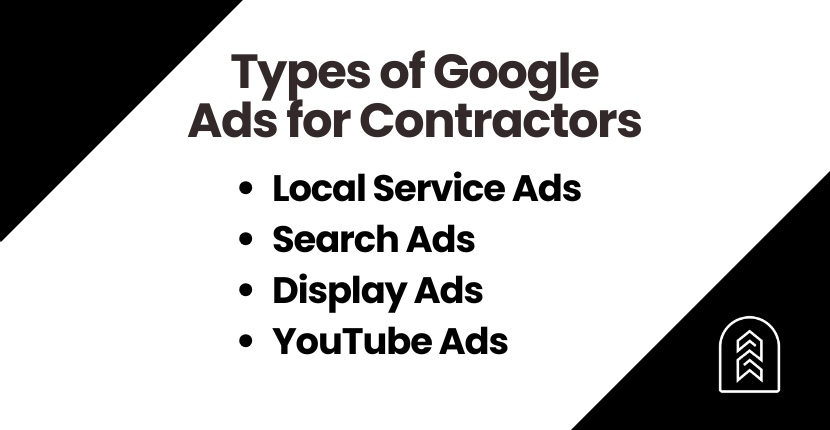
Local Services Ads
Local Services Ads appear above everything else in Google search results, including regular paid ads. They display with a “Google Guaranteed” or “Google Screened” badge, which immediately builds trust with homeowners.
Unlike traditional PPC, you pay per lead rather than per click. That means you only pay when a homeowner actually contacts you through the ad.
LSAs are available for many home service trades including plumbers, electricians, HVAC contractors, and roofing companies. If your trade qualifies, LSAs should be your first priority.
Search Ads
Search Ads are the traditional text ads that appear at the top of Google results when someone searches a specific keyword. You bid on keywords, write ad copy, and pay per click.
Search Ads work well for contractors because they capture high-intent buyers at the exact moment they are searching for what you offer. A homeowner searching “furnace repair near me” is not browsing. They need someone today.
The key to profitable Search Ads is pairing the right keywords with ads that speak directly to the homeowner’s problem and landing pages that convert visitors into calls.
Display Ads
Display Ads are visual banner ads that appear across Google’s network of websites. They are best used for staying visible to homeowners who have already visited your website but have not yet called.
This is called remarketing. A homeowner visits your roofing page, leaves without calling, and then sees your ad on other sites they visit over the next few days. It keeps your business top of mind during the consideration period.
For home remodeling contractors and landscaping companies where the sales cycle is longer, Display remarketing can be particularly effective.
YouTube Ads
YouTube Ads let you reach homeowners while they are watching videos related to home improvement, renovation, or repair topics.
They work well for contractors who want to build brand recognition in their market or showcase completed projects visually. A short video showing a before and after flooring installation or a storm damage roof replacement can be compelling to a homeowner who is in research mode.
According to Social Media Examiner, video ads consistently generate stronger brand recall than static image or text ads.
What to Expect in Your First 90 Days of PPC
One of the most common questions contractors have before starting PPC is how quickly it will work. Here is an honest, realistic breakdown.
Days 1 to 14: Campaign launch and learning phase. Google’s algorithm needs time to learn which searchers are most likely to convert for your campaign. This is called the learning phase. Expect higher costs per lead and lower efficiency during this period. Do not make major changes to the campaign during these first two weeks.
Days 15 to 45: Data starts coming in. You will start seeing which keywords are generating calls and which are wasting budget. This is when negative keywords become important. Search term reports will show you exactly what people typed before clicking your ad.
Days 46 to 90: Optimization begins driving results. With enough data, your campaign manager can start making meaningful improvements. Bids get refined, underperforming ads get paused, and landing pages get tested. Most contractors see their cost per lead decrease meaningfully between month two and month three as the campaign matures.
The contractors who get the best results from PPC are the ones who treat the first 90 days as a learning investment rather than expecting perfection from week one.
5 PPC Strategies for Contractors
1. Calculate Your Budget Based on Real Numbers
Do not pick a budget arbitrarily. Work backwards from your revenue goals.
Start with these questions: How many jobs do you want per month? What is your average job value? What lead-to-close rate does your team convert at?
If you close 30% of leads and need 10 jobs per month, you need roughly 33 qualified leads. If your target cost per lead is $75, your monthly ad spend should be around $2,500. Most contractors should plan to start between $1,000 and $3,000 per month and scale as the campaign proves itself.
According to HubSpot, contractors who set budgets based on target cost per lead outperform those who set budgets based on what feels comfortable.
2. Build Your Negative Keyword List Before You Launch
Negative keywords tell Google which searches should never trigger your ads. Without them, you will pay for clicks that have zero chance of converting.
Every contractor campaign should include negatives like:
- DIY, how to, tutorial, free
- Jobs, careers, hiring, apprentice
- Classes, training, certification
- Cheap, lowest price (if you are a premium contractor)
Add these before your campaign goes live. Revisit your search term report weekly in the first month to find additional terms wasting your budget.
3. Create a Dedicated Landing Page for Every Service
Never send PPC traffic to your homepage. A homeowner who clicked an ad for “water heater replacement” needs to land on a page specifically about water heater replacement, not a general page about your plumbing company.
A high-converting contractor landing page includes:
- A headline that matches the ad they clicked
- Your phone number visible above the fold
- A short, simple contact form
- Three to five five-star reviews prominently displayed
- One clear call to action, not multiple competing options
- Fast load time, especially on mobile
Every extra second of load time costs you conversions. According to Ahrefs, pages that load in under two seconds convert significantly better than slower pages.
4. Track Conversions So You Know What Is Actually Working
Most contractor leads come in by phone. If you are not tracking which ads and keywords are generating calls, you are making budget decisions based on guesswork.
Set up call tracking with a tool like CallRail before your campaign launches. This connects every inbound call back to the specific keyword and ad that triggered it. Track form submissions the same way and connect both to Google Ads as conversion events.
According to HubSpot, contractors who track conversions at the keyword level consistently achieve a lower cost per lead than those who only monitor clicks and impressions.
5. Use Phrase Match Keywords Instead of Broad Match
Keyword match types control which searches trigger your ads. Most contractors who set up their own campaigns default to broad match, which tells Google to show your ad for any search it considers loosely related to your keyword. A plumber bidding on “pipe repair” with broad match might show ads for “pipe repair DIY tutorial” or “pipe repair tools.” Those clicks cost real money and produce zero leads.
Phrase match is a smarter starting point. It tells Google to only show your ad when the search includes your exact keyword phrase. Start with phrase match, review your search term report weekly, and only expand to broad match for keywords that have already proven they convert.
PPC Checklist for Contractors
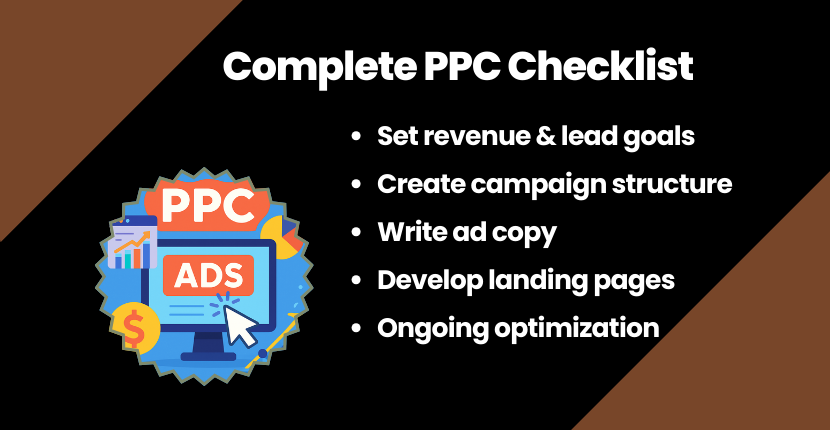
Before You Launch:
- Revenue and lead goals defined
- Starting budget calculated based on target cost per lead
- Negative keyword list built
- Call tracking set up
- Dedicated landing page created for each service
- Conversion tracking connected to Google Ads
Campaign Structure:
- Separate campaigns for each service type
- Ad groups organized by specific keyword themes
- Location targeting set to your actual service area
- Ad schedule aligned with your operating hours
- LSAs set up if your trade qualifies
Ad Copy:
- Headlines speak to the homeowner’s specific problem
- Clear value proposition in every ad
- Phone number included where possible
- Extensions added: call, location, sitelink
Landing Page:
- Headline matches the ad the homeowner clicked
- Phone number visible above the fold
- Short, simple contact form
- Three to five five-star reviews prominently displayed
- One clear call to action
- Page loads in under two seconds on mobile
Ongoing Optimization:
- Search term report reviewed weekly
- Underperforming keywords paused monthly
- New negative keywords added regularly
- Landing pages tested for conversion rate improvement
- Budget adjusted for seasonal demand
PPC for Contractors FAQ
How much should contractors spend on Google Ads per month?
Most contractors see meaningful results starting at $1,000 to $1,500 per month. Highly competitive markets or trades like HVAC and plumbing may require $2,500 to $5,000 per month to generate consistent lead volume. Start with a budget that lets you get enough data to optimize and scale from there.
What is a good cost per lead for contractor PPC?
It varies by trade and market. Emergency services like plumbing and HVAC typically run $75 to $200 per lead because competition is high, but those leads convert quickly and the job values are strong. Less competitive trades can see cost per lead as low as $30 to $60. The number that matters most is cost per booked job, not cost per click.
How long does it take to see results from PPC?
Most contractors start seeing leads within the first week of launch. The campaign typically hits its stride around the 60 to 90 day mark after Google’s algorithm has had time to learn and optimizations have been made based on real data.
What is Quality Score and why does it matter?
Quality Score is Google’s rating of how relevant your ad and landing page are to the keyword being searched. It is scored from one to ten. A higher Quality Score means you pay less per click and rank higher than competitors with lower scores. Improving Quality Score by writing better ads and building tighter landing pages is one of the most impactful things a contractor can do to reduce cost per lead.
Can I run PPC myself or do I need an agency?
You can set up a Google Ads account yourself, but managing it profitably is a different skill. Most contractors who run their own campaigns overspend on broad keywords, skip negative keywords, and send traffic to pages that do not convert. An experienced agency that works specifically with contractors will typically generate a lower cost per lead than a self-managed campaign within the first 90 days.
Should I run PPC if my SEO is already generating leads?
Yes. PPC and SEO target the same high-intent searches but deliver results differently. Even contractors with strong organic rankings benefit from PPC because it captures additional market share at the top of the page and protects against ranking fluctuations. Running both also gives you data on which keywords convert best, which informs your SEO strategy.
How do I know if my PPC campaign is actually working?
Track cost per lead, lead volume, and lead-to-close rate every month. A well-managed campaign should show a decreasing cost per lead over the first three to six months as optimizations take effect. If cost per lead is increasing or staying flat after 90 days, the campaign needs a serious review.
Ready to Fill Your Schedule With Qualified Jobs?
Inconsistent leads are one of the biggest frustrations for contractors. PPC solves that problem by putting your business in front of homeowners at the exact moment they are ready to hire.
At Four Arrows Marketing, we are the top digital marketing agency for contractors. We manage PPC campaigns for roofers, HVAC companies, electricians, plumbers, home remodelers, and more.
You get monthly strategy calls, weekly updates, and transparent reporting that shows you exactly which ads are generating calls, what each lead costs, and what your campaign is producing. Our PPC services are built around the belief that you deserve to be treated like a name, not a number.
Schedule a call today and let’s build a PPC strategy that keeps your crews booked.
–
Written by Adam Gante, Founder of Four Arrows Marketing. Last updated January 2026.
–
Further Reading