
Quick Summary: A homeowner spots a leaning oak after a windstorm, types “tree removal near me” into their phone, and calls the first company that looks credible. That call happens in under three minutes. If your tree service business is not showing up in those results, a competitor is getting the job. This guide breaks down exactly what local SEO looks like for tree service companies and how to use it to keep your crews busy year-round.
Why Tree Service Companies Need Local SEO
Tree service is one of the most search-driven trades in the home services industry. When a homeowner has a problem tree, they are not asking a neighbor for a referral first. They are grabbing their phone.
The timing behind those searches is also unique to this industry. A major storm rolls through on a Tuesday night, and by Wednesday morning, your phones should be ringing off the hook from homeowners dealing with fallen limbs, blocked driveways, and damaged rooflines. If your business is not ranking when that surge of searches happens, that entire window of opportunity closes before you ever knew it opened.
That is where local SEO comes in. It is the difference between your tree service company being the first call someone makes and being invisible while a competitor hauls away their debris.
The other reality is that most tree service companies in most markets are not investing seriously in local SEO. They rely on word of mouth, yard signs, and Facebook posts. That leaves a wide-open lane for any company willing to build a consistent online presence.
What Homeowners Are Actually Searching For

Understanding the types of searches that drive tree service leads is the first step in building a strategy that works.
Tree service searches generally fall into two categories: urgent and planned.
Urgent searches are event-driven. A storm knocked a branch onto the fence. A large tree is leaning toward the house. A dead tree needs to come down before it becomes a bigger problem. These homeowners are calling whoever shows up first that looks legitimate. Speed and visibility win.
Planned searches move at a slower pace. A homeowner has noticed their oak is looking thin and wants an arborist to take a look. A property manager needs seasonal trimming across multiple sites. A new homeowner wants a landscape cleanup before winter. These leads take more nurturing, but they also tend to book larger jobs.
Here is a solid starting list of keywords worth building around for any tree service company:
- “Tree removal near me”
- “Tree service [city]”
- “Emergency tree removal [city]”
- “Storm damage tree removal [city]”
- “Tree trimming [city]”
- “Stump grinding [city]”
- “Stump removal near me”
- “Tree cutting service [city]”
- “Arborist near me”
- “Tree company [city] PA”
- “Dead tree removal [city]”
- “Tree limb removal [city]”
- “Land clearing [city]”
- “Affordable tree service [city]”
- “24 hour emergency tree service [city]”
According to BrightLocal’s Local Consumer Review Survey, the vast majority of people use search engines to find local service businesses before making contact. For tree service companies, where the urgency is often tied to safety or property damage, the intent behind those searches is about as high as it gets.
The Google Map Pack: Where Urgent Tree Calls Are Won
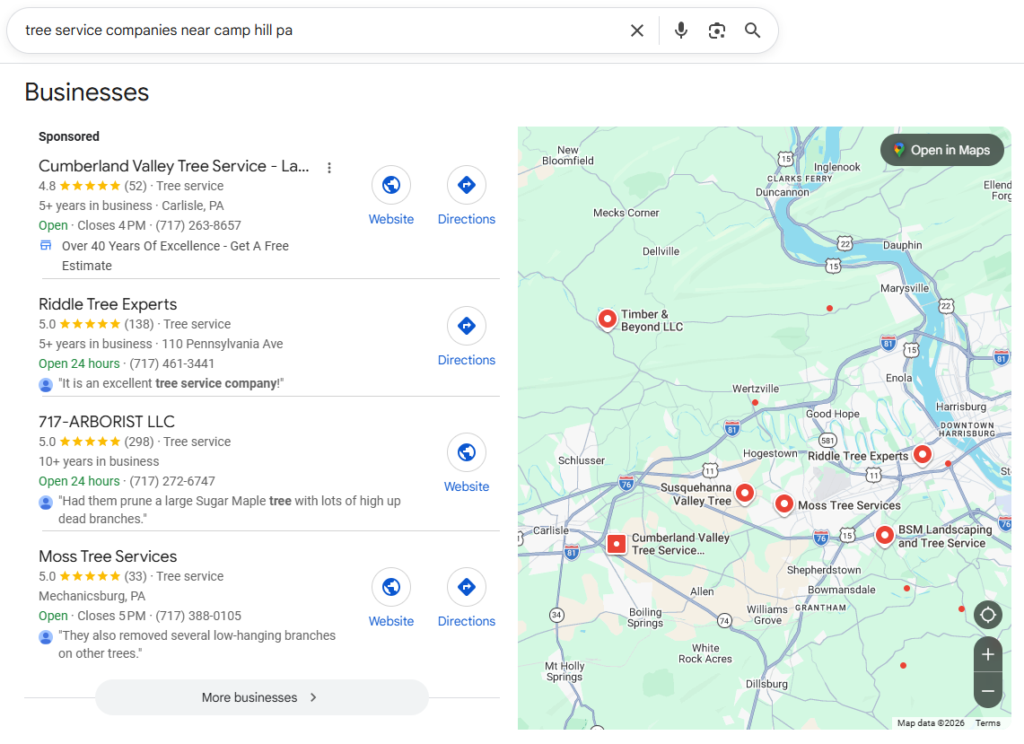
Pull out your phone and search “tree removal near me.” Before any website results appear, Google shows a map with three businesses listed directly beneath it. That section is called the Map Pack, or Local 3-Pack, and for tree service companies, it is where the majority of high-intent calls originate.
Emergency searches almost never result in someone scrolling past the Map Pack. A homeowner dealing with a tree on their car does not have time for a research project. They are scanning those three listings, checking ratings, and calling whoever looks trustworthy. The company in position four might as well not exist in that moment.
Getting into the Map Pack requires a well-optimized Google Business Profile, a strong review history, consistent business information across the web, and location-relevant signals throughout your website. None of those things happen overnight, but each one is fully within your control.
Your Google Business Profile Does the First Round of Selling
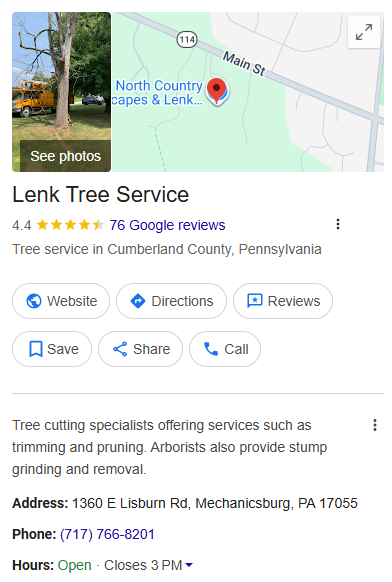
Before someone ever clicks your website, your Google Business Profile has already made an impression. Your rating, your photos, your service list, your hours, and how recently you’ve been active are all visible at a glance. That profile is not a formality. It is one of the most important marketing assets your tree service company has.
Here is what a well-built profile actually looks like in practice.
Get your categories right. Your primary category should be “Tree Service.” Beyond that, add every secondary category that applies: “Arborist,” “Tree Farm,” “Landscaper,” and any others that match your actual services. Secondary categories open up new searches your profile can rank for. Most tree service companies leave several of these slots empty.
Fill out every section Google provides. Your service area, business hours, service descriptions, business attributes, and a well-written business description should all be complete. A profile with gaps consistently loses ground to one that is fully built out.
Upload photos from real jobs. A crew working a tight residential removal. A stump grinding project before and after. A crew loading debris after a storm cleanup. Homeowners want to see that you actually do this work and do it well. Job site photos communicate that far better than anything else you could put there.
Your service area needs to reflect where you actually work. If you serve 12 different towns but only have two listed in your profile, you are leaving significant visibility behind. Go through every community you cover and make sure each one is added.
Post regularly. A note after a big storm about your emergency response availability. A photo from a large commercial removal job. A seasonal reminder about fall trimming before the dormant season. Google rewards active profiles, and a consistent posting habit is one of the simpler signals you can send to stay competitive.
Write a description that tells people something. Skip the generic phrases about being “family-owned” and “committed to quality.” Explain what types of tree work you specialize in, which cities and counties you cover, whether you are ISA-certified, and what a customer can expect when they call. Specifics build credibility.
NAP Consistency: A Small Detail With Big Consequences
Your business name, address, and phone number need to match exactly across every platform on the internet. Not close. Not “basically the same.” Exactly.
This matters because Google looks at how your information appears across dozens of directories, citation sites, and industry platforms to build confidence that your business is legitimate and located where you say it is. Inconsistencies create doubt, and that doubt shows up as weaker Map Pack rankings.
Moz’s research on local ranking factors consistently identifies citation accuracy as a fundamental requirement for strong local SEO performance. It is not an advanced strategy. It is foundational work that has to be in place before anything else can perform at its best.
Platforms to check and correct:
- Google Business Profile
- Yelp
- Angi
- HomeAdvisor
- BBB
- Nextdoor
- Thumbtack
- Houzz
- Your local Chamber of Commerce
- Any county or township business directories
If your phone number changed two years ago, or you moved to a new shop address, go find every place your old information still lives and fix it.
Your Website’s Job Is to Cover What the Map Pack Cannot
The Map Pack captures the urgent, near-me searches. Your website handles everything else: service-specific searches, location-based searches from across your broader coverage area, and the organic results that sit below the map on every search page.
Both your profile and your website need to be doing their jobs. One does not replace the other.
Build a Dedicated Page for Each Service
Combining tree removal, stump grinding, tree trimming, and land clearing all onto a single service page is one of the most common website mistakes tree service companies make. Google needs a page to be clearly focused on one subject before it will rank that page for relevant searches.
Give each service its own dedicated page. For most tree service companies, that means individual pages for:
- Tree removal
- Tree trimming and pruning
- Stump grinding
- Stump removal
- Emergency tree service
- Storm damage cleanup
- Dead tree removal
- Land clearing
- Arborist services
- Tree health assessments
- Commercial tree service (if applicable)
Write each page for the homeowner who has that specific need. Cover what the service involves, explain what the process looks like, answer common questions, and give them a reason to call you instead of the next company on the list.
Build a Dedicated Page for Each City You Serve
Having your service area listed in your Google Business Profile is a starting point. Dedicated location pages on your website carry significantly more weight in local search.
A page specifically for tree service in Lancaster, PA tells Google something that a general service area setting cannot: that you have actual, indexed content tied to that city. Build a unique page for every community you serve, and write real, distinct content for each one. Pages that only swap out a city name without changing anything else tend to underperform and can create problems for your site over time.
Reviews: The Ranking Factor You Can Start Building Today

Most local SEO strategies take time. Website authority builds gradually. Location pages take months to gain traction. Reviews are the one area where focused effort can produce real results in a short period of time.
The number of reviews your business has, how recently they were posted, your overall star rating, and the specific language your customers use all factor directly into Map Pack rankings. Two equally matched tree service companies will almost always be separated by their reviews.
A tree service company with 60 detailed, recent reviews from real customers is going to get more calls than a competitor with 12 old reviews, even if everything else about their online presence is similar.
Here is what a good review strategy looks like in practice.
Ask while you are still on the property. A homeowner who just watched your crew take down a difficult oak in their backyard, clean up every piece of debris, and leave the yard looking better than expected is primed to leave a review. That window closes fast once you are gone.
Send a direct link to your Google review page. Text it before you pull out of the driveway. One tap, straight to the review form. The more steps between the ask and the review, the fewer reviews you will collect.
Respond to every review you receive. Your responses are public and visible to every future customer reading that review. A thoughtful reply to a positive review shows you value your clients. A calm, professional response to any criticism shows you take your work seriously. Both matter.
Never fabricate reviews. Fake reviews violate Google’s policies and put your entire profile at risk. No short-term ranking bump is worth losing your Google Business Profile.
Local Link Building for Tree Service Companies
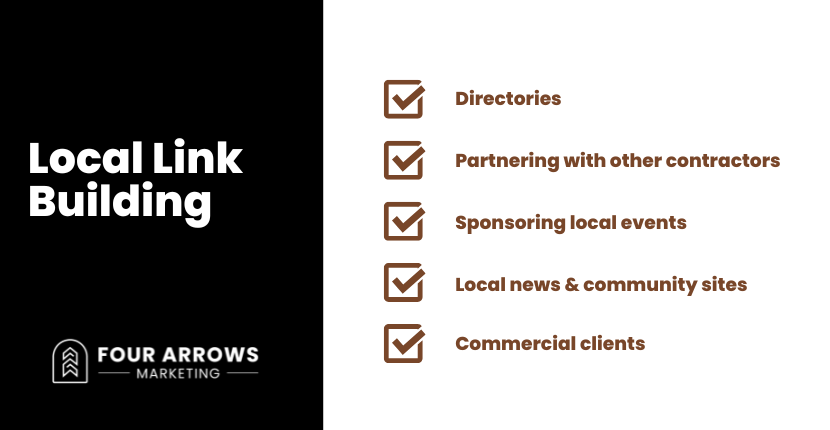
A link from another reputable website to yours signals to Google that your business is credible. Links from locally relevant sources are particularly valuable because they reinforce your geographic authority at the same time.
Here are realistic places tree service companies can earn links.
Start with directory listings. Angi, HomeAdvisor, the BBB, Yelp, Nextdoor, and your local Chamber of Commerce should all be claimed, verified, and consistent with your Google Business Profile. Most of them include a link back to your website, and this is where foundational citation work begins.
Other trades are natural partners. Landscaping companies, plumbers, and home remodeling contractors work on the same properties you do. Referral relationships with non-competing trades benefit everyone, and links from their websites carry real local authority. These partnerships tend to develop naturally from networking groups and community involvement.
Real estate agents and home inspectors refer tree service companies constantly. A buyer whose inspection report flagged a hazardous tree. A seller who needs storm damage cleaned up before listing. An agent who just watched you do a clean, professional job on a client’s property. These connections produce both referrals and, often, links from their websites and business directories.
Community involvement produces links that generic directories cannot match. Sponsoring a local sports team, contributing to a neighborhood cleanup, or supporting a community event often results in a link from that organization’s website. These links carry localized credibility and build name recognition before someone ever needs to search for a tree service.
Local SEO Checklist for Tree Service Companies
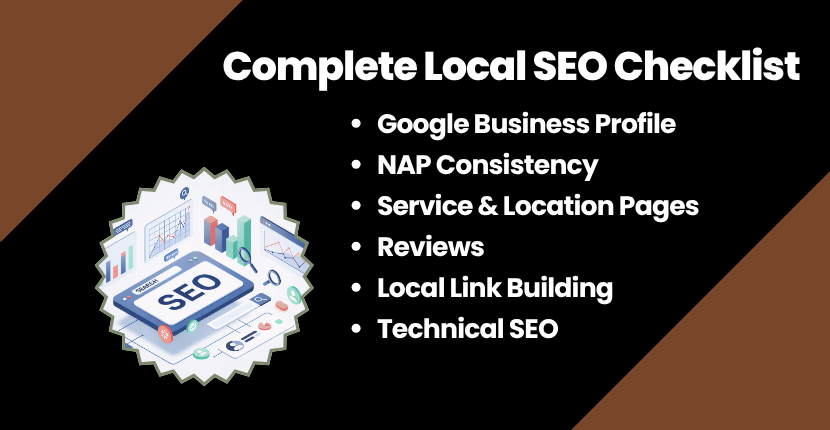
Use this as a reference point for where your online presence currently stands and what still needs attention.
Google Business Profile:
- Claimed, verified, and fully completed
- Primary category is “Tree Service” with all applicable secondary categories added
- Service area covers every city and town where you work
- Real job site photos uploaded and refreshed regularly
- Posts going out on a consistent basis
- Every review has been responded to
NAP Consistency:
- Business name, address, and phone number are identical across all platforms
- No duplicate listings exist on any site
- Any outdated information has been corrected
Service & Location Pages:
- Every service has its own dedicated page
- Every city in your service area has its own dedicated location page
- Each page targets one service and one geography
- Contact information and a clear call to action appear on every page
- Site loads quickly and works well on mobile
Reviews:
- Asking for a review is a standard part of every job close-out
- Customers receive a direct link to your Google review page
- All reviews are receiving responses
- Overall rating is 4.5 stars or higher
Local Link Building:
- All major directories are claimed and accurate
- Trade referral partnerships are in place
- Community involvement is producing local links over time
Technical SEO:
- Site loads quickly and works on mobile
- A Google Maps embed appears on the contact or location page
- Google Search Console is set up and monitored
Local SEO for Tree Service Companies FAQ
How long does it take to see results from local SEO?
Most tree service companies begin to see meaningful traction within three to six months, though some Google Business Profile improvements can show results faster than that. What drives long-term results is consistency, not speed. A year of steady effort looks dramatically different from a few months of occasional attention.
Should I prioritize my Google Business Profile or my website first?
If you are starting fresh, the Google Business Profile comes first. It is the fastest path to Map Pack visibility, which is where the most time-sensitive tree service searches convert. Your website builds broader organic visibility and handles the search results below the map. You need both working together over time.
Is tree service SEO more competitive than other trades?
It varies by market, but tree service is competitive in most areas because storm seasons create massive search surges and job values are high. That said, the majority of tree companies in most markets are not running consistent SEO campaigns, which creates opportunity for businesses willing to build and maintain a solid online presence.
Do I need separate pages for each city I serve?
Yes, and this is one of the most commonly skipped steps. Location pages on your website create on-page evidence that you are relevant in each specific city. Without them, your organic visibility outside your immediate location is significantly limited.
What should I budget for professional local SEO?
Monthly retainers for professional local SEO services typically run between $1,000 and $3,000 depending on market competition and the scope of work involved. That range generally covers Google Business Profile management, citation cleanup, review strategy, location and service page content, and monthly reporting that tracks the numbers that actually tell you whether it is working: leads, traffic, rankings, and cost per lead.
How does local SEO for tree service companies differ from general SEO?
Local SEO for contractors centers on geographic searches, which is how the overwhelming majority of homeowners find tree service companies. It targets “near me” searches, Google Maps visibility, and city-specific rankings. General SEO focuses on organic visibility without a location component. For a tree service company that works in specific towns and counties, local SEO is not one piece of the strategy. It is the strategy.
Ready to Get Your Tree Service Company to the Top of Google?

Right now, someone in your area is dealing with a downed branch, an overgrown tree, or a stump that has been an eyesore since last spring. They are searching for a tree service company to call. The question is whether your business shows up when they do.
Four Arrows Marketing works with contractors to build local search visibility that generates real, measurable leads month after month. No jargon, no vague promises, just clear communication, honest reporting, and a strategy built specifically around your business and your market.
If you want to find out where your tree service company currently stands and what it would take to start showing up consistently, schedule a call and let’s take a look together.
–
Written by Adam Gante, Founder of Four Arrows Marketing. Last updated March 2026.
–