
Key Points: AI SEO is how septic companies get found and recommended by ChatGPT, Google’s AI Overviews, and other AI tools when property owners are searching for pumping, inspections, or emergency repairs. This guide breaks down how AI search works for this industry specifically and what you can do right now to start showing up before your competitors do.
What Is AI SEO for Septic Companies?
Most property owners have no idea who their local septic company is until they need one. When that moment arrives, whether it is a backed-up system, a failed inspection during a home sale, or a tank that has not been pumped in too long, they are not flipping through a phonebook. They are asking Google or ChatGPT to tell them who to call.
AI SEO is the work of making sure your business is the one that gets recommended in that moment.
It is not the same thing as traditional SEO. Traditional search gives the user a list of websites and lets them decide where to click. AI search skips that step and hands them a direct answer, sometimes with specific business names attached. Getting your company into those answers is what AI SEO is designed to do.
The Opportunity Most Septic Companies Are Missing
Septic is not a glamorous industry to market in. Most business owners in this space are focused on running a tight operation, keeping trucks on the road, and handling calls as they come in. Digital marketing often gets pushed to the back burner, and AI SEO in particular is something almost no one in this industry has touched yet.
That is the opportunity.
When a new category of search behavior emerges and the competition has not caught on, the companies that move first build advantages that are genuinely hard to undo. The early adopters in local SEO figured this out years ago and are still reaping the benefits. AI search is following the same pattern, and the window to act early is shrinking.
How AI Search Actually Works for Septic Companies
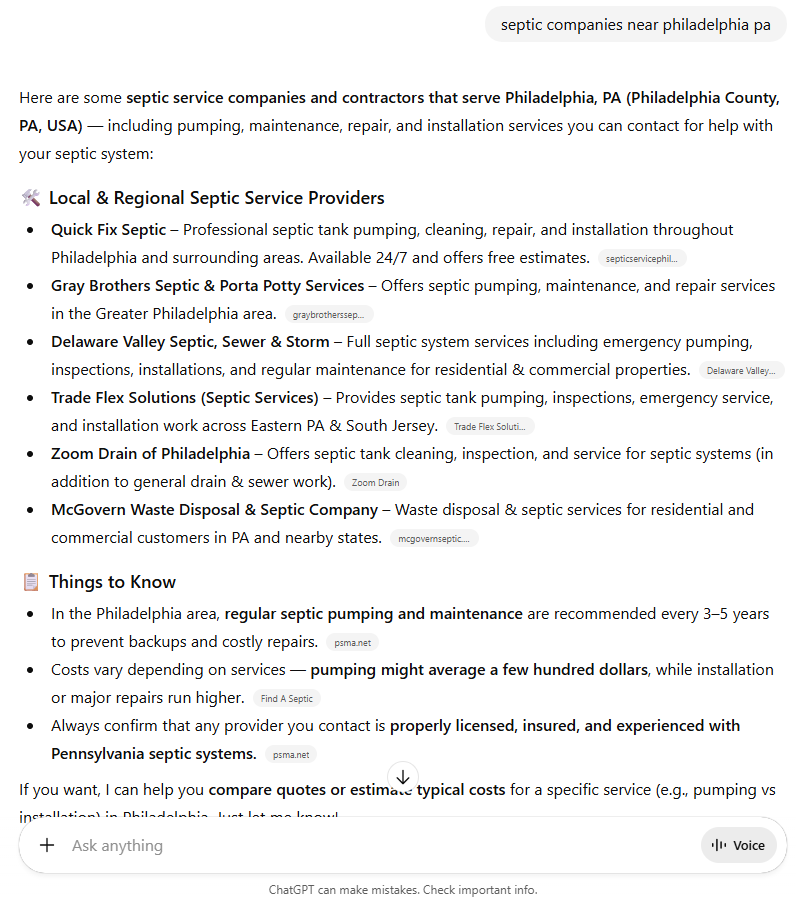
When a homeowner opens ChatGPT and asks for a septic company recommendation in their area, that tool is not running a keyword search. It is drawing from a broad set of training data and combining that with live web sources to assemble a response. The businesses that show up are the ones with the strongest, most consistent signal across the web.
For septic companies, that signal is built from a few specific sources.
- Service clarity. AI tools can only recommend what they can understand. A company that specifically describes tank pumping, system inspections, drain field repair, new installations, grease trap cleaning, and 24-hour emergency service across its website and listings is far easier to recommend than a company with a generic paragraph about handling all your septic needs.
- Educational content. Most homeowners know almost nothing about how their septic system works. They search questions like “how often does a septic tank need to be pumped” or “what are the signs my drain field is failing” before they ever reach out to anyone. Websites that answer those questions well become sources AI tools reference repeatedly.
- Urgency signals. Septic problems often require same-day or emergency service. AI tools pick up on whether a company communicates emergency availability, response times, and after-hours access. That information shapes how a recommendation gets framed.
- Reviews with real detail. A generic five-star review does almost nothing for AI visibility. A review that says “called at 8 PM for a backup and they were out within the hour” gives AI tools specific, trustworthy signals about your responsiveness and service area that vague praise cannot provide.
How to Check If You Are Showing Up in AI Results
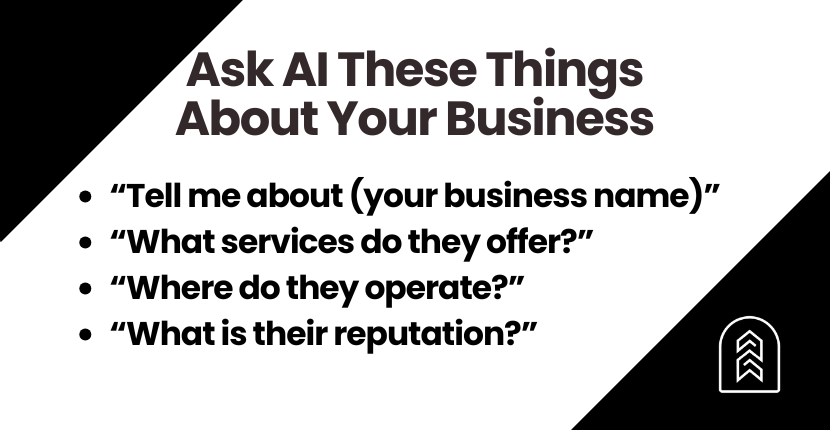
Before spending time on any strategy, it is worth knowing where you stand right now.
Open ChatGPT or Google Gemini and type your company name. Follow it with a direct question: “What services does [Your Business Name] offer, where do they operate, and what are customers saying about them?”
Read the response carefully. Is the information accurate? Does it reflect the right service area and the right services? Does it pull anything meaningful from your reviews or history? Or does it come back thin, vague, or wrong?
A weak or inaccurate response is not a reflection of your business quality. It is a signal that your online presence is not giving AI tools enough to work with.
After that, run a broader search: “Who are the best septic companies in [your city or county]?” See which names come up. If a competitor you know personally is on that list and you are not, you have a concrete picture of what this gap is costing you.
Traditional SEO vs. AEO vs. GEO: What Is the Difference?
These three terms describe different ways a business can show up in search, and all three apply to septic companies.
Traditional SEO is ranking in the standard Google results when someone searches “septic tank pumping York PA” or “drain field repair near me.” It is keyword-driven and depends heavily on your website content, backlinks, and technical setup. For most septic companies, this is still where the majority of calls originate.
AEO (Answer Engine Optimization) is about getting your content used as the source when AI tools answer specific questions. When someone asks an AI “how much does septic pumping cost in Lancaster County,” AEO is what makes your page the one that gets pulled into the response.
GEO (Generative Engine Optimization) is about earning a named recommendation when AI tools suggest service providers. When a property owner asks ChatGPT “who should I call for a septic inspection before closing on a house in Cumberland County,” GEO is what gets your business name into that answer.
All three are worth pursuing. Strong content and a consistent web presence support all of them at the same time, so the investment is never siloed to just one channel. Our broader guide to AI SEO for contractors covers how these three layers connect across the trades.
5 AI SEO Strategies for Septic Companies
1. Build FAQ Content Around the Questions Homeowners Actually Ask
The knowledge gap around septic systems is real and wide. The average homeowner cannot tell you where their tank is located, when it was last pumped, or what a failing drain field smells like. That lack of familiarity is not a problem for your business. It is a content opportunity.
When something starts going wrong, or when a real estate agent tells a buyer they need an inspection before closing, that homeowner goes straight to Google or ChatGPT. If your website is already there with clear, practical answers to what they are searching, it becomes a resource AI tools draw from when generating responses.
Content worth building out includes:
- “How often should a septic tank be pumped based on household size?”
- “What are the early warning signs of a failing drain field?”
- “How long does a septic inspection take and what does it cover?”
- “What happens if a septic tank is not pumped on schedule?”
- “Can heavy rain or flooding damage a septic system?”
Each of these is a real search with genuine intent behind it. A well-written, honest answer to any one of them is the kind of content AI tools are built to surface and cite. According to HubSpot, content that addresses specific questions in depth consistently earns more visibility in AI-driven results than broad, surface-level pages.
2. Demonstrate E-E-A-T on Every Page
E-E-A-T stands for Experience, Expertise, Authoritativeness, and Trustworthiness. Google developed this standard to determine whether content comes from a source that actually knows what it is talking about, and AI tools apply similar logic when deciding which businesses are credible enough to recommend.
Septic work is licensed, regulated, and technically demanding. The problem is that most companies in this space do not make any of that visible online. Credentials that live in a filing cabinet or on a truck door do nothing for your AI visibility.
Put the following in front of visitors across your website:
- Your state septic contractor license number and any NAWT (National Association of Wastewater Technicians) certifications your team holds
- The names and backgrounds of your technicians, not just the company owner
- How long you have been operating, how many systems you have serviced, and the specific townships and counties you cover
- Job documentation with photos, brief descriptions of the work done, and location context
- Any association memberships, local recognition, or community ties worth mentioning
According to Search Engine Journal, AI tools consistently favor businesses with visible, verifiable expertise over businesses that blend in with every other listing on the page.
3. Implement Schema Markup on Your Website
Schema markup is code added behind the scenes on your website that tells search engines and AI tools exactly what your content means. Without it, these tools are making educated guesses about your services, hours, and location. With it, you are handing them organized data they can read cleanly and trust.
This matters especially for septic companies that provide emergency service. When a homeowner is dealing with a sewage backup at 10 PM on a Saturday, an AI tool that can immediately confirm your after-hours availability is far more likely to recommend you than a company whose hours are buried somewhere inside a wall of text.
The schema types that carry the most weight for a septic company:
LocalBusiness schema: Your name, address, phone number, service hours, emergency availability, and coverage area in a machine-readable format.
Service schema: A structured breakdown of each service you provide, from routine pumping and inspections to drain field repair and new system installations.
Review schema: Your star rating and review count formatted so AI tools can cite them directly in responses.
FAQPage schema: Your question-and-answer content structured so AI tools can pull specific answers from your pages and use them in responses.
For WordPress sites, Yoast SEO handles the foundational schema setup. Service and FAQ schema typically require a bit more configuration, but for a service as urgent as septic, every signal that makes your business easier to find and recommend is worth the effort.
4. Show Up Consistently Across the Web
AI tools do not rely on a single source to form an opinion about your business. They pull from your website, your Google Business Profile, third-party directories, review platforms, and local mentions across the web. When those sources all tell the same story, the picture that emerges is credible and complete. When they contradict each other, it introduces uncertainty.
Your business name, address, phone number, service list, and service area should be identical everywhere they appear:
- Google Business Profile
- Yelp, Angi, HomeAdvisor, and the BBB
- Local chamber of commerce and county directories
- Any septic or home services directories your company is listed in
- Social media profiles and any local press or event sponsorship mentions
Something as small as an inconsistent phone number or an outdated service description can create friction for AI tools trying to verify your business. Our guide to local SEO for septic companies covers how to audit and maintain that consistency across every platform.
5. Build a Review Presence That AI Tools Can Work With
Review volume matters. Review quality matters more.
AI tools read the text inside reviews, not just the star rating. They use that text to understand where you work, what services you provide, and what it is actually like to hire you. A review that mentions a specific service and a specific location gives an AI tool something to work with. A review that just says “great company” does not.
Coaching customers does not take long and makes a real difference. After finishing a job, ask them to mention what you did and where they are in their review. Sending a direct link to your review page by text the same day the job is finished gets a much better response rate than waiting a week to follow up by email.
A few other things worth doing consistently:
- Respond to every review and reference the service and location where it makes sense to do so
- Spread review collection across Google, Yelp, Angi, HomeAdvisor, and the BBB
- Keep volume growing every month rather than collecting a batch of reviews and going quiet for a year
According to Ahrefs, businesses with detailed, location-specific reviews spread across multiple platforms are measurably more likely to earn a spot in AI-generated recommendations than businesses with a single-platform profile and generic feedback.
AI SEO Checklist for Septic Companies
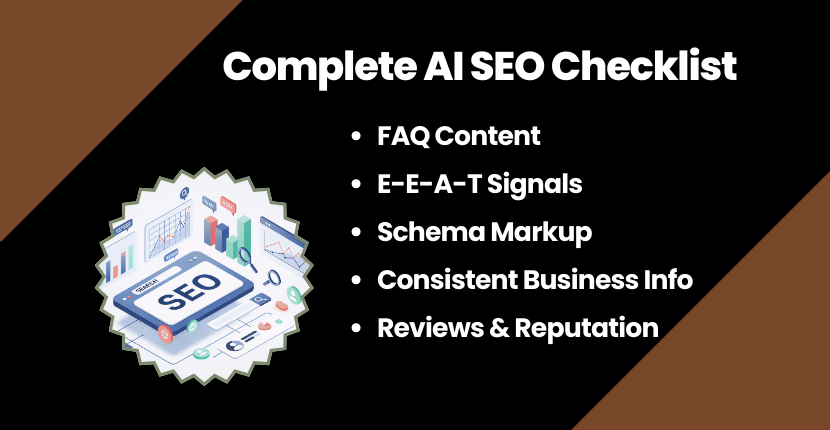
FAQ Content:
- Dedicated pages answering specific questions septic customers actually search
- Service pages written in plain language that mirrors how customers describe their problems
- Author name and credentials on every blog post and service page
- Job documentation with photos, service type, and location included
- Blog content covering pumping frequency, drain field health, inspection timelines, and emergency response
E-E-A-T Signals:
- State contractor license and NAWT certifications listed and visible on your website
- Years in business and number of systems serviced stated clearly
- Named technicians with photos where possible
- Industry memberships, awards, and local recognition displayed prominently
Schema Markup:
- LocalBusiness schema implemented, including after-hours and emergency availability
- Service schema covering every service type you offer
- FAQPage schema on all question-and-answer content
- Review schema displaying current star rating and review count
- Site loads in under 3 seconds on mobile
Consistent Business Info:
- Business name, address, and phone number identical across every platform
- Service descriptions consistent between your website and all directory listings
- Service area and coverage townships clearly defined on your website and Google Business Profile
Reviews and Reputation:
- Reviews collected across Google, Yelp, Angi, HomeAdvisor, and the BBB
- Customers coached to include the service performed and their city in their review
- Every review responded to within 48 hours
- New reviews coming in consistently every month
AI SEO for Septic Companies FAQ
How is AI SEO different from traditional SEO for septic companies?
Traditional SEO is focused on ranking in the standard blue-link Google results. AI SEO is focused on earning mentions and recommendations inside AI-generated responses from tools like ChatGPT, Gemini, and Perplexity. The practical difference is that traditional SEO gets you onto a list a homeowner chooses from, while AI SEO gets you into the direct answer they receive. Both matter, and the same underlying work supports both.
Which AI tools should septic companies pay the most attention to?
Google’s AI Overviews carry the most immediate weight because they appear inside the search results property owners are already using every day. ChatGPT is increasingly being used for local service searches and is worth paying attention to. Perplexity cites its sources directly in responses, which makes having well-organized, educational content particularly valuable there.
How long does it take for a septic company to see results from AI SEO?
Companies with an existing foundation of reviews, a well-organized website, and an active Google Business Profile can often see movement in a few months of focused work. Companies starting from a thinner foundation should plan for six to nine months before AI-driven leads become a reliable part of the business. Starting earlier always produces a stronger outcome.
Should septic companies invest in traditional SEO and AI SEO at the same time?
Yes. The majority of calls still come from traditional local search, so letting that slip while chasing AI visibility would be a mistake. The smarter approach is building a foundation strong enough to support both at once. Strong content, accurate business information, and a growing review presence fuel traditional rankings and AI recommendations simultaneously. Our SEO services are structured around exactly that.
Are AI tools actually being used to find septic companies right now?
They are. Property owners are using AI Overviews and ChatGPT to research septic problems, understand what inspection results mean, and find companies to call. The septic businesses that have put consistent work into their content, reviews, and online presence are already showing up in those conversations. The ones that have not are being passed over in favor of whoever did the work first.
Ready to Show Up Where Property Owners Are Already Searching?
Septic is an industry built on trust. When a homeowner has a problem, they need someone who will show up, do the job right, and be straight with them about what it costs. The companies that communicate that credibility online are the ones AI tools recommend.
At Four Arrows Marketing, we help septic companies build a digital presence that earns visibility in traditional search, local search, and AI results. We build strategies around your specific services, your service area, and your growth goals.
Every client gets monthly strategy calls, weekly updates, and clear monthly reports showing exactly what their marketing is producing. Our SEO services and PPC services come back to two things every time: relationships and results.
Schedule a call today and let’s build an AI SEO strategy for your septic business.
–
Written by Adam Gante, Founder of Four Arrows Marketing. Last updated April 2026.
–
Further Reading