
Key Points: AI SEO determines whether your tree service company shows up when a property owner asks ChatGPT, Perplexity, Google’s AI Overviews, or Gemini for help with a hazardous tree, an arborist recommendation, or pricing on a removal. The companies winning visibility right now are doing specific things most of the trade has not caught onto.
What Is AI SEO for Tree Service Companies?
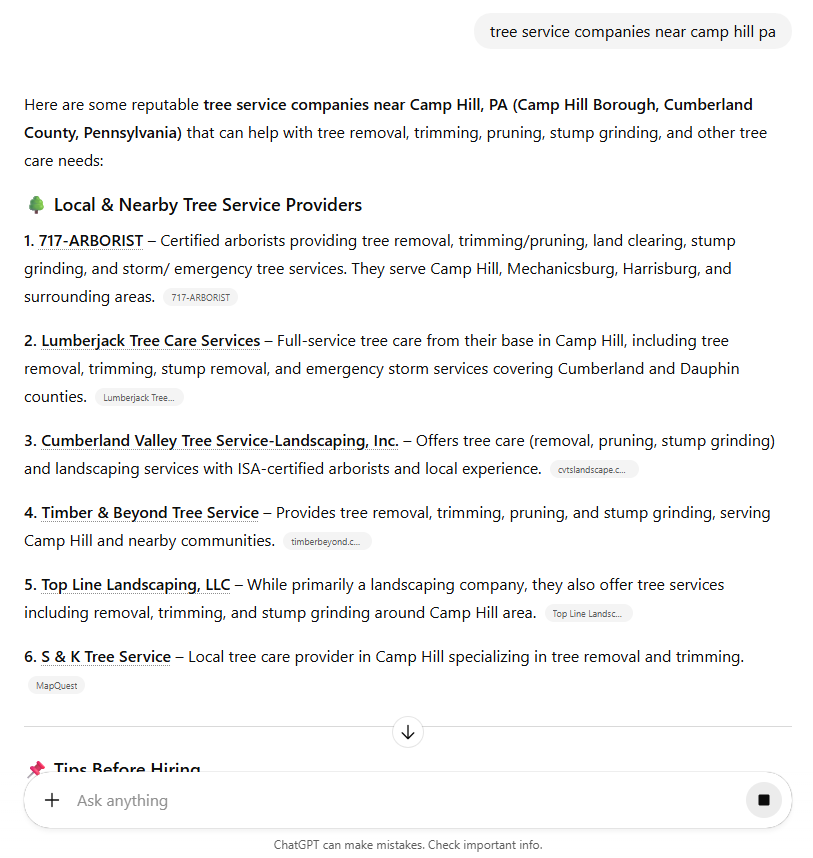
Picture a property manager walking the grounds of a small office park on Monday morning. Two large oaks dropped major limbs over the weekend and one is still hanging in the canopy. She pulls out her phone and asks ChatGPT to recommend a tree company in her area. ChatGPT does not return ten options. It returns two, with reasoning attached.
Scenes like that play out every day. The local pack on Google Maps now shares screen space with AI-generated summaries that homeowners and property managers read first.
AI SEO is the practice of getting your tree company written into those summaries. The companies pulling it off have done deliberate work to make their websites, listings, reviews, and credentials legible to AI systems. Our SEO services for tree service companies are built around exactly that process.
The Opportunity Most Tree Service Companies Are Missing
Every shift in how customers find local contractors has a window where the work to win is cheap and a window where it is expensive. AI search is firmly in the cheap window for tree services right now.
Walk through ten tree company websites in any market and you will find the same patterns. Generic homepages. Service lists with no depth. Reviews that say “great job” and nothing else. Credentials buried in an About page. Zero pricing context. None of them are doing anything wrong by traditional standards. They are simply invisible to the way customers search now. The owner who closes that gap first becomes the name AI tools recommend for the next decade.
How AI Search Actually Works for Tree Service Companies
AI tools build a profile of your business by combining everything they can find about you and only recommending companies whose profile holds together across multiple sources. Three categories of signals matter most.
- Urgency signals dominate when the search is reactive. A homeowner with a tree across their driveway, a property manager dealing with a hanger over a parking lot, a municipality looking at a road blockage. The AI scans for clear advertising of 24/7 emergency response and reviews that confirm you actually showed up.
- Specificity signals come from how you describe what you do. A page that says “tree work” is invisible. A page that names crane assisted removals, technical rigging, deadwood pruning, crown reduction, cabling and bracing, deep root fertilization, and emerald ash borer treatment gives the AI vocabulary to match against the search.
- Verification signals come from outside your website. Reviews on Google, Yelp, Angi, and HomeAdvisor. Industry directory listings. A claim on your website carries far more weight when other sources repeat it back.
When all three align, the AI feels safe naming you. When they conflict, the AI hedges or skips you.
How to Check If You Are Showing Up in AI Results
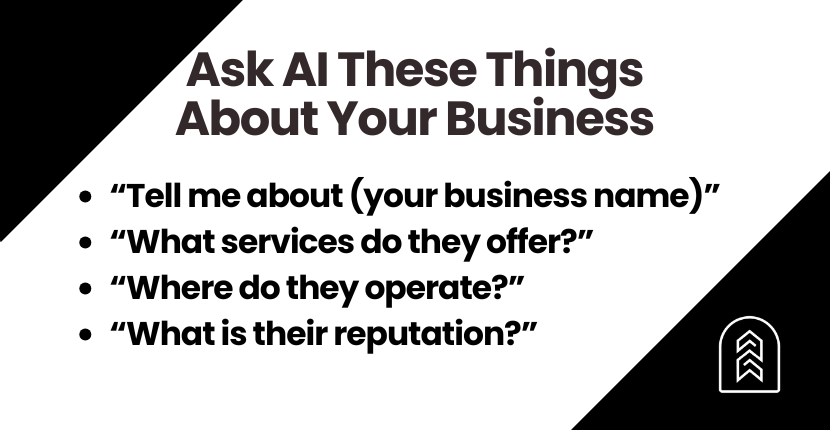
Pull up ChatGPT, Perplexity, Claude, or Gemini and feed it queries that mirror how an actual customer would search:
- “What does [Your Business Name] do, where do they work, and how are their reviews?”
- “I need a tree service in [Your Main Town]. Any recommendations?”
- “There is a large dead pine I need taken down near my house in [Your Main Town]. Who handles that?”
- “Best company for emergency tree removal in [Your County] at night?”
- “Who treats emerald ash borer in [Your Main Town]?”
Strong outcomes name your company, accurately describe your services, locate you in the right area, and ideally cite a credential or specialty. Weak outcomes lump you in with a generic list, get something wrong, or skip you altogether.
A wrong service description means your website still uses generic language. A wrong service area means your Google Business Profile contradicts your location pages. Total absence means you do not have enough cross-platform consistency yet. Run the same prompts on at least three AI tools, then on the competitors you respect most.
Traditional SEO vs. AEO vs. GEO
Traditional SEO keeps you ranking in standard Google results for searches like “tree removal Mechanicsburg PA.” Local pack visibility and organic rankings still drive a sizable share of inbound calls.
Answer Engine Optimization (AEO) is the discipline of becoming a source AI tools quote inside their answers. When a property owner types “how do I know if my oak tree is dying,” the tree services whose content actually walks through the visual signs become the ones cited.
Generative Engine Optimization (GEO) is the next layer up. GEO is about being the named recommendation when an AI tool is asked who to hire. Less about being a footnote, more about being the answer.
What Tree Removal Actually Costs
Cost is one of the most searched topics in tree care, and AI tools love folding pricing context into their answers. Tree services that publish realistic ranges get cited far more often than companies that stay silent.
Smaller removals on trees under 30 feet typically open in the low hundreds. Mid-range removals between 30 and 60 feet usually land in the four-figure range, depending on access, lean, and proximity to structures. Anything over 60 feet, removals over a roofline or pool, jobs requiring a crane, and storm response calls all run higher. Stump grinding is normally quoted separately. Some municipalities also require a permit for trees above a certain trunk size or in a right-of-way.
A page that walks through this framework will become one of the most-visited and most-cited pieces of content you have.
5 AI SEO Strategies for Tree Service Companies
1. Build Out FAQ Content That Mirrors Real Customer Questions

Most homeowners cannot identify the species in their own yard. They look at a tree, sense something is wrong, and Google their best guess. Topics that earn their own pages:
- “How do I tell if my tree is dead, dying, or just dormant?”
- “What does it cost to remove a 50 to 70 foot tree in Pennsylvania?”
- “Do I need a permit to remove a tree in Cumberland County or Dauphin County?”
- “What is emerald ash borer, and is my ash tree worth saving?”
- “How dangerous is a leaning tree?”
- “When is it safe to prune oaks in Central Pennsylvania?” (oak wilt season matters here)
Write each one the way you would explain it standing next to the homeowner in their driveway. The Tree Care Industry Association and the International Society of Arboriculture both publish technical references worth linking to, and Penn State Extension has the strongest Pennsylvania-specific tree health material on the internet.
2. Put E-E-A-T Signals Where They Can Be Seen

E-E-A-T is shorthand for Experience, Expertise, Authoritativeness, and Trustworthiness. It matters more in tree care than almost any other home service trade because the work is dangerous and the homeowner is making a decision with insurance implications. Earn that trust visibly:
ISA Certified Arborist and ISA Tree Risk Assessment Qualified (TRAQ) credentials, named on your team page and referenced on every service page
TCIA Accreditation, which signals a company-wide commitment to safety and training
Certified Treecare Safety Professional (CTSP) credentials on crew leaders
Pennsylvania Pesticide Applicator License for plant health care work
ANSI Z133 compliance, plus general liability and workers’ comp insurance with coverage figures in plain view
Membership in TCIA, ISA, the Pennsylvania Urban and Community Forestry Council, and your local chamber
Crew bios, equipment lists (bucket trucks, chippers, cranes), and project galleries with each town tagged
Homeowners feel safer hiring you. AI tools gain confidence recommending you.
3. Layer Schema Markup Across Your Site

Schema is structured code that converts your visible content into a format AI systems and search engines parse without ambiguity. Tree services should focus on a few specific types. LocalBusiness schema with full NAP details, hours, service area, and any 24/7 emergency flag. Service schema applied to each major service page. Review schema for your aggregate rating. FAQPage schema wrapped around the customer questions from Strategy 1. The technical specs are documented in Google’s structured data reference, and a competent developer can implement the basics in a few hours.
4. Make Sure Your Information Matches Everywhere It Appears

If your phone number is one digit off on Yelp and your service area on TreesAreGood.org excludes towns your Google Business Profile lists, the AI senses inconsistency and pulls back. Your information has to be aligned across:
Google Business Profile, with hours, services, photos, and emergency response clearly stated
Yelp, Angi, Thumbtack, HomeAdvisor, and the BBB
Your local chamber of commerce and county directories
TreesAreGood.org, the public-facing arborist locator run by the ISA
TCIA’s accredited company directory
Pennsylvania Urban and Community Forestry Council member listings
Every active social profile
A single neglected listing can throw the picture off. Our local SEO guide for contractors lays out a full audit process.
5. Cultivate Reviews That Give AI Tools Something Real to Quote
A five-star review that says “great service” is functionally useless to an AI. A five-star review that says “Removed a 70 foot oak that was leaning toward our house in Hershey, used a crane, finished in a single day, and the property looked spotless” is gold. The second names the work, species, size, equipment, location, and outcome.
After every job, send the customer a quick text: “If you have a minute, a Google review mentioning the type of tree, the work we did, and your town would help us out.” Spread requests across Google, Yelp, Angi, and HomeAdvisor. Respond to every review you get, including negative ones. The AI is reading your responses too.
Common AI SEO Mistakes Tree Service Companies Make
Trying to rank a single location page for ten different towns instead of building a real page for each. Treating “Tree Services” as one homepage section instead of giving removal, pruning, stump grinding, plant health care, and emergency response their own pages. Listing the ISA Certified Arborist credential exactly once, in the footer. Letting negative reviews go unanswered. Hiding the emergency response number deep in a contact page. Refusing to discuss pricing anywhere. Uploading dozens of photos with no alt text. Each is fixable in an afternoon.
AI SEO for Tree Service Companies FAQ
How is AI SEO different from traditional SEO for tree service companies?
Traditional SEO tries to win a click inside a list of ranked results. AI SEO tries to win the named recommendation that comes before the list ever appears. The two reinforce each other.
Will AI SEO help my tree service get more emergency storm work?
It is one of the strongest applications for the entire industry. Storm-driven searches are urgent, the homeowner is rarely loyal to a specific company, and AI tools are the first resource people turn to. Tree services that prominently advertise 24/7 emergency response and have storm-related reviews on file get pulled into emergency recommendations far more often than competitors who treat emergency work as a footnote.
How long before a tree service company sees results from AI SEO?
Tree services with a healthy Google Business Profile, recent reviews, and a working website typically see early movement in two to four months. Companies starting from zero should expect six to nine months before AI-driven leads become a reliable part of the pipeline.
Does AI SEO work the same way for residential homeowners and commercial property managers?
The signals overlap but priorities differ. Homeowners weight urgency, price clarity, and trust signals like reviews and credentials. Commercial property managers, HOAs, and municipal contacts weight TCIA accreditation, certificate of insurance procedures, equipment lists, and proof of multi-site capability. Tree services that want both audiences need separate landing pages tailored to each.
How does AI SEO help a local tree service compete against national chains like Davey Tree or SavATree?
Local tree services have a structural advantage money cannot buy. National chains publish broad, generic content that rarely references specific towns or county-level concerns. Local companies with named ISA arborists, customer reviews mentioning towns, and content addressing local issues like oak wilt timing or emerald ash borer pressure consistently outrank the chains in AI recommendations.
Ready to Be the Tree Service AI Tools Recommend?

Homeowners and property managers who used to call three companies for quotes are now asking an AI for a recommendation and calling exactly one. The companies on the receiving end of those single calls built their digital foundation correctly, early.
Four Arrows Marketing helps tree services across Central Pennsylvania become those companies. We handle the service pages, credential placement, schema, directory cleanup, and review systems that give AI tools a complete picture of your business. Every client receives monthly strategy calls, weekly updates, and detailed monthly reports covering leads, traffic, visibility, and revenue. Our standing target is a minimum of $3 in revenue for every $1 you invest. When fast lead flow is also a priority, we run Google Ads for tree service companies, especially heading into storm season.
If you want to know exactly where your company stands, contact us today.
—
Written by Adam Gante, Founder of Four Arrows Marketing. Last updated April 2026.