
Key Points: A damaged roof is not something homeowners put off. Whether a storm rolls through overnight or a ceiling stain appears out of nowhere, the reaction is immediate. They pull out their phone, search Google, and call the first company that looks trustworthy. Google Ads positions your roofing business to be that company, which leads to a steadier schedule, more predictable revenue, and a pipeline that does not rise and fall with word-of-mouth alone.
Why Roofing and Google Ads Are a Natural Fit
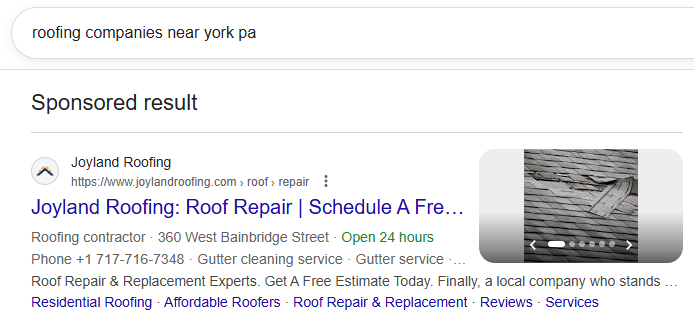
Think about how a homeowner finds a roofer. In most cases, they are not browsing social media or waiting to ask a neighbor. Something happened. A branch came through the roof, the attic is wet after a heavy rain, or an insurance adjuster just walked their property and handed them a claim number. The decision to call someone is already made. What they need now is a name.
That is where Google Ads comes in. The National Roofing Contractors Association estimates there are more than five million commercial and residential roofing projects completed in the United States each year, and the residential share of that work is driven heavily by weather events and aging housing stock. Central PA sits in a region that sees ice dams in winter, hailstorms in spring, and wind damage throughout the year. Homeowners here have real, recurring roofing needs, and more of them are turning to Google first to find someone to help.
A roofing company that shows up consistently at the top of those searches has a significant advantage over competitors waiting on referrals and seasonal rushes. Our PPC services page breaks down how we approach paid search for contractors if you want to get a sense of the process before reading further.
Why So Many Roofing Contractors Walk Away From Google Ads Too Soon
Plenty of roofing business owners have run Google Ads before. A good number of them stopped because the results did not justify the spend. That experience is frustrating, but in most situations the problem was not Google. It was how the campaign was built.
When a roofing company runs ads with poorly chosen keywords, the clicks that come in are all over the place. Someone shopping for shingles at a home improvement store. A guy looking for roofing apprenticeship programs. A homeowner in a county three towns outside your service area. You pay for all of it.
Beyond the keyword problem, there is a messaging problem. A homeowner who just had a tree limb punch through their roof is not in the mood to land on a generic “Welcome to our roofing company” homepage. They need to immediately see that you handle emergency repairs, that you serve their area, and that other people have trusted you with the same kind of job. When the ad and the page it leads to are telling two different stories, conversions suffer.
This is one of the core reasons Four Arrows Marketing focuses exclusively on contractors. We are not adapting a template from some unrelated industry. We understand how roofing customers search, what pushes them toward one company over another, and how to structure campaigns that bring in the calls you actually want to take.
Running Google Ads Alongside SEO
Some roofing companies come to us asking whether they should focus on paid search or organic SEO. The better question is how to run both in a way that makes each one more effective.
SEO for roofing contractors builds long-term visibility in search results, but it takes time. Ranking for competitive terms like “roofing contractor Harrisburg PA” or “roof replacement York PA” does not happen in a few weeks. The work compounds over months, and the payoff is real, but you cannot pay your crew with traffic that has not arrived yet.
Paid search fills that gap. A well-structured Google Ads campaign can put your business at the top of search results the same week it launches. That lead flow supports the business while organic rankings develop in the background, and the data you collect from paid campaigns, which keywords convert, which geographic areas respond best, which services generate the most calls, directly informs your SEO priorities.
Over time, as organic rankings improve for your strongest keywords, you can shift that portion of your ad budget toward new markets or service areas where you still need visibility. The two channels working together tend to outperform either one on its own.
The Google Ad Types Worth Your Attention as a Roofing Contractor
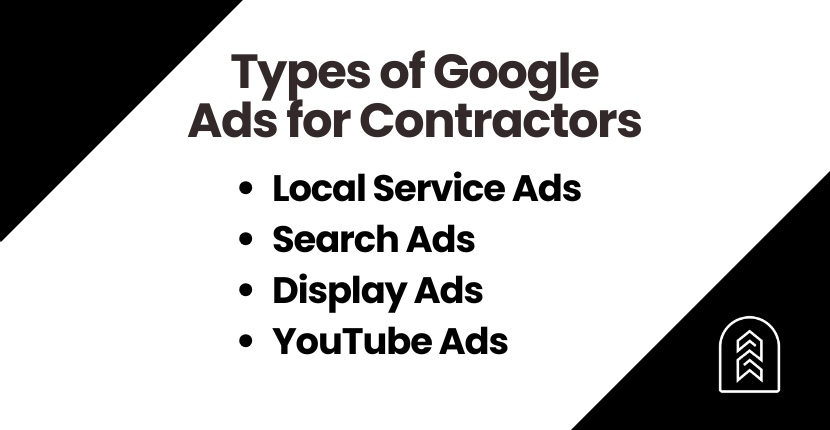
Local Services Ads
Local Services Ads appear above everything else on a Google search results page. Above the paid text ads. Above the map pack. Above every organic result. They display your business name, your review rating, and a Google Guaranteed badge that tells homeowners your company has cleared background checks and license verification.
For roofing, that badge is not a small thing. Homeowners in Central PA have heard the stories about out-of-town contractors who show up after a storm, collect a deposit, and disappear. The Google Guaranteed badge signals that your business is legitimate and has been vetted. That credibility can be the deciding factor before a homeowner ever visits your website. Local Services Ads are also charged per lead rather than per click, which changes the math significantly, especially on competitive search terms.
Search Ads
Search Ads are the text-based results that appear when someone types a specific query into Google. For roofing companies, these are often where the highest-intent traffic lives. A homeowner typing “roof repair after storm Mechanicsburg PA” is not browsing. They are ready to talk to someone.
The key to making Search Ads work is alignment. The keyword, the ad, and the landing page all need to point to the same thing. A homeowner searching for a roof inspection before closing on a house should land on a page built specifically for pre-sale inspections, not a general services page. Every core service you offer deserves its own campaign with its own message and its own destination.
Display Ads for Bigger Projects
Not every roofing decision is made in an afternoon. A homeowner getting quotes for a full roof replacement, debating between asphalt shingles and a metal roof, or working through a large insurance claim will spend days researching before they pick up the phone. Display Ads allow you to stay visible to those homeowners as they browse the web during that decision window.
This ad type works best for larger, planned projects rather than urgent same-day calls. For jobs in the $10,000 to $25,000 range, the ability to appear in front of a homeowner multiple times before they commit to calling gives you a real edge over companies they saw once and forgot.
YouTube Ads
A short video that walks a homeowner through what a roof inspection actually covers, or what the process looks like from first call to final cleanup, builds trust in a way that a text ad simply cannot. YouTube Ads reach homeowners who are researching and not yet ready to call, planting your company in their mind for when that moment arrives.
These ads work best as part of a broader awareness and remarketing strategy, particularly when targeting homeowners who have already visited your website but have not yet converted.
What the First Three Months Actually Look Like
A lot of roofing contractors abandon Google Ads before the campaign has had enough time to work. Understanding the typical arc of a new campaign helps set realistic expectations.
The first few weeks are a data-gathering period. Google is learning who engages with your ads, what those visitors do after they click, and which search terms are generating meaningful activity. The algorithm needs real-world input before it can start making smart decisions about who to show your ads to, and disrupting that process with constant changes slows things down.
From week three through roughly week six, the search term report starts becoming a genuinely useful tool. This is where you will see the full range of queries that triggered your ads, and some of them will surprise you. People searching for roofing jobs, roofing supply stores, DIY flashing repair guides, and commercial roofing certifications can all end up clicking your ad if the campaign is not properly filtered. According to Search Engine Journal, negative keyword management is one of the most consistently impactful ways to reduce wasted spend in a search campaign, and roofing is an industry where this work pays off quickly.
By the 90-day mark, the campaign has enough history to support real optimization decisions. You will know which services generate the most valuable calls, which locations within your service area are responding, and where the gaps are. That is the point where skilled campaign management can meaningfully move the numbers.
5 Habits of Roofing Companies That Get Strong Results From Paid Search
1. Know Your Numbers Before You Set a Budget
A $400 roof repair and a $18,000 full replacement are not the same job, and your ad budget should reflect the value of the work you want to attract. Before setting a monthly spend, calculate the average revenue across your full mix of jobs. That tells you what a qualified lead is actually worth, which tells you how much you can afford to spend acquiring one. Companies that skip this step end up either underspending and missing opportunities or overspending without a clear benchmark for success.
2. Block Irrelevant Searches Before Your First Ad Goes Live
A negative keyword list is not something you build after the campaign starts burning money. It should be in place on day one. For roofing, that means filtering out terms like “DIY,” “how to fix,” “roofing jobs near me,” “shingles for sale,” “roofing nailer,” and any other phrase that brings in traffic from people who are not looking to hire a contractor. Review your search term report weekly during the first few months. The list will keep growing.
3. Build Separate Landing Pages for Each Service
Homeowners searching for different services are in completely different mental states. Someone looking for an emergency repair after a storm wants confirmation that you are available now and can handle the situation. Someone researching a full replacement is in planning mode and needs to see your process, your warranty, and your past work. According to Search Engine Land, service-specific landing pages consistently convert paid traffic at higher rates than general pages. Sending all of your ad traffic to one page leaves conversions on the table.
4. Set Up Call Tracking From Day One
Phone calls are how most roofing jobs start, which means your conversion data lives inside those calls. Without tracking, you have no way to connect a booked job back to the keyword or ad that drove the call. Tools like CallRail assign unique numbers to each campaign so every call gets attributed back to its source. That data tells you what is working and gives Google Ads the conversion signals it needs to optimize toward higher-quality leads over time.
5. Capitalize on Storm Season With Bid Adjustments
Roofing demand in Central PA is not flat across the year. Spring hailstorms, summer windstorms, and the freeze-thaw cycles of late winter each create surges in homeowner searches. Having bid adjustments and budget increases ready to deploy when a significant weather event hits your service area means you are capturing calls at the exact moment demand is highest. The Insurance Information Institute reports that wind and hail are consistently among the top causes of homeowner insurance claims in the mid-Atlantic region. Those claims translate directly into roofing calls. Being visible for them is not optional if you want to grow.
FAQ: PPC for Roofing Companies
How do I compete with storm chasers and out-of-town contractors after a major weather event?
This is one of the most important Google Ads questions a roofing company in Central PA can ask. When a storm rolls through, out-of-state contractors flood the market and many of them run ads aggressively for a short window. The advantage a local company has is trust, history, and availability for warranty work after the job is done. Your ads and landing pages should lean into that. Messaging that highlights your local roots, your Google reviews, and your post-job support will outperform generic ads from companies homeowners have never heard of. Raising your bids and daily budget in the 48 to 72 hours after a storm also ensures you stay visible during the window when homeowners are most actively searching.
My roofing company handles a lot of insurance claims. Should that change how I run ads?
Yes, and it is worth building insurance claims into your campaign structure rather than treating it as a side note. Homeowners searching specifically for help with a storm damage insurance claim are a distinct audience with distinct questions. They want to know whether you work directly with insurance adjusters, whether you handle the documentation, and whether you have experience getting claims approved. A dedicated landing page and ad set built around insurance claim assistance will outperform a general roofing ad for these searches every time. It is also one of the higher-value customer types in the industry since those jobs are scoped and funded before you even show up.
Should I advertise for commercial roofing and residential roofing in the same campaign?
No. The buying process for commercial roofing is fundamentally different from residential. Commercial jobs involve longer sales cycles, multiple decision makers, bid processes, and different search behavior. A property manager searching for “flat roof repair commercial building Lancaster PA” is in a completely different situation than a homeowner with a leaking ridge vent. Mixing both audiences into one campaign makes it hard to write ads that speak clearly to either one, hard to measure which is producing results, and hard to send each type of visitor to the right page. Keep them in separate campaigns with separate budgets and separate landing pages.
What is a realistic cost per lead for roofing Google Ads in Central PA?
Most roofing companies in this market see cost per lead fall somewhere between $60 and $130 for standard repair and replacement calls. Storm-driven emergency searches often cost more per click due to competition, but the conversion rate tends to be higher because the homeowner’s need is immediate. For larger jobs like full replacements or commercial projects, a higher cost per lead is still worth it when the average job value is $12,000 to $20,000 or more. The number to watch is not cost per lead in isolation. It is cost per lead measured against the average revenue that lead produces when it books.
Is it better to pause ads in winter or keep them running at a lower budget?
Keeping a scaled-back campaign running almost always outperforms a full pause. When you shut a campaign down entirely, you lose the performance history Google has built up about who converts on your ads, and rebuilding that history takes time and money when you restart. A reduced winter budget keeps the account active, maintains your Quality Score, and keeps you visible for the calls that still come in during the colder months, including interior leak discoveries, ice dam damage, and homeowners planning spring projects. Restarting from scratch every spring is a competitive disadvantage you can avoid.
Ready to Build a Steadier Pipeline of Roofing Leads?
Running a roofing company on referrals and seasonal rushes makes planning difficult. It is hard to hire confidently, hard to invest in equipment, and hard to build the kind of business that runs on your terms rather than the weather forecast.
A well-managed Google Ads campaign gives you something more reliable to build on. Four Arrows Marketing works exclusively with contractors in Central PA, and every client gets monthly strategy calls, weekly updates, and reporting that connects ad spend directly to leads and booked revenue.
Schedule a call today to talk through what paid search could look like for your roofing company.
–
Written by Adam Gante, Founder of Four Arrows Marketing. Last updated May 2026.
–