
Key Points: Local SEO helps septic companies show up in Google Maps and “near me” searches when property owners urgently need help. This guide covers every tactic you need to win more calls and booked jobs from local search.
What Is Local SEO for Septic Companies?
Local SEO is the process of making your septic business visible when someone nearby searches for the services you offer.
When a homeowner types “septic pumping near me” or “septic repair in [your city],” Google uses a set of signals to decide which companies to display. Those signals include your Google Business Profile, the content on your website, your online reviews, and how consistently your business information appears across the web.
For septic companies, local SEO is not a nice-to-have. It is the primary driver of inbound calls.
Your customers are not browsing casually. They have a backed-up tank, a failed drain field, or a system that needs inspection before a home sale closes. They are searching right now, and they are calling one of the first three businesses they see.
What Is the Google Map Pack?
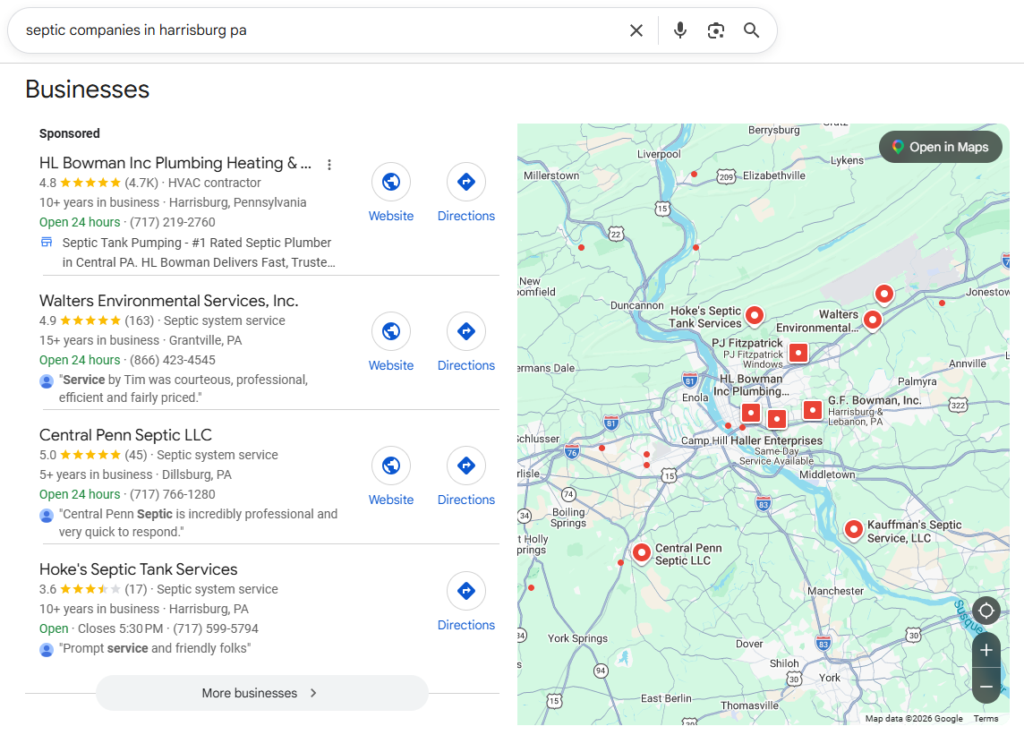
The Google Map Pack is the block of three business listings that appears at the top of local search results. It includes a map, star ratings, phone numbers, and hours — everything a property owner needs to make a fast decision.
For high-urgency searches like “emergency septic repair near me” or “septic pumping [city],” the Map Pack captures the majority of clicks. Organic results sit below it. If your septic company is not in those top three spots, most searchers never find you.
Earning a Map Pack position is the primary objective of local SEO for septic companies.
Why Local SEO Matters for Septic Companies
Septic work is almost entirely local. You serve a defined geographic area, and your customers are not driving past county lines to hire someone outside it.
When a tank backs up on a Sunday morning, the homeowner pulls out their phone and searches. If you are not visible, a competitor is getting that call. It is that simple.
Consider the searches your customers are actually making:
- “Septic pumping near me”
- “Septic tank repair [city name]”
- “Emergency septic service [county]”
- “Septic inspection before home sale”
- “Drain field replacement [town]”
Every one of those searches is a person ready to hire. Local SEO is how you make sure your phone rings instead of someone else’s.
According to BrightLocal, the majority of consumers use the internet to find local businesses before making contact. For service businesses like septic companies, that number is even higher — because most customers have no pre-existing relationship with a provider and need to find one fast.
Google Business Profile Optimization for Septic Companies
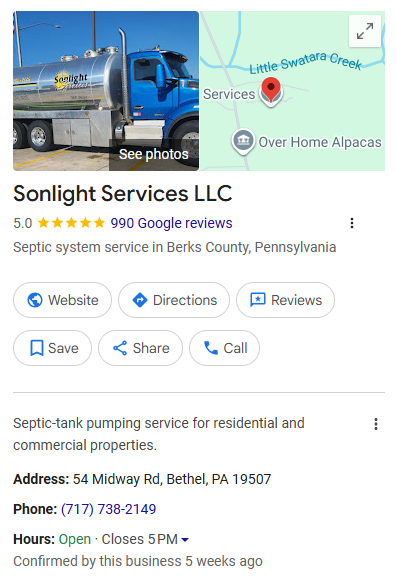
Your Google Business Profile is the foundation of your local SEO. It powers your Map Pack listing and is often the very first thing a homeowner sees before visiting your website.
Here is what a fully optimized profile looks like for a septic company:
- Primary category: “Septic system service” should be your main category. Add related categories like septic tank cleaning and septic system repair as secondaries.
- Complete every field: Business description, services offered, hours of operation, service area, and emergency availability.
- Photos: Upload images of your trucks, equipment, team, and completed jobs. Profiles with photos earn significantly more clicks than those without.
- Service area: List every city, township, and county you serve. Google uses this data to determine when to surface your profile for location-based searches.
- Weekly posts: Regular activity on your profile signals to Google that your business is active and engaged.
- Respond to every review: Every single one, within 48 hours. More on reviews below.
Your description is one of the most underutilized fields in the entire profile. Use it to explain what you do, where you do it, and what sets you apart. Work in location-specific language naturally — not as a keyword dump, but as a genuine description of your service area.
NAP Consistency
NAP stands for Name, Address, and Phone Number. Inconsistency across the web is one of the most common local SEO mistakes septic companies make — and one of the most damaging.
Google cross-references your business details across dozens of directories and platforms. When your information appears differently from one site to the next, it creates trust issues with the algorithm. That translates directly to lower rankings.
Common problems to fix:
- Business name formatted differently across listings (e.g., “Smith Septic” vs. “Smith Septic Services LLC”)
- Old phone numbers still live on Yelp or Angi after you changed numbers
- Outdated address on directories after relocating
- Duplicate listings on Google with conflicting information
Audit your citations regularly. Your NAP needs to be identical on your website, your Google Business Profile, and every directory where your business appears. According to Moz, citation consistency is one of the foundational signals in Google’s local ranking algorithm.
Key directories for septic companies to claim and maintain:
- Google Business Profile
- Yelp
- Angi
- HomeAdvisor
- BBB
- Local Chamber of Commerce
- Houzz
Service Pages and Location Pages for Septic Companies
A single “Services” page is not enough. Google wants to match search queries to specific, relevant pages. When your website has a dedicated page for each service you offer and a dedicated page for each city you serve, you give Google dozens of chances to rank you.
Service Pages
Every major service your company offers deserves its own page. For a septic company, that means separate pages for:
- Septic tank pumping
- Septic system installation
- Septic inspections
- Drain field repair and replacement
- Emergency septic services
- Grease trap cleaning (if applicable)
Each page should explain the service clearly, answer the questions customers actually have, and include a visible phone number and call to action.
Location Pages
Create a dedicated page for every city and town in your service area. A page targeting “septic pumping in Lebanon PA” tells Google you serve Lebanon — and gives homeowners in that community confidence that you work in their area.
Each location page must be genuinely unique. Pages that swap only the city name and leave everything else identical will not rank and can actually work against you in the long run.
The Keywords That Power These Pages
Every service page and location page should be built around a specific keyword. The pattern is straightforward: service plus location.
Examples of keywords to target:
- Septic pumping in Mechanicsburg PA
- Emergency septic repair York PA
- Septic tank inspection Lancaster County
- Drain field replacement near me
- Septic system installation Carlisle PA
Start by listing every service you offer. Then pair each service with every city in your service area. That list tells you exactly which pages to build and what each page should target.
According to Search Engine Journal, nearly half of all Google searches carry local intent. Building out your pages around these service-plus-location combinations is how you capture that traffic and convert it into booked jobs.
Building Reviews for Your Septic Company
Reviews are one of the most significant ranking factors in local SEO — and they are one of the highest-leverage activities a septic company can focus on right now.
Google looks at review volume, average rating, recency, and the content of reviews themselves. A company with 80 recent five-star reviews will almost always outrank a competitor with 20 older reviews, even if the competitor has a more polished website.
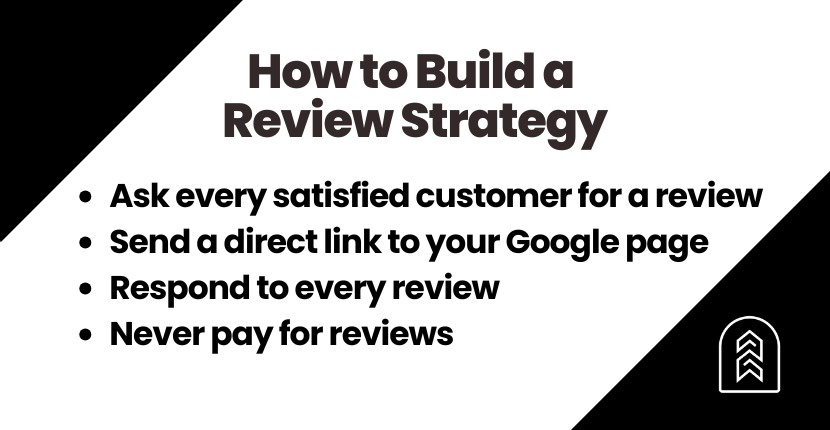
A practical review strategy for septic companies:
- Ask at job completion. Make it a standard part of wrapping up every job. If you pumped a tank or repaired a drain field, ask the customer to share their experience before you leave the driveway.
- Send a direct link. Text or email your Google review link immediately after the job. The easier the process, the more reviews you collect.
- Respond to every review promptly. Thank customers who leave positive feedback. Address negative reviews professionally and constructively — how you respond publicly tells prospective customers as much as the review itself.
- Never pay for reviews or manipulate the process. Google’s policies prohibit it, and violations can result in your profile being suspended.
Reviews also do something beyond boosting rankings. When a homeowner is deciding between two septic companies they have never heard of, reviews are often what pushes them toward one over the other.
Local Link Building for Septic Companies
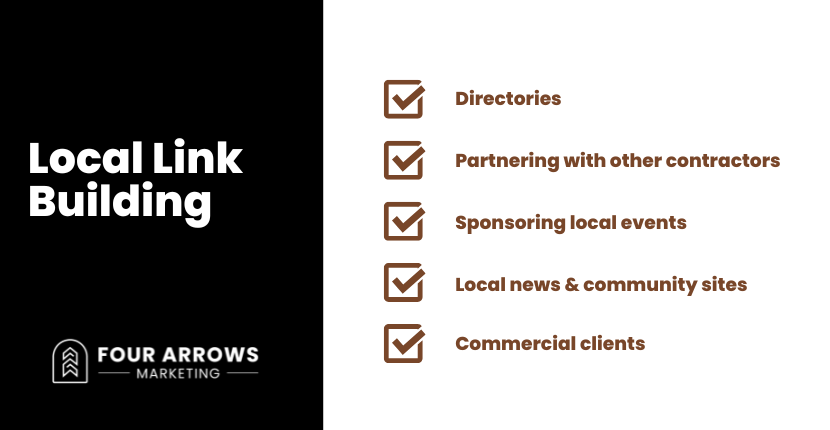
Backlinks from other local and industry-relevant websites signal to Google that your septic company is a trusted, established part of your community.
Practical ways to earn local backlinks:
- Directory listings: Claim and optimize profiles on Google Business Profile, Yelp, Angi, HomeAdvisor, and BBB. Each listing creates a citation and, in many cases, a backlink.
- Trade partnerships: Build referral relationships with complementary contractors — plumbers, home remodelers, landscapers, and roofers often work on the same properties and can link to your site or send referrals.
- Local sponsorships: Sponsoring a local sports team, fair, or community event often earns a link from the organization’s website.
- Local press: Getting featured in a local newspaper or community publication for a project or community involvement builds both credibility and links.
Even a small number of high-quality, locally relevant backlinks can meaningfully improve your Map Pack rankings over time.
Local SEO Checklist for Septic Companies
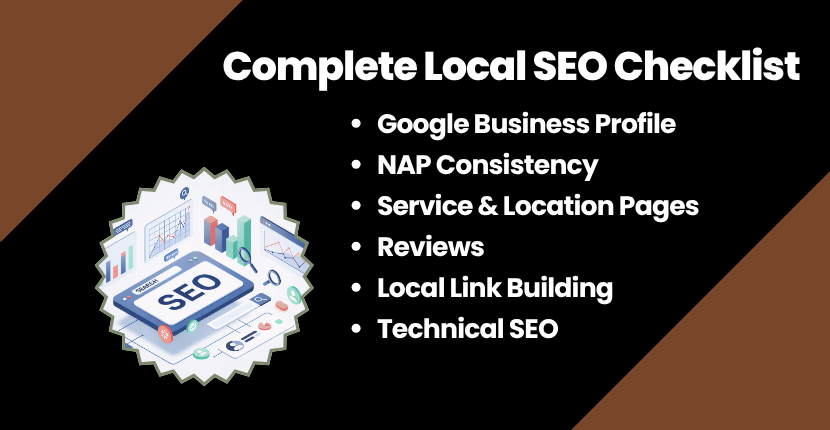
Use this to evaluate where your local search presence stands today.
Google Business Profile:
- Profile fully completed with accurate information
- “Septic system service” set as primary category
- Service area includes all cities and counties you serve
- High-quality photos of trucks, equipment, and completed jobs uploaded
- Weekly posts and updates published
- All reviews responded to within 48 hours
NAP Consistency:
- Business name, address, and phone number are identical across every platform
- No duplicate listings exist on Google or other directories
- Old or incorrect listings have been claimed and corrected
Service and Location Pages:
- Dedicated page for every service offered (pumping, installation, repair, inspections, emergencies, etc.)
- Dedicated location page for every city and town in your service area
- Each page is unique and targets a specific service-plus-location keyword
- Clear call to action and visible phone number on every page
Reviews:
- Review request is part of every job closeout process
- Direct Google review link sent to every satisfied customer
- All reviews responded to promptly and professionally
- Average rating of 4.5 stars or higher maintained
Local Link Building:
- Listed in all major directories (Google Business Profile, Yelp, Angi, HomeAdvisor, BBB, Chamber)
- Trade partnerships established with complementary contractors
- Local sponsorships and community involvement generating links
Technical SEO:
- Website loads in under 3 seconds on mobile
- Site is mobile-friendly and easy to navigate on a phone
- Emergency availability and service area findable within seconds of landing on any page
- Google Maps embed on contact page
- Google Search Console set up and monitored regularly
Local SEO for Septic Companies FAQ
How long does local SEO take for septic companies?
Most septic companies see measurable improvements in local rankings within 3 to 6 months of consistent effort. Google Business Profile optimizations can show movement faster — sometimes within a few weeks. The timeline depends on how competitive your market is, how complete your current profile and website are, and how actively you are collecting reviews. The sooner you start, the stronger your position becomes over time.
What is the most important ranking factor for local SEO?
Your Google Business Profile is the highest-impact single element. A complete, well-maintained profile with a steady flow of recent reviews is the foundation everything else builds on. After that, NAP consistency, service and location pages, and local backlinks all compound your results over time.
Do septic companies need a website for local SEO?
Yes. Your Google Business Profile alone has a ceiling. A well-built website gives you the ability to rank for dozens of service-plus-location keyword combinations, builds trust with visitors before they call, and captures leads outside of Map Pack searches. Without a website, your local SEO reach is significantly limited.
What directories should septic companies be listed in?
At minimum: Google Business Profile, Yelp, Angi, HomeAdvisor, BBB, and your local Chamber of Commerce. Industry-specific directories for home services and contractors are also worth pursuing. The key is making sure your NAP information is identical across all of them.
How do reviews affect local SEO rankings for septic companies?
Reviews are one of the most significant local ranking factors. Google weighs review volume, average rating, recency, and the actual content of reviews — including mentions of specific services and locations. A consistent stream of five-star reviews is one of the most reliable ways to improve and hold your Map Pack position.
How is local SEO different from traditional SEO?
Traditional SEO focuses on ranking in the organic results for broader, higher-volume search terms. Local SEO targets the Map Pack and location-specific searches. For septic companies, local SEO should be the priority because it captures the highest-intent customers — people searching for help right now, in your area. For a deeper look at how both strategies work together, check out our SEO for Septic Companies guide.
How much does local SEO cost for septic companies?
Professional local SEO services for septic companies typically range from $1,000 to $3,000 per month depending on market size, competition, and scope of work. That investment covers Google Business Profile management, citation building, review strategy, location and service page creation, and monthly performance reporting.
Ready to Get More Calls From Local Search?
You deserve to work with a digital marketing partner who cares about your results and your business. That is what Four Arrows Marketing is built on.
We help septic companies build local search presences that generate consistent calls, booked jobs, and real revenue growth. Monthly calls, weekly updates, and transparent reporting that connects your investment to actual results.
You deserve to be treated like a name, not a number. Schedule a call today and let’s build a local SEO strategy that keeps your trucks running.
–
Written by Adam Gante, Founder of Four Arrows Marketing. Last updated March 2026.
–