
Key Points: SEO for plumbing companies is one of the most reliable ways to generate consistent, high-quality leads for your business. This guide covers everything you need to know — from Google Business Profile optimization to local SEO, keyword strategy, content, backlinks, and AI search — so your plumbing company shows up where homeowners are already looking.
What Is SEO for Plumbing Companies?
SEO stands for Search Engine Optimization. For plumbing companies, it means making your business easy to find online when homeowners search for plumbing services in your area.
When someone searches “plumber near me” or “water heater repair in York PA,” SEO determines whether your business appears — or whether your competitor gets the call.
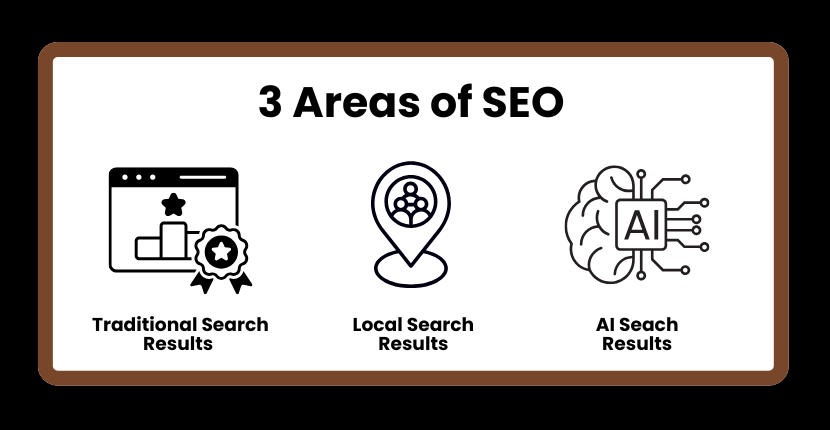
In 2026, SEO for plumbers covers three distinct areas:
- Traditional SEO — ranking in Google’s organic blue link results
- Local SEO — showing up in Google Maps and the local “3-pack”
- AI SEO (GEO) — appearing in answers from ChatGPT, Claude, Gemini, and Google’s AI Overviews
If you want a steady pipeline of incoming calls, you need visibility across all three. Our SEO services are built specifically for contractors — including plumbers — who want to grow.
Why SEO Is a Must for Plumbing Companies
When a pipe bursts or a water heater stops working, homeowners aren’t asking a neighbor — they’re grabbing their phone and searching Google. That urgency is what makes plumbing SEO so valuable.
The person searching “emergency plumber near me” isn’t browsing. They’re ready to call the first company that looks trustworthy and shows up in their results.
Here’s what’s at stake:
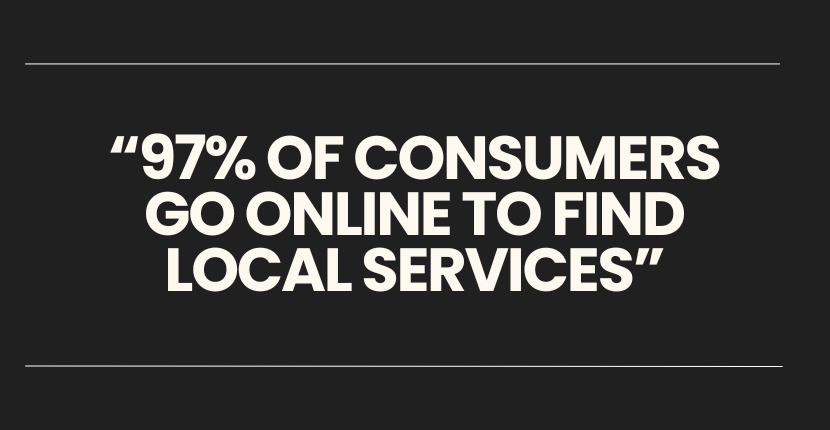
- 97% of consumers search online to find local services
- 46% of all Google searches have local intent
- The top organic result captures about 22% of all clicks — nearly double the second position
If your plumbing company isn’t on the first page of Google, you’re invisible to most of your market.
SEO vs. Paid Ads for Plumbers
Both SEO and PPC advertising can generate leads — but they work very differently.
Paid ads get you visibility immediately, but the moment you stop paying, you disappear. SEO takes longer to build, but compounds over time — a well-optimized page can generate calls for years without ongoing ad spend. Think of it as renting visibility versus owning it.
At Four Arrows Marketing, we recommend a combination of both — ads for immediate traction, SEO for sustainable long-term growth.
SEO Stats Every Plumbing Business Owner Should Know
Before we get into strategy, here’s why this investment is worth your attention:
- Over 53% of all web traffic comes from organic search (Backlinko)
- SEO leads convert at roughly 15%, compared to about 1.7% for outbound marketing (HubSpot)
- 87% of consumers begin their buying journey online
- Plumbing searches carry some of the highest purchase intent of any home service
For a plumbing company doing $500K or more in annual revenue, even a small improvement in search visibility can translate into significant new revenue.
The 3 Types of SEO for Plumbing Companies
1. Traditional SEO for Plumbers
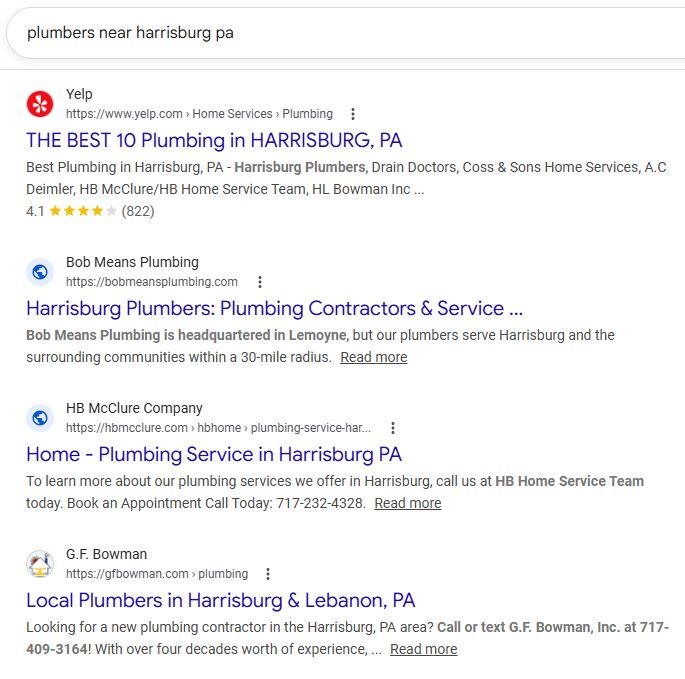
Traditional SEO focuses on ranking in Google’s organic results — the blue clickable links below any ads or map listings. It’s driven by helpful content, technical website health, and links from reputable websites. Key components include:
- Keyword research — knowing what your customers type into Google before they call
- On-page optimization — structuring pages with the right title tags, headings, and content
- Content creation — publishing service pages and blog posts that answer real questions
- Backlinks — earning links from trusted websites that signal credibility to Google
- Technical SEO — making sure Google can find, read, and understand your website
Tools like Ahrefs and SEMrush are useful for identifying keyword opportunities and tracking your rankings over time.
2. Local SEO for Plumbing Companies
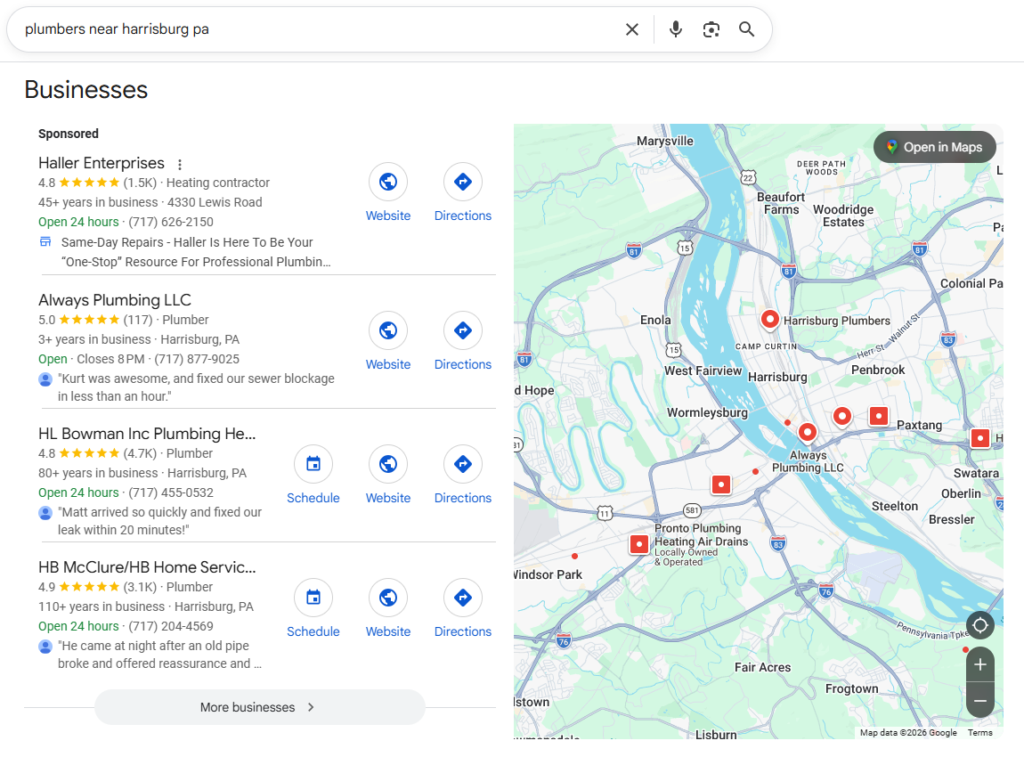
Local SEO is the most important type for most plumbing businesses. It determines whether your company appears in the Google Map Pack — the three business listings at the top of local search results. When someone searches “plumber in Harrisburg PA” or “drain cleaning near me,” local SEO is how you get your business in that set.
Common searches local SEO targets:
- “Emergency plumber near me”
- “Water heater installation Mechanicsburg PA”
- “24-hour plumber York”
- “Drain cleaning company Lancaster”
We go deeper on this in our Local SEO for Contractors guide.
3. AI SEO for Plumbing Companies
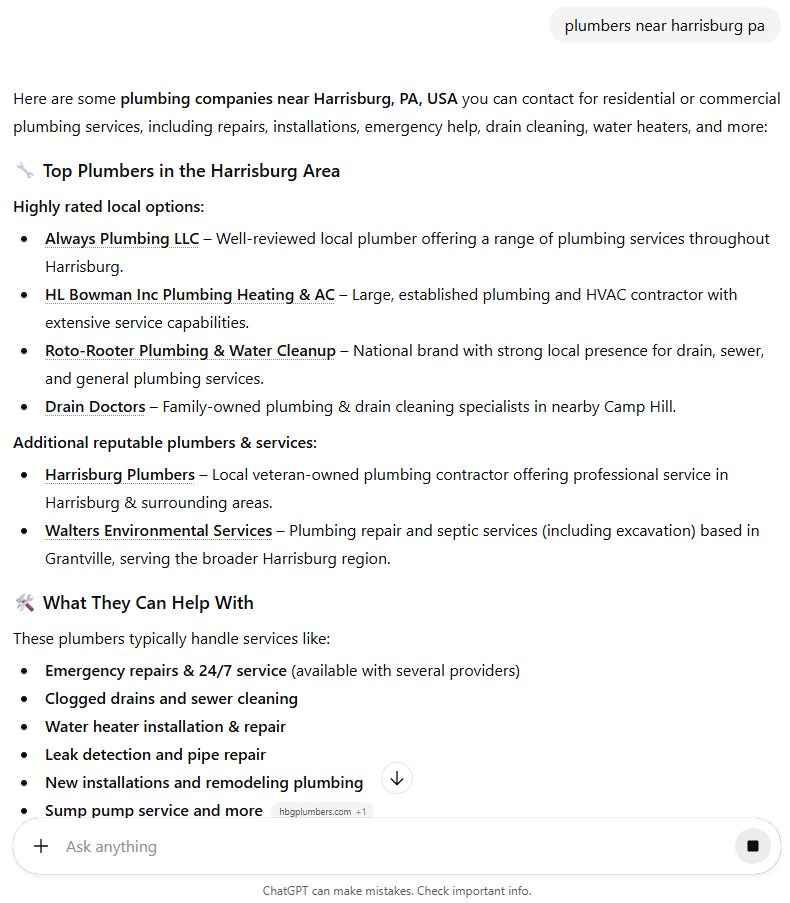
This is the fastest-growing area of plumbing SEO. More homeowners are now using AI tools like ChatGPT, Claude, and Google’s AI Overviews to find service providers before visiting a website.
Instead of searching “plumber near me,” they’re asking full questions like “Who is the best plumber for a burst pipe in my area?”
Generative Engine Optimization (GEO) involves structuring your content and online presence so AI systems recommend your business in those answers. Key strategies:
- Writing conversational, question-and-answer style content
- Implementing structured data (schema markup) on your website
- Keeping business information consistent across every platform
- Building authority through reviews, backlinks, and brand mentions
We cover this in our AI SEO for Contractors guide.
Google Business Profile: The #1 Priority for Plumber SEO
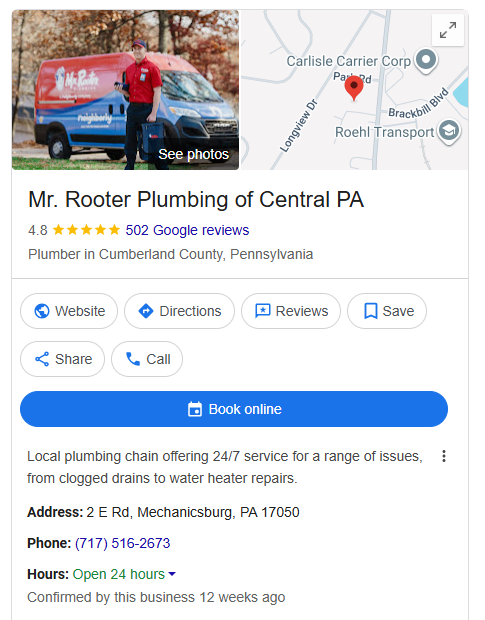
If you only do one thing from this guide, optimize your Google Business Profile (GBP). It is the single most impactful step a plumbing company can take to improve local search visibility — and it’s free.
How to Optimize Your Google Business Profile
Step 1: Claim and verify your profile Go to Google Business Profile and claim your existing listing or create a new one.
Step 2: Complete every section Include your business name, address, phone number, website, hours of operation (including emergency availability), service areas, and a keyword-rich description.
Step 3: Choose the right categories Select “Plumber” as your primary category. Add secondary categories for specialized services — drain cleaning, water heater installation, sewer repair, etc.
Step 4: Upload real photos Share photos of completed jobs, your crew, your vehicles, and your equipment. GBPs with photos consistently receive more calls and website visits than those without.
Step 5: Collect and respond to reviews Plumbing reviews carry extra weight because customers are trusting you with something urgent. Ask every satisfied customer to leave a review. Respond to every one, positive or negative.
Step 6: Post updates regularly Use GBP posts to share completed projects, seasonal tips, or promotions. Regular activity signals to Google that your business is active.
Step 7: List all your services Add every service you offer with descriptions. This helps Google connect your profile to specific searches like “water heater repair” or “sewer line inspection.”
NAP Consistency: The Foundation You Can’t Skip
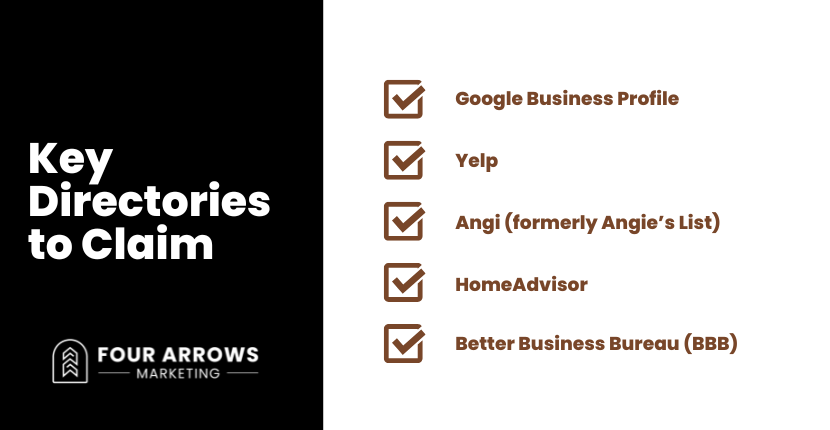
NAP stands for Name, Address, and Phone number. Google cross-references your business information across dozens of online directories — Yelp, Angi, the Better Business Bureau, HomeAdvisor, and more.
If your information is inconsistent across platforms, Google loses confidence in your data — and that hurts your local rankings.
Every place your business appears online should list the exact same information: same business name format, same address format, same phone number format.
Key Directories to Claim for Your Plumbing Business
- Google Business Profile
- Yelp
- Angi (formerly Angie’s List)
- HomeAdvisor
- Better Business Bureau (BBB)
- Houzz
- Nextdoor
- Facebook Business Page
- Apple Maps
Each consistent listing is a signal to Google that your business is legitimate and located where you say it is.
Keyword Research for Plumbing Companies
Keyword research is the process of identifying what potential customers actually type into Google when they need a plumber. Most business owners think they know — but the data often tells a different story.
Types of Keywords to Target
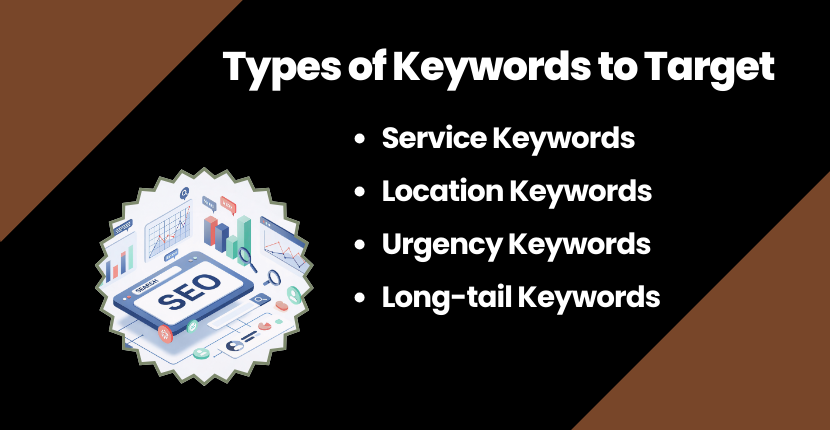
Service keywords: What you do.
- Water heater installation, drain cleaning, sewer line repair, leak detection, pipe replacement
Location keywords: Your service combined with a city.
- “Plumber in Harrisburg PA,” “Drain cleaning Mechanicsburg PA,” “Emergency plumber York PA”
Urgency keywords: Searches from people who need help immediately.
- “24-hour plumber near me,” “Emergency pipe burst repair,” “Same-day plumber open now”
Long-tail keywords: Specific, lower-competition phrases that often convert best.
- “Licensed plumber for water heater replacement Carlisle PA”
- “Sewer line camera inspection Central PA”
Ahrefs helps you see exact search volume and competition levels for each term. Google’s autocomplete suggestions are also free, valuable research — start typing a phrase and see what fills in.
On-Page SEO for Plumber Websites
Once you know your keywords, optimize your website pages to align with them. Every important page should target a specific keyword or topic.
Elements to Optimize on Every Page
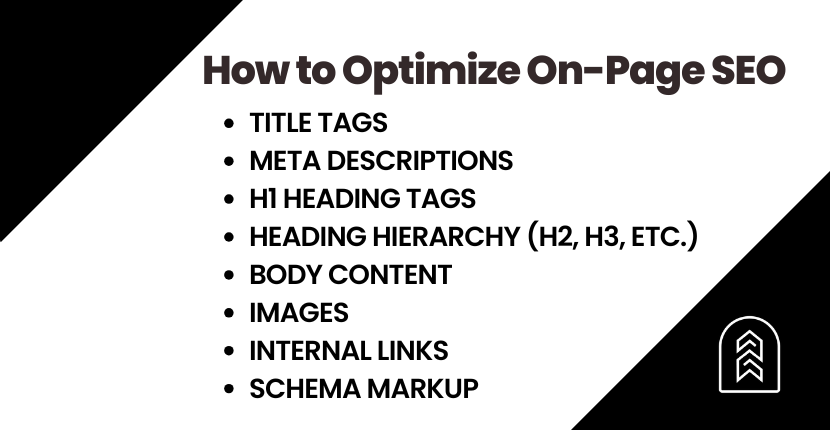
Title Tag: Include your keyword and location. Example: “Licensed Plumber in Harrisburg, PA | [Company Name]”
Meta Description: Write it like an ad — include your keyword and a reason to click.
H1 Heading: One per page. Include your primary keyword naturally.
Heading Hierarchy (H2, H3): Use subheadings to organize your content and naturally work in related keywords. A clear structure helps both Google and readers scan the page quickly.
Body Content: Write helpful content that genuinely answers what the searcher is looking for. Thin, generic pages don’t rank.
Images: Add descriptive alt text to every image.
Internal Links: Connect service pages, location pages, and blog posts to each other.
Schema Markup: Add local business schema so Google and AI systems can accurately read your business information.
Service Pages and Location Pages

One of the highest-impact SEO strategies for plumbers is building a complete set of service pages and location pages.
Service Pages
Each service should have its own dedicated page — not a single list page covering everything. A full-service plumbing company might build separate pages for:
- Water heater installation and repair
- Drain cleaning and clog removal
- Sewer line inspection and repair
- Emergency plumbing services
- Pipe repair and replacement
- Leak detection
- Fixture installation
Each page targets a specific keyword and gives Google a clear signal about what you offer. This is how plumbers and other contractors rank for multiple high-value keywords simultaneously.
Location Pages
If you serve multiple cities, build a dedicated page for each one. A plumbing company covering Central PA might create pages for Harrisburg, Mechanicsburg, York, Lancaster, Carlisle, and Hershey — each targeting “plumber + [city name].” Each page tells Google exactly where you work and what you do there.
Content Marketing for Plumbing Companies

Beyond service and location pages, publishing blog content helps you rank for informational keywords and build trust with potential customers before they ever pick up the phone.
Think about what homeowners search before calling a plumber:
- “How much does it cost to replace a water heater?”
- “What are signs of a sewer line problem?”
- “Should I repair or replace my water heater?”
- “What causes low water pressure in my home?”
If your website answers these questions, Google sends those searchers your way. You build credibility before the first conversation — and when they’re ready to hire, they already feel like they know you.
Thorough content that covers a topic comprehensively tends to outperform thin pages in competitive search results, according to Backlinko.
Building Backlinks for Your Plumbing Website
A backlink is a link from another website pointing to yours. Google treats these like votes of confidence — when reputable sites link to your plumbing company, it signals credibility and boosts your rankings.
How Plumbing Companies Can Earn Backlinks
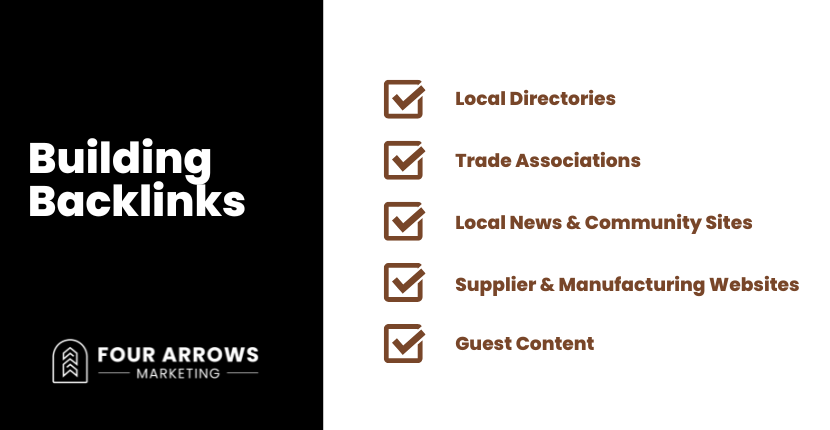
- Local directories: Yelp, HomeAdvisor, Angi, and the BBB all provide a link back to your site when you claim your listing.
- Trade associations: Join organizations like PHCC and get listed in their member directory.
- Local sponsorships: Sponsor a community event or youth sports team. These often result in a mention and link from a local news site.
- Manufacturer partnerships: Some brands list certified installers on their websites with a link to your business.
- Local business networks: Chambers of commerce often list member businesses with a link.
Quality matters far more than quantity. One link from a respected local news outlet is worth more than dozens from low-quality directories.
Technical SEO for Plumbing Websites
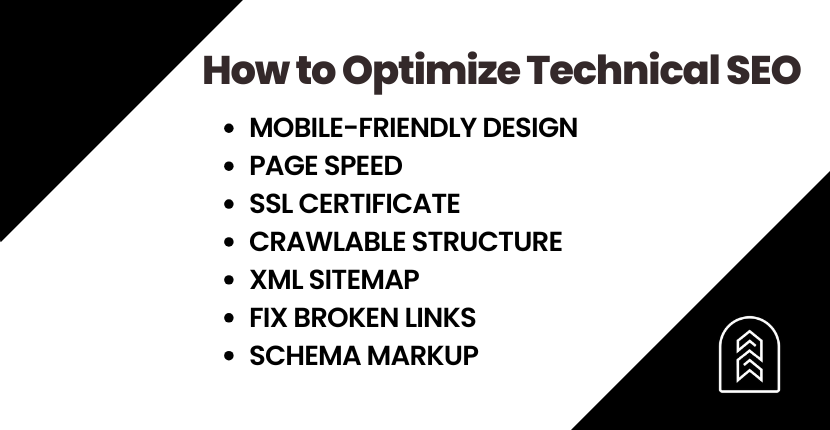
Technical SEO ensures Google can crawl, index, and understand your website. Even excellent content won’t rank if technical problems are holding it back.
Technical SEO Checklist for Plumbers
- Mobile-first design: Most plumbing searches happen on smartphones. Your site must work flawlessly on mobile.
- Page speed: Slow sites frustrate visitors and hurt rankings. Compress images and use reliable hosting.
- SSL certificate: Your site must use “https://” — a basic trust signal for Google and visitors alike.
- XML sitemap: Submit one through Google Search Console so Google knows every page on your site.
- Fix broken links: Broken pages waste Google’s crawl budget and frustrate potential customers.
- Schema markup: Structured data helps Google and AI tools accurately understand your business, services, and reviews.
Screaming Frog can run a full technical audit of your site and surface issues you didn’t know existed.
Plumbing SEO FAQ
How long does SEO take to work for plumbing companies?
Most plumbing companies begin seeing meaningful improvements within 3 to 6 months. Competitive markets may take 6 to 12 months for significant results. SEO is a long-term investment — the companies that stick with it are the ones that dominate their local market for years.
What is the most important SEO strategy for plumbers?
A fully optimized Google Business Profile delivers the fastest results for most plumbing companies. Beyond that, NAP consistency, dedicated service and location pages, and a steady stream of customer reviews are the highest-return activities.
How do I get my plumbing company to show up on Google Maps?
Claim and verify your Google Business Profile, fill out every section completely, upload photos of real jobs, and actively collect reviews. Consistent NAP information across the web strengthens your map pack rankings over time.
What keywords should a plumbing company focus on?
Start with your core service plus your primary service area — “plumber in Lancaster PA” or “water heater repair Mechanicsburg PA.” Then expand to surrounding cities, specialty services, and informational keywords. Ahrefs can show you exactly where the best opportunities are in your market.
How much does SEO cost for a plumbing company?
Professional plumbing SEO typically ranges from $1,500 to $5,000 per month depending on your market and scope of work. At Four Arrows Marketing, our goal is to generate at least $3 in revenue for every $1 our clients invest in digital marketing.
Ready to Grow Your Plumbing Business with SEO?

You deserve a digital marketing agency that understands your industry, communicates clearly, and delivers measurable results.
At Four Arrows Marketing, we help plumbing companies and contractors grow through SEO and PPC that actually moves the needle.
Here’s what working with us looks like:
- Monthly strategy calls so you always know what’s happening
- Weekly updates so you’re never left wondering
- Monthly performance reports covering leads, revenue, cost per lead, traffic, and rankings
- A goal of at least $3 in revenue for every $1 you invest
Schedule a call with Four Arrows Marketing and let’s talk about what growth looks like for your plumbing business.
–
Written by Adam Gante, Founder of Four Arrows Marketing. Last updated February 2026.
–
Further Reading