

Key Points: Today’s homeowner planning a kitchen gut, primary bath upgrade, or whole-home renovation is researching for months before contacting anyone. Their first stop may no longer be Google or a referral from a neighbor. It could be ChatGPT, Perplexity, Gemini, or Claude, and the answer they receive narrows their entire shortlist to two or three names. AI SEO is what decides whether your home remodeling company makes that shortlist or never gets considered.
What AI SEO Actually Means for Remodelers
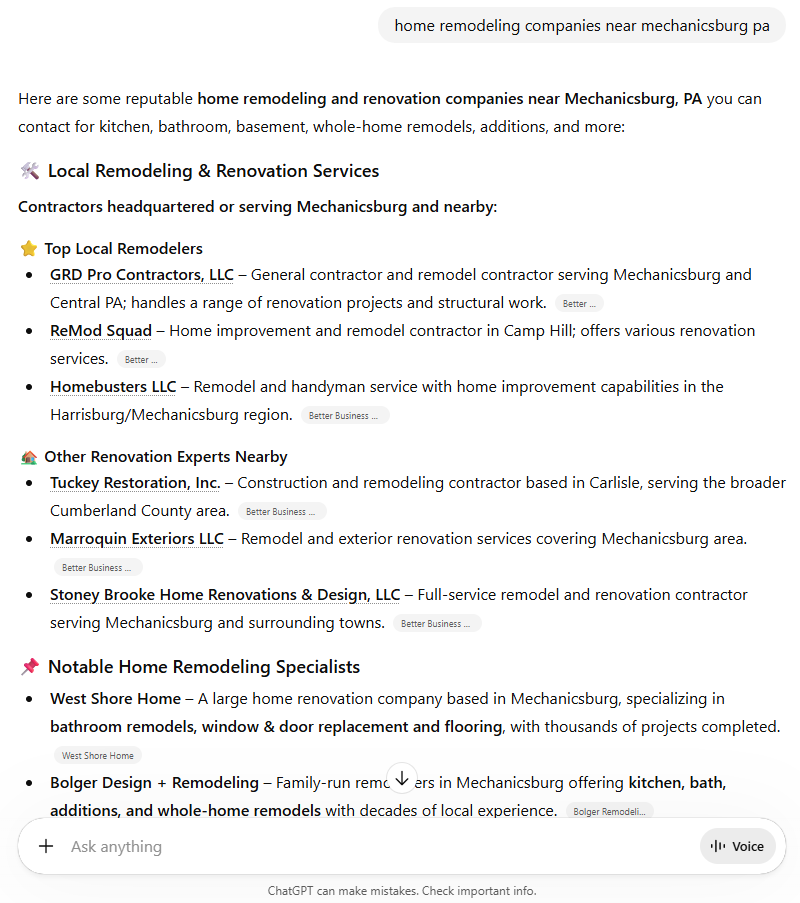
The renovation buying journey looks completely different than it did even three years ago. Research from the Joint Center for Housing Studies at Harvard shows homeowners pricing major remodels typically spend four to seven months in research mode before signing a contract. They scroll Pinterest, save Houzz photos, watch YouTube walkthroughs, and now hand the entire vetting process to an AI assistant.
Picture a homeowner who has lived with a cramped 1980s kitchen for fifteen years and finally has the budget to renovate. She opens ChatGPT and describes what she wants: cabinets to the ceiling, a six-foot island, the wall to the family room removed if structurally possible. Within seconds the reply names two local design-build firms, explains why each fits, and notes the lead-safe certification her 1962 split-level requires. She books a consultation that afternoon. Two of her three planned interviews have already been chosen for her.
The pattern is now standard across remodeling. Property investors use it for turnkey flips. Multigenerational families use it for accessible bathroom retrofits and ADU additions. Empty nesters use it for downsize-in-place renovations. Sellers use it to find someone who can refresh a kitchen without scaring buyers off the contract.
AI SEO is the work of becoming the contractor an AI tool actually names. It pulls together your service architecture, trade credentials, reviews, project portfolio, and local presence into a story that large language models can read, verify, and cite. Our SEO services for contractors treat this as the new ground floor.
Why You Have a Short Window to Win
Most remodelers have not adapted yet. Open ten remodeling websites in any market and the pattern is identical: a kitchen hero photo, a generic services page, a portfolio dumped on one URL with no project notes, and trade association badges hiding in the footer.
Companies that close the gap first compound the advantage. AI tools learn through repetition. Once your business becomes the name an AI links to design-build kitchens or full-home renovations in your service area, that association reinforces itself month after month. The Joint Center for Housing Studies puts annual remodeling spending above $480 billion. Contractors visible to AI tools are positioned to capture a disproportionate share.
What Large Language Models Actually Evaluate
Home remodeling is high-trust work. Homeowners are letting your team into their house for three to nine months and writing checks that frequently exceed six figures. AI tools weigh evidence carefully before recommending in this category. Three signals dominate.
Service specificity comes first. The phrase “home remodeling” tells the AI almost nothing. Real queries running through these tools look like this: kitchen layout change with structural beam install, primary bath converted to curbless shower with heated floors, second-story addition over existing footprint, load-bearing wall removal with engineered LVL, pre-1978 home requiring lead-safe protocols, historic district renovation requiring HARB approval, first-floor primary suite with universal design. Contractors with a dedicated page for each scope get cited. Contractors with one Services page lumping everything together do not.
Trade rigor comes second. AI tools verify credentials against external directories. The National Association of the Remodeling Industry maintains a public directory of Certified Remodelers, Certified Kitchen and Bath Remodelers, and Certified Aging-in-Place Specialists. The National Kitchen and Bath Association directory verifies CKD, CBD, and AKBD designers. The National Association of Home Builders confirms Certified Graduate Remodeler status. The EPA Lead-Safe Renovator program confirms federal compliance for any work on pre-1978 housing. When your claims match these sources, AI tools recommend you with confidence.
Outside corroboration closes the picture. Houzz project pages with detailed scope notes and budget ranges. Reviews on Google, Angi, and BBB that name specific projects with specific outcomes. Awards from NARI Contractor of the Year competitions or Best of Houzz. When all of this aligns with your website, the recommendation engine works in your favor.
The Five-Minute Audit You Can Run Right Now
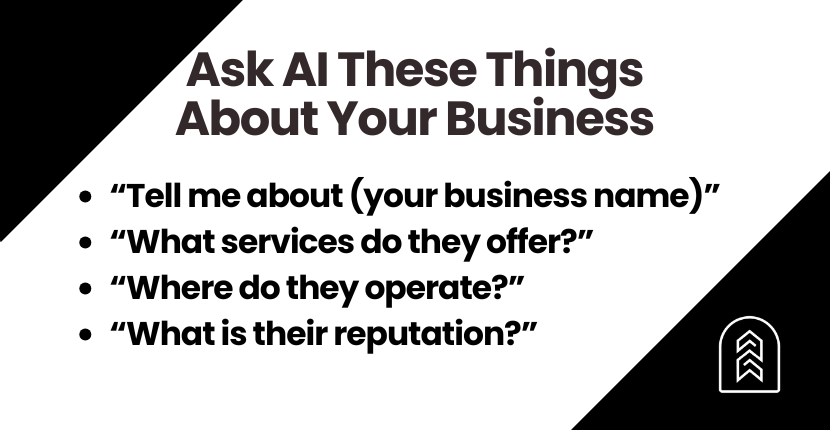
Open ChatGPT, Perplexity, Claude, and Gemini in four browser tabs. Run these prompts:
- “Tell me about [Your Company Name]. What kind of remodeling do they specialize in?”
- “We want to gut and rebuild our kitchen, including taking out the wall to the dining room. Recommend three design-build firms in [your city].”
- “Looking for a contractor in [your region] with experience renovating older homes from the 1920s through 1950s.”
- “I need a primary bath remodel with curbless shower and heated floor. Best contractors near [your city]?”
- “Find me a NARI Certified Aging-in-Place Specialist in [your service area].”
If your name surfaces with accurate services and the right specialties, you are ahead of nearly every competitor in your market. Wrong service descriptions means generic website language. Wrong service area means your Google Business Profile and location pages contradict. No appearance at all means weak cross-platform consistency. Run the same prompts on three competitors to see who is winning the AI conversation.
Traditional SEO, AEO, and GEO Each Solve Different Problems
Classic SEO still drives “kitchen remodeler near me” and “[city] bathroom contractor” searches. The Google Local Pack still drives phone calls.
Answer Engine Optimization, or AEO, targets a different moment. When a homeowner asks an AI “what is the difference between a remodel and a renovation” or “do I need an architect for an addition,” the contractor whose page answers that question in clear, specific language becomes the source the AI quotes. AEO earns you citations.
Generative Engine Optimization, or GEO, sits one layer higher. It targets the moment an AI names a specific contractor to call. AEO gets you cited. GEO gets you hired. Most remodelers are doing neither.
Pricing Belongs Somewhere on Your Site
The most-searched topic in remodeling is cost, and most contractors refuse to publish anything beyond “every project is custom.” That silence is one of the reasons their content does not get cited. Ranges, even broad ones, get pulled into AI answers repeatedly. The annual Cost vs. Value Report from Remodeling Magazine provides national context for major project categories, and your own historical bands by tier (refresh, mid-range, high-end) provide local context no national report can match. You are not committing to a price. You are participating in the homeowner’s research the way they actually want you to.
Five Moves That Get Remodeling Companies Cited by AI
Move 1: Build the FAQ Content Your Buyers Are Actually Searching
Homeowners typing questions into AI tools rarely use industry language. They ask things like:
- How much does a full kitchen remodel cost in 2026?
- What is the difference between a general contractor, a design-build firm, and a kitchen designer?
- Do I need an architect, a structural engineer, both, or neither for my addition?
- How long should a whole-home renovation realistically take?
- Is the wall I want to remove load-bearing, and how do I find out?
- What is EPA Lead-Safe certification and why does it matter for my older home?
- What is the realistic ROI on a kitchen remodel if I plan to sell within five years?
Each page should read like a thirty-minute conversation at the homeowner’s island. Cite outside authorities like the EPA Lead-Safe program and your local building department. Authoritative outbound links signal that your content sits inside a verifiable knowledge network.
Move 2: Surface Every E-E-A-T Signal You Already Have
Experience, Expertise, Authoritativeness, and Trustworthiness should be visible on every page, not buried in a footer. Your state contractor license number in the footer. Your EPA Lead-Safe firm certification on any page that touches pre-1978 housing. NARI, NKBA, and NAHB credentials with verified badge images. In-house designer and lead carpenter bios with their certifications. Insurance coverage figures stated in plain language. Warranty terms with the actual document linked. Real before-and-after galleries from completed jobs, not stock photography.
If your firm has a NARI Certified Aging-in-Place Specialist, that name belongs on the universal design page, the bath page, and the addition page. If you carry a premium cabinet line as an authorized dealer, the dealer badge belongs on your kitchen page.
Move 3: Add Schema Markup So Machines Can Read You
Schema is structured data that translates your visible content into a format AI tools parse without ambiguity. Remodeling firms should deploy LocalBusiness schema with full hours, service area, and a free consultation flag, Service schema on each project-type page, Review schema for the aggregate Google rating, FAQPage schema around the questions from Move 1, and Article schema on case studies. Implementation guidance lives at Schema.org and Google’s structured data documentation. A capable developer handles the basics in an afternoon.
Move 4: Audit Every Listing of Your Business Online

A single mismatched phone number across your Google Business Profile, NARI directory listing, and website is enough to make AI tools hedge. Run a quarterly audit covering Google Business Profile, Houzz, Angi, BBB, your state contractor licensing database, NARI, NKBA, and NAHB directories, the EPA Lead-Safe firm lookup, and your social profiles. Name, address, phone, primary service description, and service area should match across all of them. Our local SEO guide for contractors covers the audit workflow in detail.
Move 5: Train Customers to Leave Specific, Detailed Reviews
A review that says “great work” gives AI tools nothing to cite. A review that names the project, scope, and outcome (“complete kitchen renovation in our 1958 ranch including removing the wall to the dining room with an LVL beam, custom inset cabinets, finished in eleven weeks within five percent of the original estimate”) gives AI tools something quotable, project-tagged, and specific.
Build a structured review request into your project closeout. Spread requests across Google, Houzz, Angi, and BBB rather than concentrating them on one platform. Reply to every review, including the negative ones. AI tools weigh your responses too.
Common Mistakes That Make Remodelers Invisible
A handful of fixable problems show up on nearly every remodeler website. One generic Services page covering kitchens, baths, additions, and whole-home work instead of dedicated pages for each scope. A dumped portfolio with no captions or budget bands. NARI and NKBA credentials buried in footer text. Zero pricing context. Project photos with file names like DSC_0247.jpg and no alt text. EPA Lead-Safe certification missing from the website even when the firm is federally certified. Negative reviews left unanswered for years. Each one is a one-afternoon fix.
AI SEO for Home Remodeling Companies FAQ
Should I publish remodeling pricing if my competitors keep theirs hidden?
Yes, and your competitors hiding their pricing is exactly why this works. AI tools cite contractors who provide ranges over those who refuse. Homeowners researching a $60,000 kitchen or a $200,000 addition want a frame of reference before they engage. Publishing realistic ranges by tier with appropriate caveats positions you as the trustworthy option and feeds AI answers as the source of pricing context for your market.
How do I get AI tools to position my firm correctly as design-build, general contracting, or design-only?
This is one of the most common positioning errors in remodeling. AI tools categorize you based on what your content says, not what your business cards say. If your homepage reads “remodeling contractor” but your services include in-house design, project management, and construction, the AI hears “general contractor” and skips you on design-build searches. Be explicit. State your model on the homepage and on every service page. Name your in-house designers and architects. Describe your process in a way that distinguishes design-build from a referral relationship between separate firms. AI tools cite the firm that explains itself clearly.
My Houzz portfolio is one of my strongest assets. How do AI tools handle it?
Houzz is one of the few platforms where AI tools find rich, project-tagged remodeling content with photos, scope notes, and verified contractor connections. Your portfolio is doing real work for your AI visibility, but only if the project pages are filled out properly. Each project should include a clear title, project type, rough budget range, location, scope, and your role. Vague titles like “Kitchen Remodel” with five photos and no notes give AI tools nothing to work with. Cross-link your Houzz portfolio prominently from your website, and make sure your business name, address, and phone match your Google Business Profile exactly.
Do my NARI, NKBA, and NAHB credentials actually move the needle with AI tools?
Yes, more than almost any other credential in this industry. AI tools cross-reference your claim against the member directories on the certifying body websites. When the directory confirms you, the AI gains a verifiable third-party signal that lifts you in recommendations. Make sure your certifications are named on the relevant service pages, badge images load with proper alt text, and your listing in each directory matches your Google Business Profile exactly. EPA Lead-Safe Renovator firm certification is in the same category and is federally required for any work on pre-1978 housing.
How do I get AI tools to cite my niche specialties like aging-in-place or historic preservation?
Niche specialties are where small and mid-sized remodelers consistently outperform larger competitors on AI visibility. The strategy is dedicated content depth. If you handle aging-in-place work, build a hub page around CAPS-certified universal design and surround it with FAQ pages, project case studies, and content on specific scope items: curbless showers, lever handles, doorway widening, lighting strategy, grab bar placement. If you handle historic preservation, do the same for HARB compliance, period-appropriate materials, and architectural style restoration. AI tools reward depth in narrow categories far more than breadth in broad ones.
Ready to Be the Remodeling Company AI Tools Recommend?

The homeowner who used to interview three contractors for a kitchen estimate now asks ChatGPT and books one consultation. The contractors on the receiving end of those single calls did the digital groundwork first. They built dedicated service pages, surfaced their credentials, deployed schema, cleaned up their directory listings, and trained customers to leave specific reviews.
Four Arrows Marketing helps remodeling companies become those contractors. Every client gets monthly strategy calls, weekly updates, and monthly reports tracking leads, traffic, AI visibility, and revenue. Our target is at least $3 in revenue for every $1 you invest. When you need fast lead flow alongside the long-term AI work, we run Google Ads campaigns for remodeling companies timed to spring and fall project seasons.
If you want to know exactly where your firm stands today, contact us for a complimentary AI visibility audit.
—