
Quick Summary: Home remodeling is one of the highest-ticket local service industries — and one of the most competitive online. This guide breaks down exactly what it takes to show up at the top of Google Maps and local search results, and convert that visibility into the high-value projects your business runs on.
What Does “Local SEO” Actually Mean for a Home Remodeling Company?
Think about what happens the moment a homeowner decides they want a new kitchen.
They open Google — or ask ChatGPT — and type something like “kitchen remodeling contractor near me” or “home addition company in [city].” Within seconds, Google returns a list of businesses to choose from. The ones at the top did not land there by accident.
That list is the result of a specific set of signals Google uses to rank local businesses. Local SEO is the ongoing work of sending those signals — through your Google Business Profile, your website structure, your online reviews, and the consistency of your business information across the web.
Home remodeling companies that invest in local SEO capture the attention of homeowners who are ready to spend real money on their homes. The ones that don’t end up handing those projects to competitors.
The Google Map Pack: Why It Matters More Here Than Almost Any Other Trade
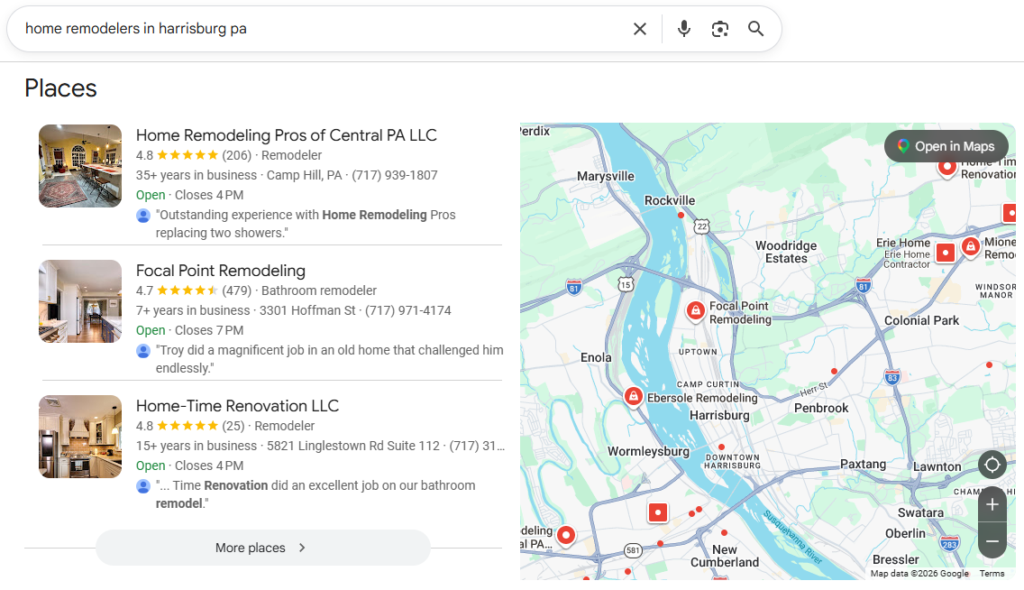
Pull up Google on your phone and search “home remodeling company near me.”
The first thing you’ll see — above the blue links, above the ads in many cases — is a block of three local businesses paired with a map. That’s the Google Map Pack. It’s where the majority of clicks go on location-based searches.
For a remodeling company, this is especially important. Kitchen renovations, bathroom remodels, and home additions are high-consideration purchases. Homeowners are doing their homework, and the businesses showing up in those top three spots get the majority of the research traffic — and the phone calls that follow.
If your business isn’t in that block, the homeowners making those searches never even know you exist.
Why Local SEO Is a Natural Fit for the Home Remodeling Industry

Remodeling is not an impulse purchase.
A homeowner thinking about a kitchen remodel might research contractors for weeks — sometimes months — before making a single call. They’re reading reviews, browsing project photos, comparing options, and asking their neighbors who they used. The whole process starts on Google.
That consideration window is actually an advantage for remodeling companies that have invested in local SEO. Every touchpoint — your Map Pack listing, your website, your project photos, your reviews — compounds into a picture of credibility before a prospect ever contacts you.
Here’s a snapshot of the searches homeowners are making at any given moment:
- “Home remodeling company near me”
- “Kitchen remodeler [city]”
- “Bathroom renovation contractor [county]”
- “Home addition contractor [town]”
- “Basement finishing company [city]”
- “Whole-home remodel [city] PA”
- “Licensed general contractor [city]”
- “Deck addition contractor near me”
Each of those searches represents a homeowner with a project in mind and a budget set aside. Local SEO puts your business in front of them at exactly the right moment.
According to BrightLocal, the vast majority of people research a local service business online before ever reaching out. For a high-trust, high-ticket service like remodeling, that research phase carries enormous weight.
Your Google Business Profile: The Single Most Important Thing to Get Right
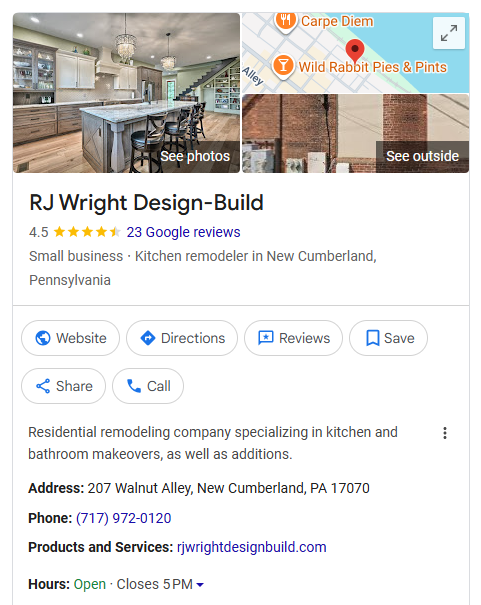
If a homeowner finds your remodeling company through a local search, the first thing they’ll see is your Google Business Profile — not your website. It’s your digital first impression, and it directly determines whether or not you show up in the Map Pack.
Here’s what a well-optimized profile looks like for a home remodeling company:
Choose your categories carefully. Set your primary category as “General Contractor” or “Home Improvement Contractor,” depending on your focus. Add secondary categories — “Kitchen Remodeler,” “Bathroom Remodeler,” “Home Builder” — for every specialty you offer. These categories tell Google which searches to surface your business for.
Complete every single field. Business description, services offered, hours, and your full service area. A half-finished profile will consistently lose to a complete one.
Load up on project photos. Remodeling is intensely visual. Homeowners are imagining their own kitchens and bathrooms while they scroll through yours. Before-and-after photos, in-progress shots, finished rooms, exterior additions — the more genuine, high-quality imagery you have, the longer people stay on your profile and the more likely they are to reach out.
Map your entire service area. List every city, township, and county you serve. This is what tells Google to show your profile when someone searches in those areas.
Publish regular posts. Seasonal promotions, completed project highlights, tips for homeowners planning a remodel — consistent posting signals that your business is active and engaged.
Write a business description that actually says something. Most remodeling companies leave this generic. Use it to describe who you serve, what you specialize in, and what your process looks like. Speak directly to the homeowner you want to work with.
The NAP Problem That Quietly Tanks Local Rankings
NAP — your business Name, Address, and Phone number — has to be identical everywhere your company appears online.
When Google sees “Cornel Construction” on your website, “Cornel Construction LLC” on Houzz, and “Cornel Construction & Remodeling” on Yelp, it reads those as three separate businesses. That confusion dilutes your local authority and pushes your Map Pack position down.
The same problem happens when your phone number changed two years ago but still appears on old directory listings, or when an outdated address is still floating around on Angi or the BBB.
The fix is straightforward: audit your citations, find the mismatches, and clean them up. According to Moz’s Local Search Ranking Factors, citation consistency remains one of the foundational signals Google uses in local rankings.
Directories every home remodeling company should be listed and consistent on:
- Google Business Profile
- Yelp
- Houzz
- Angi
- HomeAdvisor
- BBB
- Local Chamber of Commerce
- NARI (National Association of the Remodeling Industry)
Building a Website That Ranks for the Searches That Matter
Your Google Business Profile handles a portion of your local visibility. A well-built website multiplies it.
The key is not how your site looks — it’s how it’s structured. Specifically, whether you have dedicated pages for each service you offer and dedicated pages for each city or area you serve.
Why Individual Service Pages Are Non-Negotiable
A single “Services” page listing everything you do cannot compete for “kitchen remodeler near me” and “basement finishing contractor [city]” at the same time. Those are two entirely different search intents, and they need two entirely different pages.
For a home remodeling company, that means building individual pages for things like:
- Kitchen remodeling and renovation
- Bathroom remodeling
- Home additions (room additions, second story, garage conversions)
- Basement finishing and waterproofing
- Whole-home renovation
- Outdoor living spaces and decks
- Interior renovations (flooring, trim, painting)
- Commercial remodeling (if applicable)
Each page should speak directly to the homeowner planning that specific project. Walk through your process. Show finished project photos. Address the questions homeowners typically ask before they hire. Make it easy to reach you.
Why Location Pages Are Just as Important
A dedicated page targeting “home remodeling company in Lancaster PA” tells Google — and the homeowner searching — that you’re actively serving Lancaster. That specificity matters.
Build a page for every city and community in your service area. Keep each one genuinely distinct. Swapping city names on a copy-paste template won’t rank, and over time it can create content quality problems that hurt your entire site.
The Keyword Formula Behind Every High-Ranking Page
Every service page and location page should anchor to a specific search phrase. The structure is simple: service + location.
Target searches like:
- Home remodeling company Harrisburg PA
- Kitchen remodeler Mechanicsburg PA
- Bathroom renovation contractor Lancaster County
- Home addition company York PA
- Basement finishing Carlisle PA
- Whole-home remodel Hershey PA
- Deck contractor Lebanon PA
Map every service against every area you serve. Each combination is a page waiting to generate leads.
According to Search Engine Journal, nearly half of all Google searches carry local intent. Service-location pages are how remodeling companies capture that traffic month after month.
Reviews: The Fastest Way to Move Up in the Map Pack
Here’s something that often surprises remodeling business owners: reviews are one of the most controllable ranking factors in local SEO — and one of the most powerful.
Google’s local algorithm weighs the volume of your reviews, how recent they are, your overall rating, and the language customers use. A remodeling company that finishes a bathroom renovation and follows up for a review will climb the Map Pack faster than a competitor who does equally great work but never asks.
What an effective review strategy looks like in practice:
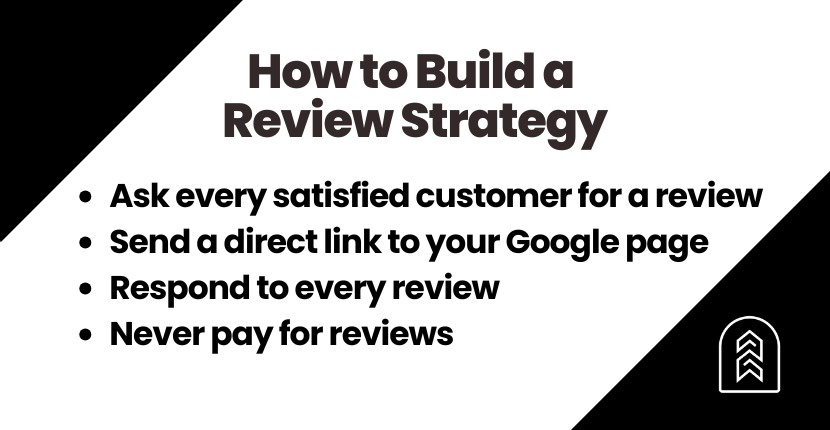
Make asking part of your job closeout. At project completion — when the homeowner walks through the finished space and their excitement is real — ask them if they would be willing to share their experience on Google. In-person requests convert far better than emails sent three weeks later.
Send a direct link to your Google review page. Most homeowners are happy to leave a review; they just aren’t going to hunt for where to do it. Remove the friction. A text with a direct link is usually all it takes.
Respond to every review. Your responses are publicly visible. How you handle a great review — or a difficult one — is part of what future clients are evaluating when they read your profile. A professional, genuine reply builds trust with every reader.
Never fabricate or purchase reviews. Beyond violating Google’s policies, it’s a risk that can get your profile suspended entirely. It’s not worth it.
For a high-ticket service like home remodeling, where the homeowner is weighing a $50,000+ decision, a profile stacked with recent, detailed reviews from real clients is often what separates the business that gets the call from the one that doesn’t.
Link Building for Home Remodeling Companies
Links from other credible websites signal to Google that your remodeling business is trusted and established in your community. Even a modest number of quality local links can make a meaningful difference in where you rank.
Practical ways to earn them:
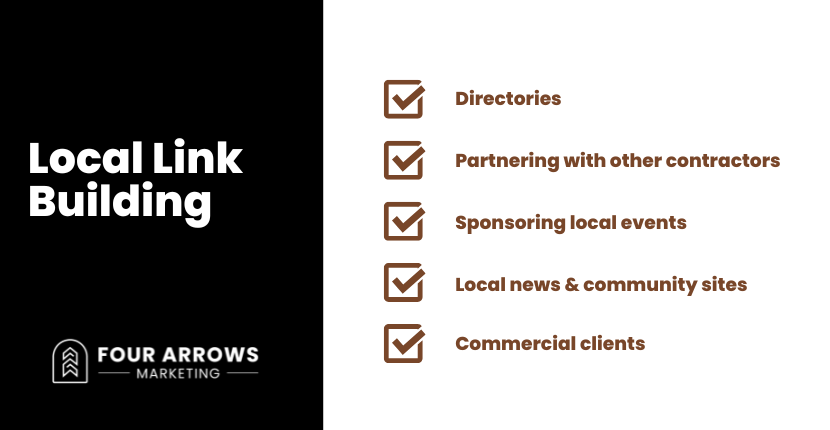
Claim all major directory profiles. Google Business Profile, Houzz, Angi, HomeAdvisor, the BBB, and your local Chamber of Commerce are the foundation. Most link back to your site, and all of them contribute to your citation footprint.
Build trade referral relationships. Roofers, flooring contractors, HVAC companies, and plumbers are often working on the same homes as remodelers. Those cross-referral partnerships — and links from each other’s websites — are a natural fit.
Get involved in your community. Sponsoring a local event, participating in a neighborhood build project, or partnering with a local nonprofit often generates a link from their website. These community-rooted links carry weight in local SEO because they tie your business to a specific geography.
Pursue real estate and interior design relationships. Real estate agents frequently recommend remodelers to buyers and sellers. Interior designers collaborate with contractors on project after project. Links from professionals in those networks are both relevant and valuable.
Local SEO Checklist for Home Remodeling Companies
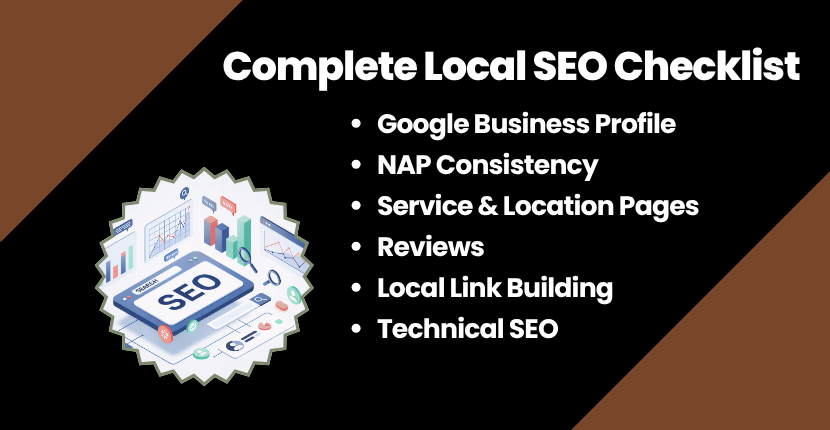
Run your business through this list to find the gaps.
Google Business Profile:
- Claimed, verified, and fully completed
- “General Contractor” or “Home Improvement Contractor” set as primary category with relevant secondaries
- Full service area mapped with all cities and counties
- High-quality before-and-after project photos uploaded and updated regularly
- Regular posts published (promotions, completed projects, tips)
- Every review responded to
NAP Consistency:
- Business name, address, and phone number are identical across all platforms
- No duplicate listings
- Old or outdated listings corrected
Service & Location Pages:
- Individual page for every remodeling service offered
- Individual location page for every city and area served
- Every page targets a unique service-plus-location keyword
- Phone number and clear call to action on every page
Reviews:
- Review request built into project closeout
- Direct Google review link sent to every client after completion
- Responding consistently to all reviews
- Maintaining a 4.5-star rating or higher
Local Link Building:
- All major directories claimed and consistent
- Trade partnerships in place with complementary contractors
- Community involvement generating local links
Technical SEO:
- Website loads quickly on mobile devices
- Easy to navigate on a phone
- Google Maps embed on contact or service area page
- Google Search Console active and monitored
Local SEO for Home Remodelers: Frequently Asked Questions
How long before a home remodeling company starts seeing results?
Most remodeling companies begin seeing measurable ranking movement within 3 to 6 months of consistent work. Google Business Profile improvements can show up faster — sometimes within a few weeks. The timeline depends on how competitive your market is, how much your profile and website needed at the start, and how actively you’re gathering reviews. The results compound the longer you stay consistent.
Should I focus on my Google Business Profile or my website first?
Your Google Business Profile has the most direct influence over your Map Pack position, so that’s where to start if you’re choosing. A well-built website then extends your reach well beyond what the profile can capture on its own. Over time, both working together is what drives sustained lead flow.
What makes home remodeling SEO different from other trades?
The consideration cycle is longer. A homeowner planning a kitchen renovation might research contractors for weeks or months before calling. That means every piece of your online presence — your photos, your reviews, your website content — has more time to either build trust or lose them to a competitor. It also means the payoff per client is significantly higher, which makes the ROI on local SEO particularly strong for remodelers.
Which directories matter most for a remodeling company?
Google Business Profile is the priority by a wide margin. After that: Houzz (which is specifically built around remodeling and design), Angi, HomeAdvisor, Yelp, and the BBB. What matters most is accurate, consistent information across all of them — not just quantity of listings.
How many reviews does my remodeling business need?
There’s no magic number, but more recent reviews consistently outperform a large number of old ones. A remodeling company generating a steady stream of reviews throughout the year will outrank a competitor with 50 reviews from three years ago. Focus on velocity — making review requests a standard part of every project — rather than a one-time push.
What’s the difference between local SEO and traditional SEO for remodelers?
Local SEO for contractors focuses specifically on the Map Pack and location-based searches — the highest-intent traffic for any remodeling business with a defined service area. Traditional SEO targets broader organic rankings that often compete at a regional or national level. For most remodeling companies, local SEO is where the leads come from.
What does professional local SEO cost for a home remodeling company?
Depending on your market and the scope of work, professional local SEO services typically run between $1,000 and $3,000 per month. That usually covers Google Business Profile management, citation building and cleanup, review strategy, content creation for service and location pages, and monthly performance reporting on rankings, traffic, and leads.
Let’s Get Your Remodeling Business in Front of the Right Homeowners

Your crews do exceptional work. Your finished projects speak for themselves. The challenge isn’t what you do — it’s whether the homeowners in your market can find you when they’re ready to hire.
Four Arrows Marketing helps contractors build the kind of local search presence that fills project pipelines and grows revenue. No vague reports. No guesswork. Just clear communication, honest strategy, and results you can measure.
Schedule a call today and let’s talk about what local SEO could look like for your home remodeling company.
–
Written by Adam Gante, Founder of Four Arrows Marketing. Last updated March 2026.
–