

Key Points: AI SEO decides whether ChatGPT, Google’s AI Overviews, Perplexity, and other AI tools name your landscaping company when a homeowner starts asking about a new paver patio, a failing irrigation zone, a slope washing out, or a lawn that has drifted off from the rest of the block. This guide covers how AI search handles the landscaping industry and what you can do to pull ahead while most of your competitors have not noticed the shift.
What Is AI SEO for Landscapers?
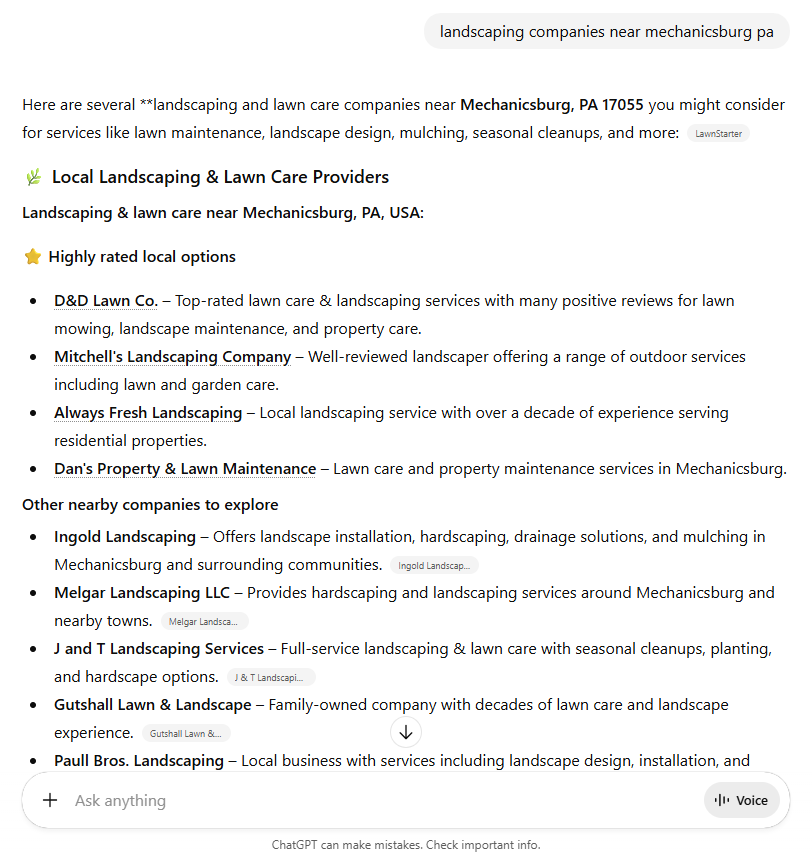
A homeowner pulls into the driveway after work, spots the crew finishing a new paver install two houses down, and opens their phone before they even get out of the car. They are not flipping through the Yellow Pages. They are not scrolling past ten Google results. They are typing into ChatGPT. “How much does a backyard patio with a fire pit run.” “Who does the best hardscaping in Hershey.” “Is a paver patio worth it compared to stamped concrete.”
That exchange, happening in driveways across Central PA every evening, is where most landscaping leads are being born now. The AI builds an answer, and more often than not, that answer names one or two specific companies. Not ten. Not a ranked list. One or two.
AI SEO is the work that decides whether your company is on that short list. Google used to deliver a page of blue links and leave the searcher to sort through them. AI tools skip that and return a direct recommendation with reasoning attached. Companies showing up inside those recommendations are not getting lucky. Their websites, profiles, reviews, and citations are structured so AI can read them easily and repeat them with confidence. That foundation is what our SEO services for landscapers are built around.
The Opportunity Most Landscapers Are Missing
Think back to the early 2010s, when local SEO first started rewarding whoever filled out a Google Business Profile, gathered reviews, and cleaned up their directory listings. Landscapers who took that seriously in 2012 are still at the top of their markets. The ones who waited until 2018 are still chasing.
AI search sits in that same moment right now. The difference is that most of the industry has not registered it yet. Between routing crews, tracking materials, running design consults, writing commercial bids, and answering a phone that will not stop once weather breaks, there is simply no time in most owners’ weeks to think about what ChatGPT does and does not know about their company. That silence is the opportunity.
How AI Search Actually Works for Landscapers
When a homeowner asks ChatGPT to recommend a landscaping company in a specific town, the AI is not reading one source. It stitches signals together from your website, your Google Business Profile, your reviews on Google, Yelp, Angi, and Houzz, and every other spot your company gets mentioned. Then it cross checks. Companies the AI can verify across multiple places are the ones it feels safe recommending.
- Timing signals lead when the question is urgent. A pipe splits under an irrigation zone and the lawn turns spongy. A wall starts bowing after a week of rain. Half a client’s turf yellows the week before a backyard graduation party. For urgent searches, the AI rewards companies clearly showing same-week availability and fast response. Signals buried three clicks into your site do nothing. Signals on your homepage and your Google Business Profile earn the call.
- Descriptive service language comes next. “Landscaping services” on a homepage says nothing useful. Named services like paver patio installation, segmental retaining wall construction, landscape design, spring and fall cleanups, core aeration and overseeding, Rain Bird and Hunter irrigation install and repair, drainage correction, low-voltage landscape lighting, fire pit installation, and commercial site maintenance give the AI something precise to latch onto.
- Review substance beats review volume. Fifty reviews reading “highly recommend” sit below fifteen that describe the actual work. A review reading “installed a Unilock patio with a seat wall at our house in Lititz, finished in six days” carries more weight than a stack of one-line praise. The AI reads the service, material, town, and outcome.
- Educational content keeps pulling you into answers. Homeowners research before they call. They want to know what a paver patio costs, how long a retaining wall should hold up, whether they need a permit, and what plant zone they are in. A site that walks through those questions becomes a source the AI returns to.
How to Check If You Are Showing Up in AI Results
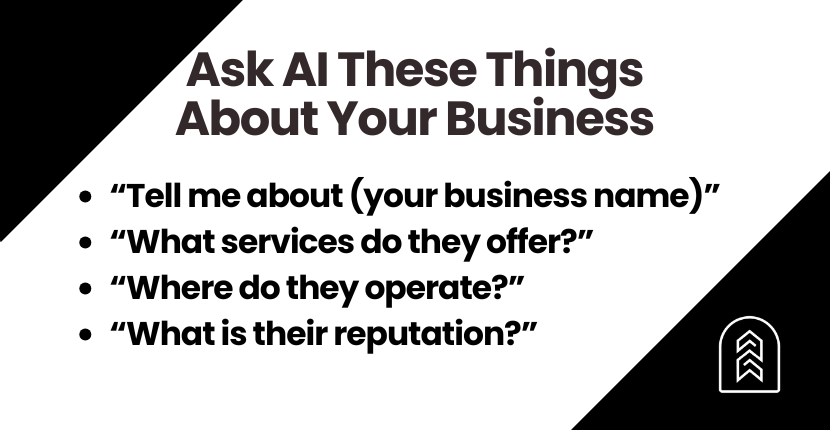
Pull up ChatGPT or Google Gemini and ask: “Tell me about [Your Business Name]. What services do they offer, where do they work, and what do customers say?”
Read what comes back. If the response is thin, generic, or wrong, the AI does not have enough consistent information to recommend you confidently. All of that is fixable. Then run the test on your competition. Whoever shows up while you do not is pulling leads that could have been yours.
Traditional SEO vs. AEO vs. GEO
Landscapers need all three working together.
- Traditional SEO is the foundation. Rankings for queries like “landscape design Camp Hill PA” still generate a major share of local calls.
- AEO (Answer Engine Optimization) is about becoming the source AI tools cite inside their answers. When a homeowner asks “what does a paver patio cost in Central Pennsylvania,” the landscapers whose content contains real pricing context and local detail are the ones AI pulls from.
- GEO (Generative Engine Optimization) is about becoming the direct recommendation when a homeowner asks ChatGPT for the best hardscaping company in York or the top irrigation installer in Mechanicsburg.
Our AI SEO guide for contractors walks further into how those layers reinforce each other.
5 AI SEO Strategies for Landscapers
1. Write FAQ Content That Matches How Homeowners Actually Think
The average homeowner cannot tell you the difference between fescue and ryegrass. They know the yard does not look right and want someone to explain it before they pick up the phone. Pages that deserve a spot on your site:
- “How much does a paver patio actually cost in Central Pennsylvania?”
- “When is the best time to aerate and overseed a lawn in Pennsylvania?”
- “Do I need a permit for a retaining wall in Cumberland County or York County?”
- “What causes brown patches in a lawn and is it grubs, drought, or disease?”
- “What is the difference between a landscape designer and a landscape architect?”
Write them the way you would explain each topic standing on a property with a clipboard. The National Association of Landscape Professionals (NALP) resource library and the Pennsylvania Landscape and Nursery Association (PLNA) technical materials are strong references.
2. Make E-E-A-T Visible on Every Page
E-E-A-T stands for Experience, Expertise, Authoritativeness, and Trustworthiness. Your crews make calls every week that determine whether a wall stands for decades or whether a grade sends stormwater into a basement. That experience rarely shows up on landscaping websites. Signals worth putting front and center:
- Pennsylvania Home Improvement Contractor (HICPA) registration number
- PA Pesticide Applicator License for any turf, weed, or pest treatment work
- Pennsylvania Certified Horticulturist (PCH) credentials on staff
- ICPI Concrete Paver Installer and NCMA Segmental Retaining Wall Installer certifications for hardscape crews
- ISA Certified Arborist credentials for any tree work
- Manufacturer status like Techo-Bloc PRO, Unilock Authorized Contractor, Belgard Authorized Contractor, and certified Rain Bird or Hunter irrigation designer
- Memberships in PLNA, NALP, or the Irrigation Association
- Team bios, project galleries with towns tagged, and local chamber involvement
Homeowners relax when they see credentials. AI tools gain confidence when they see them.
3. Add Schema Markup to Your Website

Schema is behind-the-scenes code that translates your content into a format AI and search engines can read without guessing. For landscapers, service-area accuracy carries real weight.
- LocalBusiness schema for your name, address, phone, hours, service area, and seasonal notes. Google’s structured data documentation covers the fields.
- Service schema laid out one service at a time. Patios, walls, drainage, irrigation, lighting, design, and lawn care each deserve their own tagged pages.
- Review schema showing your rating and review count in a format machines can parse.
- FAQPage schema wrapping your Q&A so AI tools can extract individual answers cleanly.
4. Keep Your Presence Consistent Everywhere Online

No AI builds a picture of your business from one page. Your information has to stay aligned across:
- Google Business Profile
- Yelp, Angi, Thumbtack, Houzz, HomeAdvisor, and the BBB
- Your local chamber of commerce and county-level directories
- Professional locators on PLNA, NALP, and the Irrigation Association
- Manufacturer finders for Techo-Bloc, Unilock, Belgard, Rain Bird, and Hunter
- All active social profiles
A single old Houzz listing with a disconnected phone number can be enough to make the AI back off. Our local SEO guide for contractors covers how to audit and clean those listings.
5. Build a Review Profile AI Tools Can Actually Work With
Reviews that name the job type, town, and result give AI tools specific material to draw from. “They were great” gives almost nothing.
One of our Google reviews at Four Arrows Marketing reads along these lines: “Adam from Four Arrows Marketing is the best. He really takes the time to understand the market you work in, and how you can grow in said market. He works hard and smart. I’m in the irrigation business, and he has helped me develop an online footprint through his marketing strategy. Highly recommend Adam.” That review names the industry, describes the approach, and points at the outcome. An AI reading that has real material to use.
At the end of each project, send the customer a short text: “If you have a minute, we’d appreciate a review that mentions the project we did and the town you are in.” Then work it into job close-out: respond to every review, spread requests across Google, Yelp, Angi, Houzz, and HomeAdvisor, and treat review collection as a standard step.
AI SEO for Landscapers FAQ
How is AI SEO different from traditional SEO for landscapers?
Traditional SEO competes for a click inside a list of ranked results. AI SEO competes to be the named recommendation a homeowner reads before they see a list. Both are worth doing, and work that wins at one usually pushes the other forward.
How can AI SEO help my design-build landscaping company attract higher-ticket projects?
Homeowners planning $50,000-and-up outdoor living projects research heavily before they reach out. They read about material options, design approaches, timelines, warranties, and the difference between a landscape contractor and a landscape designer. Companies whose websites answer those questions in real depth, supported by ICPI or PCH credentials and a project gallery proving scope, become the names AI tools return for higher-value searches.
How long before a landscaping company sees results from AI SEO?
Companies already running a healthy Google Business Profile, an active review base, and a working website can see traction within a few months. Landscapers starting closer to zero should plan on six to nine months before AI-driven leads become consistent.
How do I rank in AI search across the multiple towns my landscaping company serves?
Each core town you serve needs its own dedicated page with real content about that market, not a template with the name swapped out. Pair those pages with accurate schema, a Google Business Profile service area that matches, and client reviews that reference those towns by name.
How does AI SEO help a local landscaper compete against national chains like TruGreen?
Better than any other channel. National chains outspend locals on paid ads, but their content reads generic and their reviews rarely mention specific towns or job details. Local landscapers with real reviews, named local crews, credentials from PLNA, and content answering hyper-local questions like when to apply pre-emergent in Central PA consistently outperform national chains inside AI recommendations.
Ready to Be the Landscaper AI Tools Recommend?

The work coming into landscaping right now is larger, more technical, and more design-driven than anything the trade handled a decade ago. Homeowners planning those projects are making their first call based on what an AI recommended. The companies earning those recommendations set up the right digital foundation early.
Four Arrows Marketing helps landscapers across Central Pennsylvania earn those recommendations. We build out service pages, credential signals, schema, directory accuracy, and review strategy that give AI tools a clear picture of your business. Every client gets monthly strategy calls, weekly updates, and monthly reporting tied to leads, traffic, visibility, and revenue. We also run Google Ads for landscapers when short-term lead flow matters as much as long-term visibility.
If you want your competitors wondering next year how you keep showing up inside ChatGPT, book a call. We will put together a strategy that gets you there.
—
Written by Adam Gante, Founder of Four Arrows Marketing. Last updated April 2026.