
Quick Summary: Landscaping is one of the most competitive local service industries in 2026. This guide breaks down exactly how to show up in Google Maps and local search results — and turn that visibility into a full schedule.
What Does “Local SEO” Actually Mean for a Landscaping Company?
Here is the simplest way to think about it.
When someone in your town opens Google or ChatGPT and types “landscaping company near me” or “lawn care in [city],” the search engine has to decide which businesses to show. That decision is not random. It is based on a specific set of signals — and local SEO is the work of sending the right signals.
Those signals include how complete and accurate your Google Business Profile is, how well your website pages match what people are searching for, how many recent reviews your company has, and how consistently your business information appears across the web.
Landscaping companies that invest in local SEO win more of those searches.
The Google Map Pack: Why It Should Be Your Top Priority
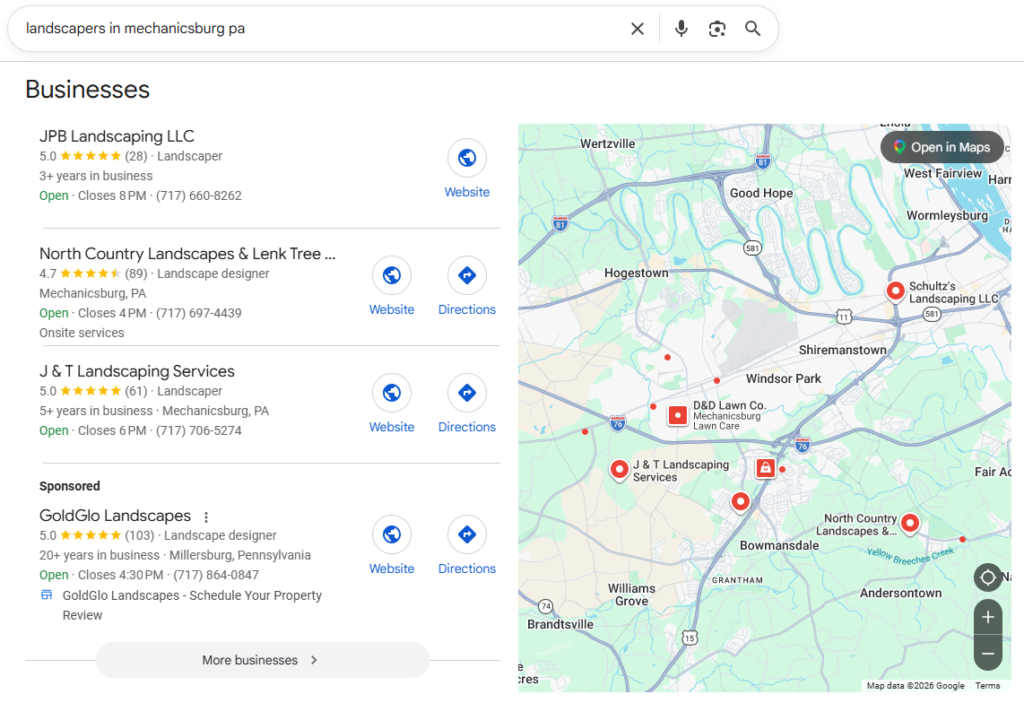
Open Google on your phone and search “landscaping company near me.”
See that block of three business listings at the top — with the map, star ratings, and call buttons? That is the Google Map Pack. It is the most valuable piece of real estate in local search.
Homeowners making a hiring decision rarely scroll past it. They see three options, scan the ratings, and reach out to one or two. If your landscaping business is not in those three spots, you are essentially invisible to the majority of people looking to hire in your area.
Why Local SEO Matters for Landscapers
A homeowner browsing “landscape design ideas” today might not reach out for another two weeks. A property manager looking for a commercial lawn care company is going to compare a few options before committing.
That consideration window is actually good news for your SEO strategy. It means first impressions carry serious weight. Your Google Business Profile photos, your review count, your website — these all factor into whether someone reaches out to you or keeps scrolling.
Think about the variety of searches your potential customers are making at any given moment:
- “Landscaper near me”
- “Lawn maintenance company [city]”
- “Hardscape patio contractor [county]”
- “Sod installation near me”
- “Fall cleanup [town]”
- “Commercial lawn care [city]”
- “Landscape designer [city name]”
Each of these searches represents a real person with a real project. Local SEO puts your business in front of them at the exact moment they are looking and keeps your phone ringing.
According to BrightLocal, the vast majority of people research local service businesses online before ever making contact. For a visual, relationship-driven service like landscaping, that research phase matters even more than in other trades.
Your Google Business Profile: The Foundation of Everything
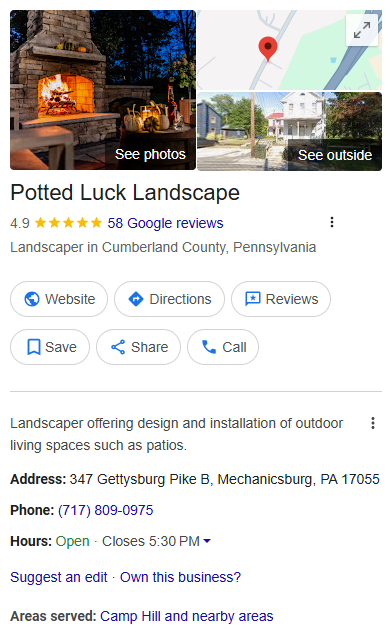
If you had to pick one thing to get right, this is it.
Your Google Business Profile is what powers your Map Pack listing. It is often the very first thing a homeowner sees — before your website, before your social media, before anything else. Getting it right is not optional if you want to compete in local search.
Here is what a well-optimized landscaping profile actually looks like:
Category selection matters more than most people realize. Set “Landscaper” as your primary category. From there, add secondary categories that reflect what you do — “Lawn care service,” “Landscape designer,” “Irrigation service,” or “Snow removal service” depending on your specialties. Google uses these categories to determine which searches to show your profile for.
Fill out every single field. Business description, services, hours, service area, and any seasonal notes. Incomplete profiles get outranked by complete ones — consistently.
Upload real project photos. Landscaping is a visual business. Homeowners are making an aesthetic decision, and your photos are doing sales work around the clock. Before-and-after shots, completed hardscaping projects, manicured lawns, seasonal installs — the more genuine, compelling imagery you have, the better.
Map your full service area. Every city, borough, township, and county you actively serve should be listed. This tells Google when and where to surface your business.
Stay active with posts. Seasonal tips, project spotlights, limited-time promotions — publishing regularly signals that your business is alive and engaged.
Write a real business description. Most landscaping companies leave this generic. Use it to communicate your service area, your specialties, and what makes working with your company worth choosing. Speak to the kind of client you actually want to attract.
The NAP Problem Most Landscapers Do Not Know They Have
NAP — Name, Address, Phone Number — needs to be identical everywhere your business appears online.
When Google sees your business listed as “Green Valley Landscaping” on your website, “Green Valley Landscaping LLC” on Angi, and “Green Valley Lawn & Landscape” on Yelp, it treats those as three different businesses. That confusion chips away at your local rankings.
The same problem happens with phone numbers that changed two years ago but still appear on old directory listings, or an address from a previous location that never got updated.
Audit your citations. Find the inconsistencies. Fix them. This is not glamorous work, but it has a direct impact on your Map Pack position. According to Moz, citation consistency is one of the foundational signals in Google’s local ranking algorithm.
Directories every landscaping company should be listed and consistent on:
- Google Business Profile
- Yelp
- Angi
- HomeAdvisor
- Houzz
- BBB
- Local Chamber of Commerce
- Any trade-specific directories relevant to lawn and landscape
Building a Website That Actually Ranks for Local Searches
Your website is where your local SEO goes deep.
A Google Business Profile can get you into the Map Pack for a handful of searches. A well-structured website extends your reach to dozens — or hundreds — of additional searches that your profile alone can never capture.
The key is structure. Specifically, dedicated pages for each service you offer and dedicated pages for each area you serve.
Why You Need Individual Service Pages
One generic “Services” page cannot rank for “hardscape patio contractor near me” and “sod installation [city]” at the same time. Each service needs its own page — written specifically for that service, optimized for the terms people actually search.
For a landscaping company, that means building out individual pages for things like:
- Lawn care and maintenance
- Landscape design and installation
- Hardscaping (patios, walkways, retaining walls, fire pits)
- Irrigation system installation and repair
- Sod installation
- Mulching and bed maintenance
- Spring and fall cleanups
- Tree and shrub trimming
- Snow removal (if you offer it)
- Commercial landscaping and property maintenance
Each page should speak directly to someone who needs that specific service. Answer their common questions. Describe the process. Show your work with photos. Make it easy to reach you.
Why You Need Location Pages Too
A page targeting “landscaper in York PA” tells Google you serve York — and tells the York homeowner searching that you are local to them.
Build a page for every city, borough, and township in your service area. Keep each one genuinely unique. Pages that just swap out the city name without any other meaningful differences will not rank and can create content quality issues over time.
The Keyword Formula That Drives It All
Every service page and location page should be built around a specific search term. The pattern is straightforward: service + location.
Examples to target:
- Landscaping company Harrisburg PA
- Lawn care service Mechanicsburg PA
- Hardscaping contractor Lancaster County
- Sod installation York PA
- Landscape design Lebanon PA
- Commercial lawn care Hershey PA
- Fall cleanup Carlisle PA
Start by listing every service you offer. Then list every area you serve. Pair them together. That combination tells you exactly what pages to create.
According to Search Engine Journal, close to half of all Google searches carry local intent. Service-specific location pages are how landscaping companies capture that traffic and turn it into actual project inquiries.
Reviews: The Ranking Factor You Can Actually Control
Here is something most marketing agencies will not tell you directly: reviews are one of the fastest, most reliable ways to move the needle on your local rankings — and they are almost entirely within your control.
Google pays attention to how many reviews you have, how recent they are, your average rating, and the actual language customers use. A landscaping company that finishes strong projects and consistently follows up for reviews will climb the Map Pack faster than a competitor relying on a prettier website alone.
What an effective review strategy actually looks like in practice:
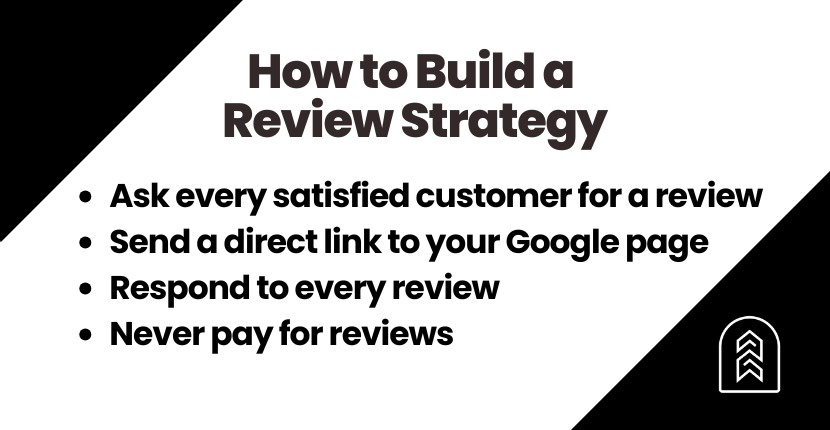
Make the ask part of your process. At the end of every job — whether it is a one-time cleanup or a large installation — ask the customer if they would be willing to share their experience on Google. Do it in person when the conversation is warm.
Send a direct link, not a vague request. Follow up by text or email with a link straight to your Google review page. Most people are willing to leave a review; they just will not go searching for where to leave it. Reduce the friction.
Reply to every review, every time. Your responses are public. When a potential customer reads your reviews, they also read how you respond. A thoughtful, professional reply — even to a difficult one — builds trust with every future visitor.
Do not fake it. Paying for reviews or incentivizing them is against Google’s policies and can get your profile suspended. It is not worth it.
When a homeowner is choosing between two landscaping companies they have never worked with, a profile full of recent, detailed, positive reviews almost always wins the call.
Link Building for Landscaping Companies
Links from other reputable websites signal to Google that your landscaping business is trusted in your community. Even a small number of quality local links can meaningfully strengthen your Map Pack rankings.
Practical ways to build links as a landscaping company:
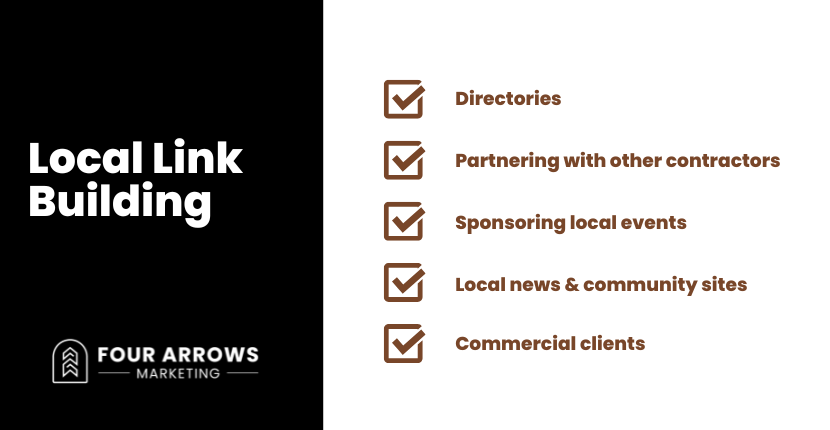
Claim and fully optimize your directory listings. Google Business Profile, Yelp, Angi, Houzz, and the BBB are the starting point. These profiles act as citations and, in most cases, link back to your website.
Build relationships with complementary trades. Roofers, home remodelers, fence companies, and HVAC contractors often work on the same properties as landscapers. Cross-referral relationships — and links from partner websites — are a natural fit.
Get involved locally. Sponsoring a neighborhood event, donating time to a community garden project, or partnering with a local nonprofit often earns a link from their website. These community links carry real weight in local SEO because they tie your business to a specific geography.
Pursue HOA and property management relationships. Many HOAs and property management companies maintain resource pages or approved vendor lists. A link from one of these is highly relevant and genuinely valuable.
Local SEO Checklist for Landscaping Companies
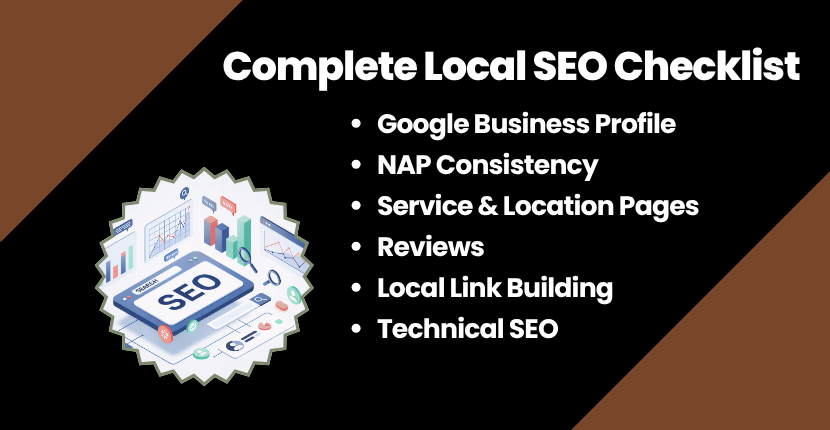
Run your business through this checklist to see where the gaps are.
Google Business Profile:
- Claimed, verified, and fully completed
- “Landscaper” set as primary category with relevant secondaries
- Service area includes all cities and counties you serve
- Strong project photos uploaded and kept current
- Regular posts published
- Every review responded to
NAP Consistency:
- Business name, address, and phone are identical across all platforms
- No duplicate listings present
- Old or outdated listings corrected
Service & Location Pages:
- Individual page for each service you offer
- Individual location page for each city and town you serve
- Every page targets a unique service-plus-location keyword
- Phone number and call to action visible on every page
Reviews:
- Review request built into every job closeout
- Direct Google review link sent to every satisfied customer
- Responding to all reviews regularly
- Maintaining a rating of 4.5 stars or higher
Local Link Building:
- All major directories claimed and consistent
- Trade partnerships in place with complementary contractors
- Local sponsorships or community involvement generating links
Technical SEO:
- Website loads quickly on mobile
- Easy to navigate on a phone
- Google Maps embed on contact or service area page
- Google Search Console active and monitored
Local SEO for Landscapers Frequently Asked Questions
How long before a landscaping company starts seeing results from local SEO?
Most landscaping businesses start seeing measurable movement in rankings within 3 to 6 months of consistent effort. Google Business Profile improvements can show up faster — sometimes within weeks of optimizing. How quickly you progress depends on your market’s competitiveness, how much work your profile and website needed at the start, and how actively you are collecting reviews. The results compound over time, which is why starting sooner always pays off more.
What matters most — the website or the Google Business Profile?
Both matter, and they work together. That said, your Google Business Profile carries the most direct influence over your Map Pack position. For a landscaping company looking to gain traction quickly, that is where to focus first. A well-built website then extends your reach far beyond what the profile alone can capture.
Can a landscaping company do local SEO without a website?
Technically yes — but with real limitations. Your Google Business Profile can get you visibility for a limited set of searches. A website opens up dozens of additional ranking opportunities through service and location pages, and it gives prospective clients a place to evaluate your work in depth before they call. Most landscaping companies at a growth stage need both.
Which directories are most important for landscapers?
Google Business Profile is the clear priority. Beyond that: Yelp, Angi, HomeAdvisor, Houzz, and your local Chamber of Commerce. What matters most is not the quantity of directories but the accuracy of your information across all of them.
How much do reviews actually affect local rankings?
More than most landscapers expect. Google’s local algorithm weighs review velocity (how often you are getting new ones), overall rating, and the content of the reviews themselves — including whether customers mention specific services or locations. A landscaping company generating a steady stream of recent five-star reviews will consistently outperform a competitor with a stale review profile.
What is the difference between local SEO and regular SEO?
Regular SEO for landscapers targets organic rankings for broader search terms — often with national or regional competition. Local SEO is focused specifically on the Map Pack and location-based searches where nearby customers are the audience. For a landscaping company serving a defined service area, local SEO delivers the highest-intent traffic. For a deeper look at how SEO services work for contractors, visit our services page.
What does professional local SEO cost for a landscaping company?
Depending on market size and competition, professional local SEO services typically run between $1,000 and $3,000 per month. That scope of work usually includes Google Business Profile management, citation building, review strategy, content creation for service and location pages, and monthly reporting that shows how your rankings, traffic, and leads are progressing.
Let’s Get Your Landscaping Business Found
Your crews do great work. Your clients love the results. The problem is not the quality of your service — it is that the right people cannot find you when they go looking.
Four Arrows Marketing helps contractors build the kind of local search presence that keeps phones ringing and schedules full. No vanity metrics. No guesswork. Just clear reporting, honest communication, and a strategy built around leads and revenue.
Schedule a call today and let’s talk about what local SEO could look like for your landscaping company.
–
Written by Adam Gante, Founder of Four Arrows Marketing. Last updated March 2026.
–