
Quick Summary: No trade runs on urgency the way HVAC does. A broken furnace in February or a failed AC unit in the middle of August isn’t a project homeowners schedule for next month — it’s a phone call that happens within the hour. This guide covers exactly what it takes to make sure your HVAC company is the one they find and call when that moment arrives.
What “Local SEO” Actually Means for an HVAC Business
Most HVAC owners have heard the term. Fewer have a clear picture of what it actually involves.
Here’s the short version: when someone in your area types “furnace repair near me” into Google — or asks an AI tool like ChatGPT to recommend an HVAC company — a very specific set of factors determines which businesses get shown and in what order. Local SEO is the work of making sure those factors point toward you.
Those factors include your Google Business Profile, how your website is organized, what your reviews look like, and whether your business information is consistent across the web. Get those things right and your HVAC company starts showing up in front of people who are ready to call. Get them wrong — or ignore them entirely — and that traffic goes to whoever in your market has figured it out.
The good news is that most HVAC companies haven’t. There’s real opportunity sitting on the table right now.
The Map Pack: 3 Spots That Drive Most of the Phone Calls
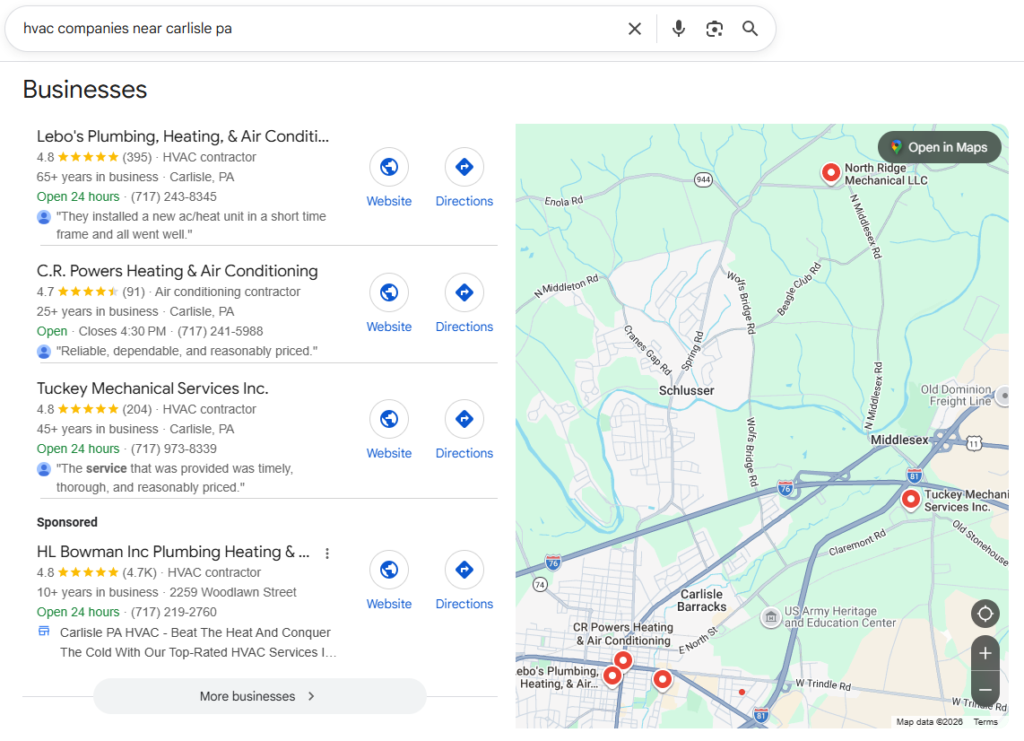
When someone searches for an HVAC company in your area, Google typically shows three local businesses above the regular search results, alongside a map. That block — called the Google Map Pack — is where the majority of local search clicks land.
This is especially true in HVAC. When a homeowner’s system goes down, they aren’t scrolling through pages of results or reading long blog posts. They’re scanning the first thing they see and calling the business with the best reviews. The Map Pack is that first thing.
Getting into those three spots is the single most impactful thing you can do for inbound lead volume. Dropping from position one to position four isn’t a minor shift — it’s the difference between being visible and being invisible.
The Search Behavior That Makes HVAC a Local SEO Goldmine

Think about the searches happening in your service area on any given day.
Some are urgent: a system failure, no heat, an AC that won’t turn on. Some are planned: a homeowner replacing aging equipment before it fails, someone installing a mini split in a new addition, a property manager setting up maintenance plans across a portfolio. Both types of searches end up in Google.
HVAC-related searches your website should be targeting:
- “HVAC company near me”
- “AC repair [city]”
- “Furnace replacement [city]”
- “Heat pump installation [county]”
- “Air conditioning not working [city]”
- “HVAC maintenance plan [city]”
- “Emergency heating repair [city]”
- “Mini split installation [city] PA”
- “HVAC contractor [town]”
- “Central air installation near me”
Every search on that list represents someone with an active problem and a real intent to hire. BrightLocal’s research consistently shows that most consumers turn to online search before contacting any local service business — even for urgent needs. That behavior is your opportunity.
Google Business Profile: Where Local Rankings Start
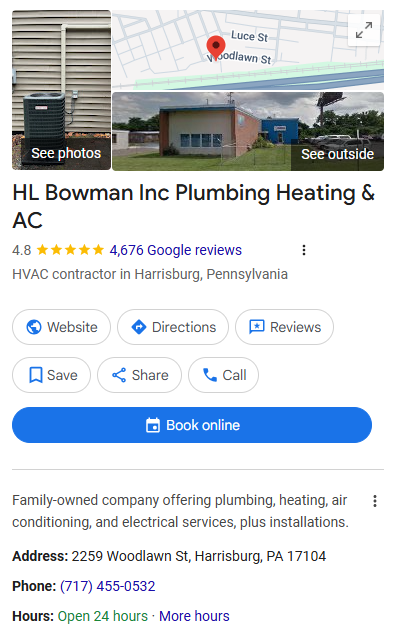
Long before a homeowner ever lands on your website, they’ve already formed an opinion about your business. That opinion forms on your Google Business Profile — the listing that shows your name, rating, photos, hours, and reviews directly inside search results.
It’s also the primary signal Google uses to decide where you rank in the Map Pack. Here’s how to make it count:
Categories first. “HVAC Contractor” should be your primary category. Then layer in every applicable secondary category: “Air Conditioning Contractor,” “Heating Contractor,” “Furnace Repair Service,” “Air Conditioning Repair Service.” Each one tells Google which additional searches your profile is eligible to appear for. Most HVAC companies set one category and stop — that’s a missed opportunity.
Complete means complete. Services listed, hours confirmed, holiday hours filled in, service area defined, business description written. A profile with gaps will consistently lose to one that’s fully built out. There’s no good reason to leave any field empty.
Photos from actual jobs. Truck on a job site. Technicians working. Before and after equipment shots. Finished installs. Homeowners want some sense of who’s coming to their house and what the work looks like. Real photos do that in a way no amount of text can.
Map your territory accurately. Every city, township, and borough you serve should be in your service area settings. Google uses this to decide when to surface your profile for location-specific searches.
Keep the profile alive. Post updates — a pre-season tune-up special, a completed job highlight, a tip on changing air filters before winter. Consistent activity signals to Google that your business is current and engaged, which factors into where it ranks.
Make your description useful. Skip the boilerplate about being a “family-owned business committed to quality.” Instead, tell a prospective customer what you do, where you work, what your process looks like, and why people trust you. One specific, honest paragraph beats three vague sentences every time.
NAP Consistency: The Silent Ranking Factor
Your business name, address, and phone number — referred to as NAP — needs to match exactly across every platform where your HVAC company appears online.
When Google crawls the web and finds “Johnson HVAC” on your website, “Johnson Heating & Cooling” on Yelp, and “Johnson H&C LLC” on Angi, it doesn’t know those are the same company. That confusion weakens your local authority, and weakened authority means lower Map Pack rankings.
This problem is more common than most business owners realize. Phone numbers change. Addresses get updated. Old directory listings never get corrected. Over time, these small discrepancies accumulate into a real drag on your rankings.
Moz’s Local Search Ranking Factors identifies citation consistency as one of the foundational elements of local SEO performance. The fix isn’t complicated, but it does require a systematic audit of everywhere your business information lives online.
Platforms to prioritize:
- Google Business Profile
- Yelp
- Angi
- HomeAdvisor
- BBB
- Nextdoor
- Local Chamber of Commerce
- ACCA (Air Conditioning Contractors of America)
- PHCC (Plumbing-Heating-Cooling Contractors Association)
Find the mismatches. Fix them. Then keep the information consistent going forward.
How Your Website Should Be Built to Rank Locally
A strong Google Business Profile gets you into the Map Pack. A properly structured website is what captures the organic search results that sit below it — and extends your reach far beyond what any single profile listing can cover.
The architecture of your site matters more than most HVAC business owners realize.
Service Pages
Putting all of your services on a single page is one of the most common and costly mistakes in local SEO. A page that lists AC repair, furnace installation, heat pump service, and indoor air quality all together can’t realistically rank for any of those things individually — because Google is looking for pages that are specifically about each specific topic.
Every service you offer deserves its own dedicated page. For an HVAC company, that typically includes:
- Air conditioning repair and service
- Air conditioning installation and replacement
- Furnace repair and service
- Furnace installation and replacement
- Heat pump installation and repair
- Mini split installation
- HVAC maintenance plans and tune-ups
- Indoor air quality and filtration
- Emergency HVAC repair
- Commercial HVAC services (if applicable)
Each page should be written for the homeowner with that specific need — explain the service, describe the process, address common questions, and make it easy to reach you.
Location Pages
There’s a meaningful difference between telling Google you serve Lancaster and having a dedicated page on your website about your HVAC services in Lancaster. The latter performs dramatically better.
A dedicated page for each city or community in your service area signals to Google — with specificity — that you’re an active, relevant option for searchers in those locations. Build one for every area on your list. Write each one uniquely. Duplicated content with swapped city names doesn’t rank and creates problems for your site over time.
The Keyword Pattern That Powers Local Rankings
Each service page and location page should target a defined search phrase built on the same simple formula: service + location.
Target searches like:
- HVAC company Mechanicsburg PA
- AC repair Harrisburg PA
- Furnace replacement Carlisle PA
- Heat pump installation Lancaster PA
- Air conditioning service York PA
- HVAC contractor Hershey PA
- Emergency furnace repair Camp Hill PA
- Mini split installation Lititz PA
Grid out your services against your service areas. Each combination is a potential page, and each page is a potential source of inbound leads. According to Search Engine Journal, roughly half of all Google searches carry local intent — these pages are how you capture that volume consistently over time.
Reviews: The Ranking Factor You Actually Control
A lot of what goes into local SEO involves fixing technical problems or waiting for authority to build. Reviews are different. They’re one of the few factors where consistent daily habits produce directly measurable results — faster than almost anything else in local search.
Google’s Map Pack algorithm weighs your review count, how recently reviews were posted, your overall star rating, and the specific language reviewers use. Two HVAC companies with similar profiles and similar websites will be separated largely by their reviews. The one with more, newer, and more detailed reviews wins.
Here’s how to build a review process that actually works:
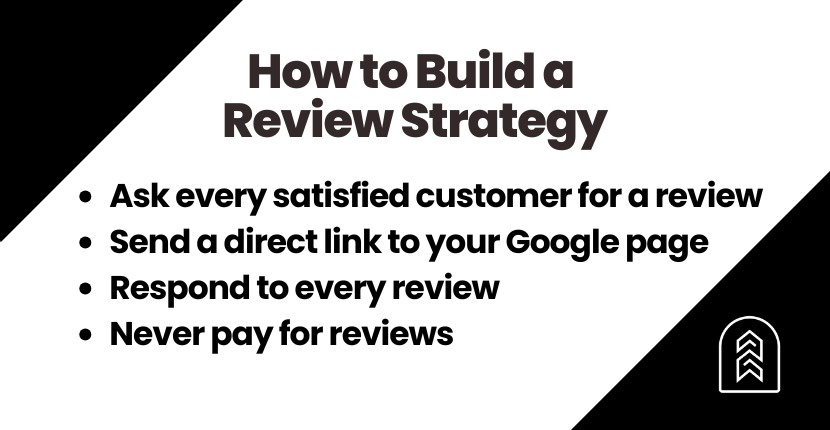
The close is the moment. When your technician finishes a job and the homeowner is satisfied, that’s when to ask — not three days later in an email they may never open. A warm, in-person ask at job completion converts far better than any automated follow-up.
Eliminate friction. Send a text with a direct link to your Google review page before the van pulls out of the driveway. Most homeowners are willing to leave a review; they just won’t spend five minutes figuring out how. Make it a one-tap process.
Respond to every review, publicly. Potential customers read your responses as much as they read the reviews themselves. A thoughtful reply to a five-star review reinforces trust. A professional, non-defensive response to a critical one can actually increase confidence in your business. Either way, silence is the wrong answer.
Don’t shortcut it. Bought reviews or fabricated reviews violate Google’s policies and can get your entire profile suspended. The risk far outweighs whatever short-term bump they might provide.
For HVAC companies selling full system replacements — jobs that can run $10,000 or more — reviews are often the deciding factor for a homeowner who’s never used you before. A profile with 60 detailed, recent reviews beats a competitor with 200 old ones almost every time.
Link Building for HVAC Companies
When credible websites link to yours, it signals to Google that your business has standing in your industry and community. Links don’t replace the other factors — but they amplify them, especially when you’re competing against established local players.
The most practical approach for HVAC companies:
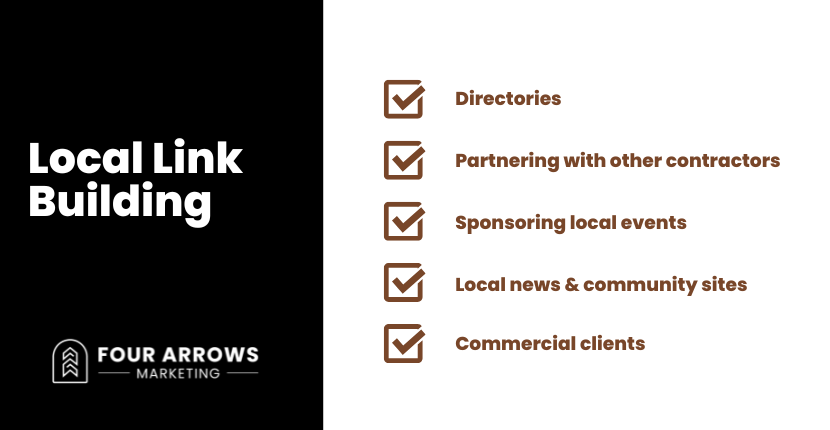
Start with the directories you should already be on. Google Business Profile, Angi, HomeAdvisor, Yelp, the BBB, Nextdoor, and your local Chamber of Commerce are the floor. Most of them link back to your site, and collectively they build the citation footprint that supports your overall local authority.
Form trade alliances. Plumbers, electricians, and roofers work in the same homes you do. Building referral relationships with those trades — and linking to each other’s websites — is a natural arrangement that benefits everyone’s SEO.
Show up in the community. Event sponsorships, youth sports, local nonprofits — these often generate links from the organization’s website. A link from a local little league or chamber event page carries geographic authority that a random directory link simply doesn’t.
Connect with real estate professionals. Agents, inspectors, and property managers refer HVAC companies constantly — to buyers who need a system evaluated, to sellers making repairs before closing, to landlords managing aging equipment. A link from a local real estate professional’s website is both topically relevant and geographically valuable.
Local SEO Checklist for HVAC Companies
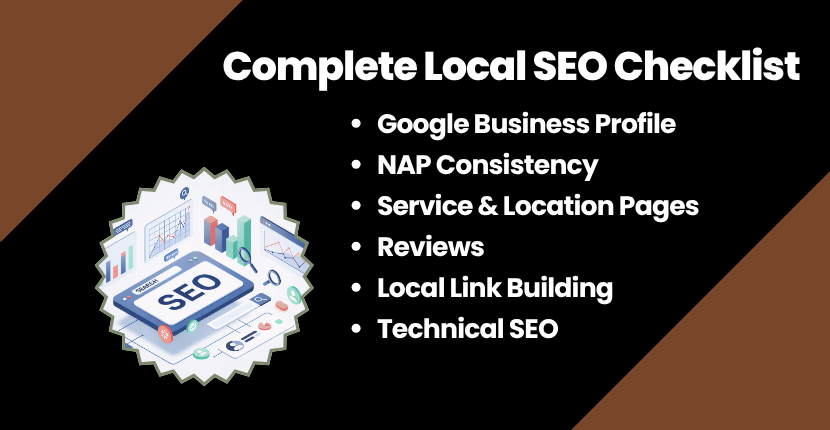
Use this to identify what’s already in place and what still needs attention.
Google Business Profile:
- Claimed, verified, and 100% complete
- “HVAC Contractor” as primary category; all relevant secondary categories added
- Service area includes every city and township you cover
- Job photos added and kept current
- Posts going out regularly (seasonal, promotional, educational)
- All reviews have a response
NAP Consistency:
- Business name, address, and phone number match exactly across all platforms
- No duplicate listings exist
- Any outdated listings have been corrected
Service & Location Pages:
- Dedicated page for every service offered
- Dedicated location page for every area served
- Each page is built around a specific service-plus-location keyword
- Contact information and a clear CTA are on every page
Reviews:
- Review request is part of every job closeout process
- Direct Google review link is sent to every customer
- Responding to all reviews consistently
- Overall rating is at 4.5 stars or higher
Local Link Building:
- All major directories are claimed and consistent
- Trade referral partnerships are in place
- Community involvement is generating local links over time
Technical SEO:
- Site is fast and easy to use on a mobile phone
- Google Maps embed exists on the contact or service area page
- Google Search Console is active and being checked regularly
Frequently Asked Questions
How long before an HVAC company sees results from local SEO?
Three to six months is a reasonable expectation for meaningful ranking movement, though Google Business Profile improvements can show up in weeks. The timeline depends on how competitive your market is and how much ground you’re starting from. One thing that’s consistent: results compound. An HVAC company that stays consistent for 12 months will be in a dramatically different position than one that treats it as a one-time project.
Should I start with my Google Business Profile or my website?
Your Google Business Profile is the more direct lever for Map Pack rankings, so that’s where to focus first if you can only do one thing. Your website is what expands your reach into the organic results below the Map Pack — and it’s what converts visitors into callers. Both need to work together for sustained lead flow.
What separates HVAC SEO from other contractor industries?
The buying cycle is almost nonexistent. A homeowner considering a kitchen remodel might research for two months before calling. An HVAC customer might go from search to phone call in under five minutes. That compressed decision window changes the math — being ranked at the top is worth exponentially more because you’re capturing people at peak urgency, not competing for attention over an extended consideration period.
Which review platforms matter most for HVAC companies?
Google is by far the most important — it directly impacts your Map Pack ranking. Yelp, Angi, and HomeAdvisor matter too, both for SEO and because some homeowners specifically search those platforms. But if you’re going to prioritize one, Google reviews are where to focus.
How many reviews do I need?
Enough to look credible — and enough recent ones to look active. A profile with 20 reviews from the past six months will often outperform one with 150 reviews that stopped accumulating two years ago. The habit of asking after every job is more important than hitting any specific number.
What’s the difference between local SEO and traditional SEO for HVAC companies?
Local SEO for contractors is specifically about winning location-based searches — “HVAC company near me,” “furnace repair Harrisburg PA” — which is where almost all of an HVAC company’s inbound search traffic comes from. Traditional SEO is broader and typically oriented toward organic rankings at scale. For HVAC businesses with a defined service territory, local SEO is the work that moves the needle.
What should I expect to pay for professional local SEO?
For most HVAC companies, professional local SEO runs between $1,000 and $3,000 per month depending on the market and scope. That generally covers Google Business Profile management, citation cleanup and monitoring, review strategy, service and location page content, and monthly reporting on the metrics that actually matter — rankings, traffic, leads, and cost per lead.
Ready to Start Getting More Calls from Local Search?

Homeowners in your area are searching for HVAC help right now. Some are dealing with an emergency. Some are planning ahead. All of them are going to call whoever shows up first in Google — and that could be you.
Four Arrows Marketing works with contractors to build the kind of local search presence that drives consistent, measurable leads. We keep it simple: clear communication, honest reporting, and strategies that are built around your specific market and goals.
Schedule a call and let’s figure out what’s standing between your HVAC company and the top of Google.
–
Written by Adam Gante, Founder of Four Arrows Marketing. Last updated March 2026.
–