
Quick Summary: No homeowner goes looking for a plumber on a slow Tuesday afternoon with nothing better to do. They search because something went wrong — a leak under the sink, a water heater that stopped working, a drain that’s completely backed up. By the time they open Google, they’re already frustrated and ready to book. This guide walks through what it takes to be the plumbing company they find in that moment.
Local SEO Is the Most Important Marketing Investment a Plumber Can Make
Think about where your last 10 customers came from. Word of mouth, maybe a yard sign, possibly a referral from someone you’ve worked with before. Those sources are valuable — but they’re unpredictable. You can’t control when a neighbor mentions your name or when a past customer thinks to pass along your number.
Local SEO works differently. It puts your plumbing company in front of people who are actively, right now, in this moment, looking for exactly what you offer. They’re not browsing. They’re not comparing options for later. They need a plumber and they’re about to call one.
The mechanics behind it come down to a handful of signals Google evaluates — your Google Business Profile, how your website is organized, what your online reviews look like, and whether your business information is consistent across the web. Get those signals aligned, and Google starts routing high-intent searchers your way. Let them slide, and those calls go to a competitor who got there first.
The opportunity is real, and the window is open: most plumbing companies in most markets haven’t invested in this seriously yet.
The Map Pack: Where Most of Your Future Customers Will Find You
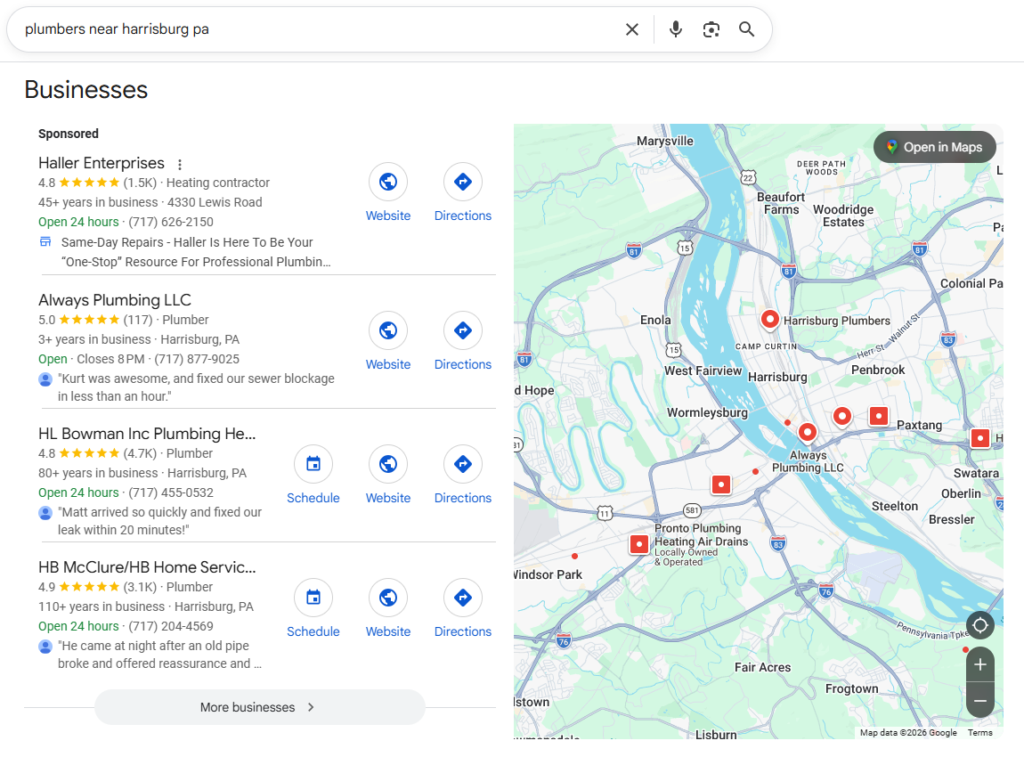
Pull up Google on your phone and search “plumber near me.” Before the regular list of websites, you’ll see a map with three business listings pinned to it. That’s the Google Map Pack — and for local service businesses like plumbing companies, it’s where the vast majority of search traffic lands.
Why does it matter so much for plumbers specifically? Because plumbing problems don’t allow for leisurely research. A homeowner dealing with a leak isn’t going to open six tabs and compare blog posts. They’re looking at whatever’s in front of them, picking someone with a solid rating, and making the call.
Showing up in those three spots is what changes the economics of inbound leads for a plumbing business. Falling below that cut — even to position four — means most searchers never see you at all. It’s not a subtle difference in results; it’s a near-complete loss of visibility for that search.
Local SEO Keywords Plumbers Should Focus On

Plumbing searches tend to cluster into two categories: emergencies and projects.
Emergency searches happen fast. Someone woke up to standing water in the basement. The toilet won’t stop running at 11 PM. The water heater gave out and there are four people in the house who need to shower before work. These searches are short, urgent, and happen on a phone. The business that’s ranked and visible gets the call.
Project searches are slower but still highly motivated. A homeowner planning a bathroom renovation needs a plumber. Someone whose water heater is 14 years old starts researching replacement options before it actually fails. A new homeowner wants a whole-house water softener installed. These searches carry strong intent too — just with a slightly longer lead time before the call.
Both types are worth targeting. Here’s a starting list of searches worth building around:
- “Plumber near me”
- “Emergency plumber [city]”
- “Water heater replacement [city]”
- “Drain cleaning service [city]”
- “Sewer line repair [city]”
- “Burst pipe repair [city]”
- “Toilet installation [city]”
- “Water softener installation [city] PA”
- “Licensed plumber [town]”
- “24 hour plumbing [city]”
- “Sump pump installation [city]”
- “Whole house repiping [city]”
According to BrightLocal’s consumer research, nearly all consumers turn to online search before contacting a local service business — and plumbing, given its urgency, has among the highest conversion rates of any home service category. These aren’t tire-kickers. They’re ready to spend money.
Your Google Business Profile Is Doing More Work Than You Think
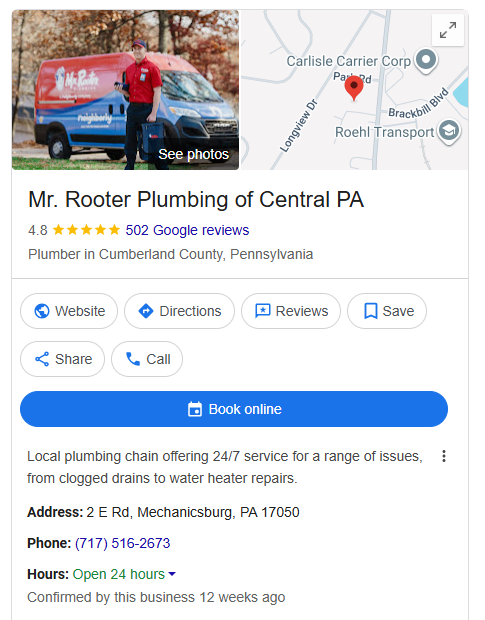
Before a homeowner reads a single word on your website, they’ve already formed an opinion about your business. That opinion comes from your Google Business Profile — the listing that surfaces directly inside search results with your name, rating, photos, hours, and reviews all visible at a glance.
Your profile is also the single biggest factor in where you rank in the Map Pack. A half-built profile with a few photos and minimal information will consistently lose to a competitor whose profile is thorough, active, and dialed in. Here’s what “dialed in” actually looks like:
Categories matter more than most plumbers realize. Your primary category should be “Plumber.” From there, layer in every applicable secondary category: “Drainage Service,” “Water Heater Repair Service,” “Emergency Plumbing Service,” “Septic System Service,” “Sewer Drain Cleaning Service.” Every secondary category is an additional set of searches your profile becomes eligible for. Picking one and stopping is leaving real visibility on the floor.
Treat completeness as non-negotiable. Every field Google offers — services, hours (including emergency hours), service area, business description, attributes — should be filled in. Profiles with gaps consistently underperform against fully completed ones. There’s nothing to gain from leaving fields empty.
Photos should come from real jobs. A truck parked at a job site. A technician replacing a water heater. A before-and-after of a drain repair. Homeowners want a sense of who’s walking through their front door and what the finished work looks like. Authentic job site photos build that credibility far better than anything professionally staged.
Your service area settings need to reflect reality. Every city, township, and borough you actually serve should be listed. This is how Google matches your profile to location-specific searches — and if you haven’t added a location, you won’t appear for searches originating there.
Post to your profile regularly. Seasonal reminders, a water heater special, a tip on preventing frozen pipes heading into winter. Regular posts signal to Google that your business is active, which is a factor in how it ranks your profile against competitors who haven’t touched theirs in months.
Write a business description worth reading. A sentence about being family-owned and community-focused tells a homeowner nothing useful. Use the description to explain what kinds of work you do, which areas you serve, what customers can expect from working with you, and why they’re better off calling you than whoever’s listed below you.
Mismatched Business Information Quietly Tanks Your Local SEO
Here’s a problem that affects nearly every local business that’s been operating for more than a couple of years: your name, address, or phone number is listed differently across different platforms online.
Maybe you changed your phone number two years ago and updated Google but missed Yelp. Maybe an old directory listing has a slightly different version of your company name. Maybe your address is formatted one way on your website and another way on Angi. These differences seem minor, but to Google, they create uncertainty about whether these are actually the same business.
That uncertainty weakens your local authority. And weakened authority shows up directly in your rankings.
Moz’s Local Ranking Factors research identifies citation consistency as a foundational requirement for strong local SEO performance — not an optimization, but a baseline. The process of fixing it isn’t difficult once you know where to look; it just takes a systematic pass through every platform where your information lives.
Platforms worth auditing and keeping current:
- Google Business Profile
- Yelp
- Angi
- HomeAdvisor
- BBB
- Nextdoor
- Thumbtack
- Local Chamber of Commerce listing
- PHCC (Plumbing-Heating-Cooling Contractors Association)
Track down anything that doesn’t match. Fix it. Then keep a record of what’s listed where so future updates stay consistent.
Use Service Pages & Location Pages to Improve Your Local SEO

The Map Pack gets you in front of searches near your location. Your website is what captures everything beyond that — all the searches happening slightly further out, all the service-specific queries that don’t surface Map Pack results, and all the organic results that appear below the map on every search page.
Those two things need each other. A strong profile without a solid website puts a ceiling on how much ground you can cover.
One Service Per Page
The single most damaging structural mistake a plumbing website can make is cramming multiple services onto one page. A page that covers drain cleaning, water heater installation, sewer repair, leak detection, and emergency plumbing simultaneously isn’t going to rank well for any of them. Google needs a page to be clearly about one thing to confidently surface it for searches about that thing.
Build a dedicated page for each service you offer. For most plumbing companies, that list looks something like:
- Emergency plumbing repair
- Drain cleaning and clog removal
- Water heater repair and replacement
- Tankless water heater installation
- Sewer line inspection, repair, and replacement
- Pipe repair and whole-house repiping
- Toilet repair and installation
- Leak detection and repair
- Water softener and filtration system installation
- Sump pump installation and maintenance
- Garbage disposal repair and installation
- Commercial plumbing services (if applicable)
Write each page for the homeowner with that specific problem. Explain what the service involves, describe the process, answer the questions people actually ask before hiring, and make it easy to call or submit a contact form.
One Page Per Location
There’s a meaningful difference between Google knowing you serve Harrisburg and Google finding a dedicated page on your site specifically about plumbing services in Harrisburg. The latter performs dramatically better in local search.
A location-specific page gives Google concrete, on-page evidence that your business is relevant and active in a given city or area — not just that you’ve checked a box in your profile settings. Build a unique page for each community in your service area. Write actual, distinct content on each one. Thin pages that use the same template with only the city name swapped out are a problem — they either don’t rank or actively create issues for your site over time.
Reviews: The One Ranking Factor You Can Improve Immediately
Most of local SEO takes time. Profiles need to age. Pages need to build authority. Links accumulate gradually. Reviews are the exception.
The volume of your reviews, how recently they were posted, your overall star rating, and the language customers use to describe your work — all of it feeds directly into how Google ranks your business in the Map Pack. Two plumbing companies that are otherwise evenly matched on every other factor will be separated by their reviews almost every time.
The plumbing companies winning the Map Pack in competitive markets didn’t get there by accident. They built a review habit into the way they close every job.
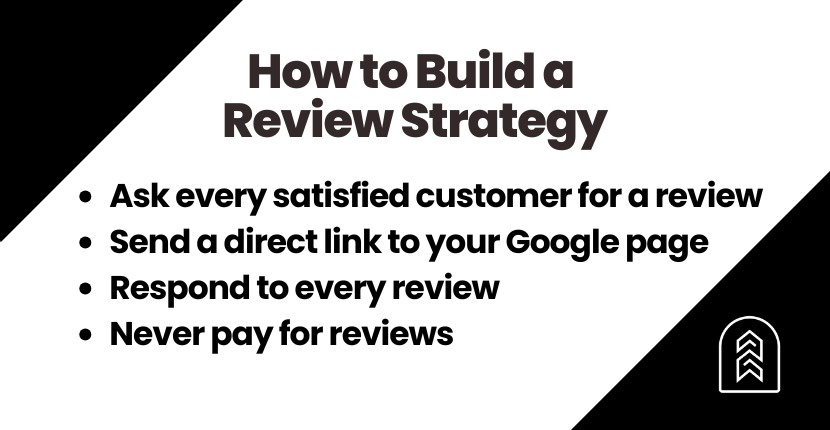
Ask while you’re still on-site. The window between finishing a job and pulling out of the driveway is your best shot. A satisfied customer who’s standing in front of you is far more likely to leave a review than that same customer three days later, when the moment has passed and your email is buried.
Make leaving a review effortless. Before you leave, text the customer a direct link to your Google review page. One tap. No searching for the right place to click. Friction is the enemy of follow-through, and most people who intend to leave a review never do because they can’t find where to go.
Respond to everything — publicly. Your response to a review is visible to every future customer reading it. A thoughtful reply to positive feedback shows you’re engaged. A measured, professional response to a critical review actually builds more trust than ignoring it. Silence looks worse than either.
Don’t manufacture reviews. Paid or fabricated reviews violate Google’s policies. If they catch it — and they’re getting better at catching it — your profile can be suspended entirely. No short-term boost is worth that risk.
For plumbing jobs that run $3,000, $8,000, or more — sewer replacements, whole-house repipes, large water heater installs — reviews are often the tipping point. A homeowner who’s never heard of you before hiring you for a $7,000 job is going to read your reviews carefully. Fifty detailed, recent reviews from real customers closes the gap between “who is this company?” and “okay, I’m calling.”
Local Linking Building to Improve Local SEO
A backlink is a vote of confidence from one website to another. The more credible the voter, the more weight Google assigns to the vote. For local businesses, links from other trusted local sources carry particular value because they also signal geographic relevance — Google can see that trusted local entities are vouching for you.
Here’s where plumbing companies can realistically build links:
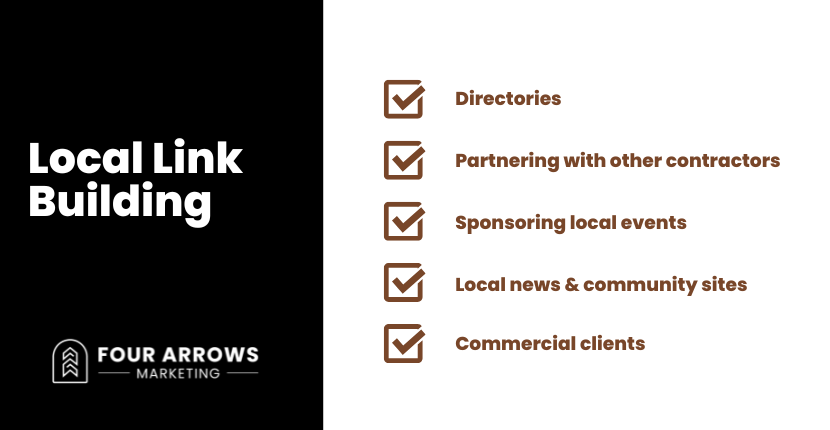
Your directory listings are step one. Angi, HomeAdvisor, Yelp, the BBB, Nextdoor, and your local Chamber of Commerce should all be claimed and consistent. Most of them include a link back to your site. This is the floor, not the ceiling — but you have to start somewhere.
Other home service contractors are natural partners. HVAC companies, electricians, and roofers serve the same homeowners you do, often on the same jobs. A referral relationship with other non-competing trades — including a link exchange on your respective websites — benefits everyone. This isn’t a manufactured tactic; it’s how contractors already operate.
Get involved in your community. Sponsoring a local event, supporting a school fundraiser, or donating to a nonprofit often comes with a link from their site. These links carry localized authority that generic directory submissions can’t replicate. They also build the kind of visible community presence that helps a plumbing company’s name get recognized before someone even needs to Google it.
Real estate is a referral pipeline with SEO benefits attached. Agents and home inspectors refer plumbing companies to buyers and sellers constantly — for pre-purchase inspections, for repairs before closing, for full system evaluations on older properties. A link from a local real estate professional’s website signals to Google that your business is legitimate, established, and locally relevant.
Local SEO Checklist for Plumbing Companies
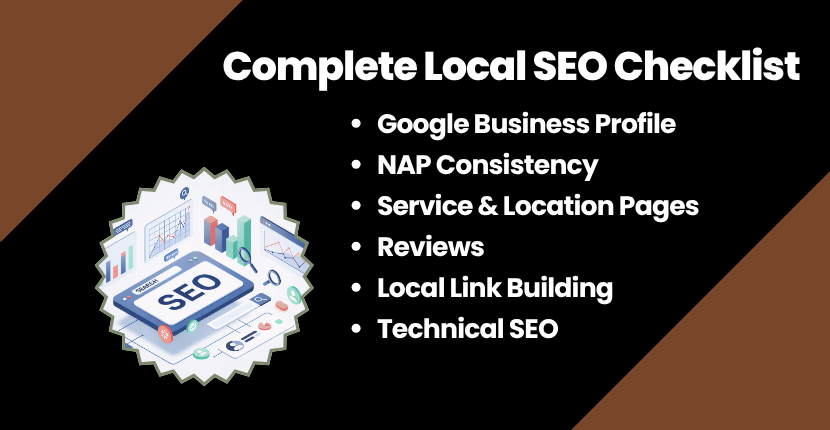
Run through this periodically to see what’s solid and what needs work.
Google Business Profile:
- Claimed, verified, and every field filled out
- Primary category is “Plumber”; all applicable secondary categories are added
- Service area includes every city and community you serve
- Photos from real jobs added and refreshed regularly
- Posts going out on a consistent schedule
- Every review has received a response
NAP Consistency:
- Business name, address, and phone number are identical across every platform
- No duplicate listings exist anywhere
- Any outdated or mismatched information has been corrected
Service & Location Pages:
- Every service has its own dedicated page
- Every city or area served has its own dedicated location page
- Each page is built around one service + location keyword combination
- Contact information and a clear call-to-action appear on every page
Reviews:
- Asking for a review is a standard part of every job close-out
- Every customer receives a direct link to the Google review page
- Reviews are being responded to regularly
- Overall rating is at 4.5 stars or higher
Local Link Building:
- All major directories are claimed and accurate
- Trade referral partnerships are in place
- Community involvement is producing local links over time
Technical SEO:
- Site loads quickly and works well on mobile
- A Google Maps embed appears on the contact or locations page
- Google Search Console is set up and monitored
Local SEO for Plumbers FAQ
When should a plumbing company expect to see results from local SEO?
It depends on your market and your starting point, but most plumbing businesses begin to see meaningful ranking movement within three to six months. Some Google Business Profile improvements show up faster than that. What matters more than a specific timeline is consistency — the compounding nature of SEO means that twelve months of steady effort produces results that bear no resemblance to what three months of sporadic effort produces.
Should I prioritize my Google Business Profile or my website first?
If you’re starting from scratch, prioritize the profile. It’s the most direct path to Map Pack visibility, which is where the highest-urgency plumbing searches convert. Your website handles the broader organic results below the Map Pack and does the work of converting visitors into callers. Neither can fully substitute for the other — they’re complementary, not competing priorities.
Is plumbing SEO harder than other contractor trades?
The urgency cuts both ways. It makes plumbing searches incredibly high-value — a top ranking captures homeowners the moment they’re ready to pay for help. But it also means searchers aren’t spending much time evaluating options, so being in the top positions matters more, not less. The level of effort to compete is similar to other contractor trades; the payoff per ranked keyword is often higher.
Do reviews actually affect where I rank, or are they just for reputation?
Both, and the two are connected. Review count, recency, and rating directly influence your Map Pack ranking. But reviews also determine whether someone who finds you actually calls — especially for larger plumbing jobs where a homeowner is trusting an unfamiliar company with significant work inside their home. Ignoring reviews means leaving ranking points and conversion rate on the table simultaneously.
Is there a target number of reviews I should be aiming for?
Not a specific number, no. The more meaningful metric is whether your reviews look active. A profile with 25 recent reviews signals something very different from a profile with 200 reviews that all came in during one month three years ago and nothing since. The goal is a consistent, ongoing volume — which means building the ask into every job, not running a one-time review campaign and calling it done.
What’s the difference between local SEO and general SEO for a plumbing business?
Local SEO for contractors is built around location-based searches — “plumber Mechanicsburg PA,” “emergency plumber near me” — which is the dominant search pattern for plumbing companies with a defined service territory. General SEO is oriented around organic rankings without a geographic anchor. For a plumbing business that serves specific cities and towns, local SEO is the strategy. It’s not a subset of what you should be doing — it’s the main event.
What should a plumbing company expect to spend on professional local SEO?
Monthly retainers for professional local SEO services typically fall between $1,000 and $3,000, depending on how competitive your market is and how much ground needs to be covered. That range generally includes Google Business Profile management, citation cleanup, review strategy support, location and service page content, and monthly performance reporting covering the numbers that actually tell you whether it’s working: leads generated, keyword rankings, traffic volume, and cost per lead.
Let’s Get Your Plumbing Company to the Top of Google
Right now, someone in your service area is searching for a plumber. In a few hours, someone else will be. Those searches are happening whether you’re visible or not — and whoever shows up at the top is getting the call.
Four Arrows Marketing works with contractors to build local search visibility that generates real, measurable leads month over month. No jargon, no vague promises — just clear communication, honest reporting, and a strategy built specifically around your business and your market.
If you’re ready to find out where your plumbing company stands and what it would take to get it ranking, schedule a call and let’s dig in.
–
Written by Adam Gante, Founder of Four Arrows Marketing. Last updated March 2026.
–