

Key Points: SEO for landscapers is the most reliable way to generate a consistent flow of inbound leads from homeowners and property managers who are actively searching for your services. This guide covers every layer of landscaper SEO — from Google Business Profile to keyword strategy, seasonal content, and visual optimization — so you can outrank competitors and grow your revenue.
What Does SEO for Landscapers Actually Mean?
When a homeowner needs a lawn maintained, a patio installed, or a yard completely redesigned, their first move is a Google or ChatGPT search. They type something like “landscaping company near me” or “hardscaping contractor in York PA” and pick from the first few results.
SEO — search engine optimization — is the process of making sure your landscaping business is one of those first results.
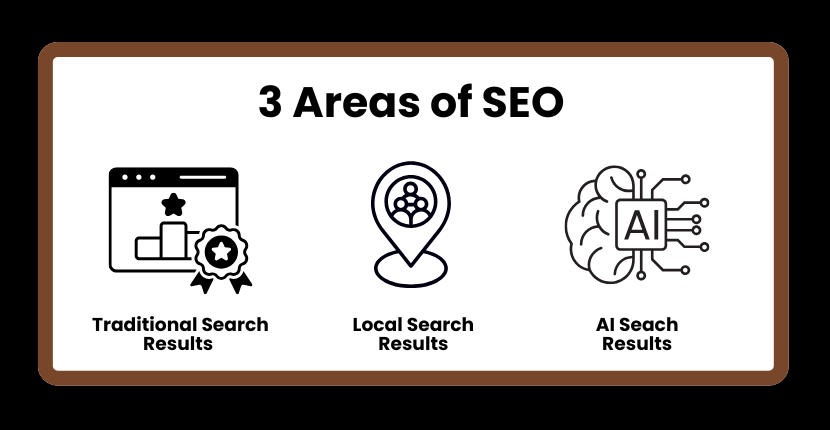
For landscapers, that means three things working together:
- Getting your website to rank in the traditional blue-link results on Google
- Showing up in the Google Maps pack for local searches
- Appearing in AI tools like ChatGPT and Google’s AI Overviews when homeowners ask for recommendations
Each of these is a different search environment. A complete landscaper SEO strategy covers all three.
Why Landscapers Need SEO in 2026
The landscaping industry has more than 600,000 companies competing across the United States. Locally, your competition is real and growing.
Homeowners and property managers do not call a number from a yard sign anymore. They search Google, ChatGPT, read reviews, look at photos, and then call. If you are not showing up in those results, a competitor is getting your leads.
The economics make SEO hard to ignore:
- A residential landscape design project can run $5,000 to $50,000+
- Commercial maintenance contracts bring in predictable recurring revenue
- One new client acquired through organic search can outperform months of ad spend
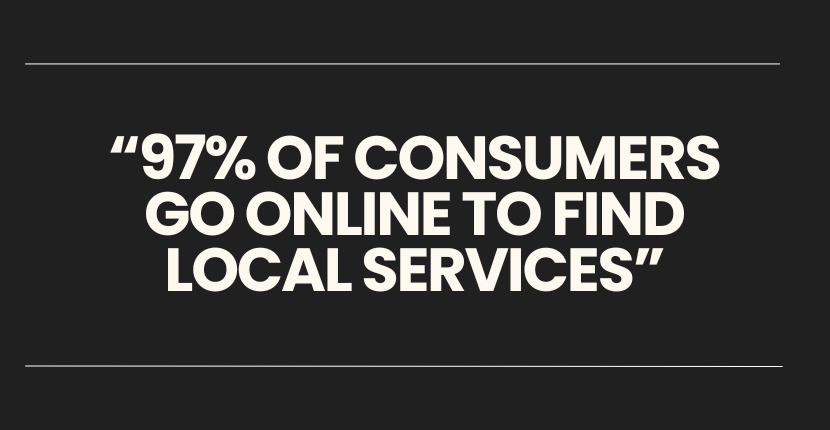
- 97% of consumers go online to find local services
According to Backlinko, the first result on Google gets nearly 28% of all clicks. Page two gets almost none. That gap represents real revenue.
Keyword Research for Landscaping Companies
Most landscapers think about one or two keywords and stop there. That leaves a huge amount of potential traffic on the table.
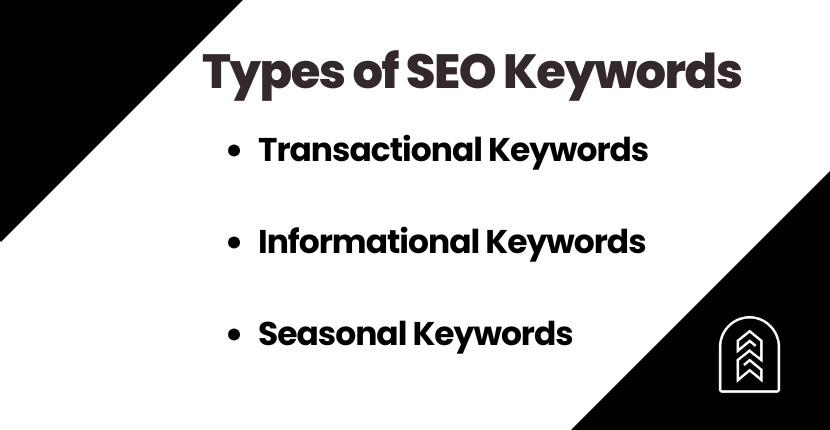
Keyword research for landscapers should cover three types of searches:
Transactional keywords — These are searches from people ready to hire. Examples include “landscaping company Mechanicsburg PA,” “hard-scape contractor near me,” or “lawn maintenance service Harrisburg.” These are your highest-priority targets.
Informational keywords — These are searches from people doing research before they call. Examples include “how much does a paver patio cost,” “best grass seed for Pennsylvania lawns,” or “when to aerate lawn in Central PA.” Ranking for these builds trust early in the buying process.
Seasonal keywords — These are searches tied to specific times of year. “Spring lawn cleanup,” “fall leaf removal service,” and “snow removal contractor” all spike at predictable times. Publishing content before the season hits gives your pages time to rank.
According to Moz, matching your content to searcher intent is one of the most important factors in modern SEO. A page targeting “paver patio installation Lancaster PA” will outperform a generic “landscaping services” page almost every time because it answers the searcher’s exact question.
Use tools like Google’s free keyword planner or Ahrefs to find the terms your customers are actually using in your service area.
On-Page SEO: Building a Website That Ranks
Your website structure is the backbone of your SEO strategy. Here is what a well-optimized landscaping website looks like.
Service Pages
Create a dedicated page for every service you offer. Do not bundle everything onto one page.
Separate pages for lawn maintenance, landscape design, hardscaping, irrigation, mulching, seasonal cleanups, and tree trimming each give you the opportunity to rank for that specific service. Each page should include the service name, your service area, a description of what you do, photos of completed work, and a clear call to action.
View our landscaping SEO services to see how we structure these pages for maximum visibility.
Location Pages
If you serve multiple towns, each one deserves its own page. A location page for “landscaping company in Carlisle PA” is fundamentally different from one for “landscaping company in Hershey PA” — the content should reflect local context, nearby neighborhoods, and relevant project examples.
Generic location pages that swap out city names rank poorly. Unique, locally relevant pages rank well.
Title Tags and Meta Descriptions
Every page on your website needs a unique title tag that includes your primary keyword and your location. Meta descriptions should be written to earn the click, not just describe the page.
Page Speed and Mobile Experience
According to Search Engine Land, the majority of local searches happen on mobile devices. If your site loads slowly or is difficult to navigate on a phone, you are losing leads before they ever read a word.
Run your site through Google’s PageSpeed Insights and aim for a score above 90. Fix anything that is slowing you down.
Google Business Profile: Your Most Important Local SEO Asset
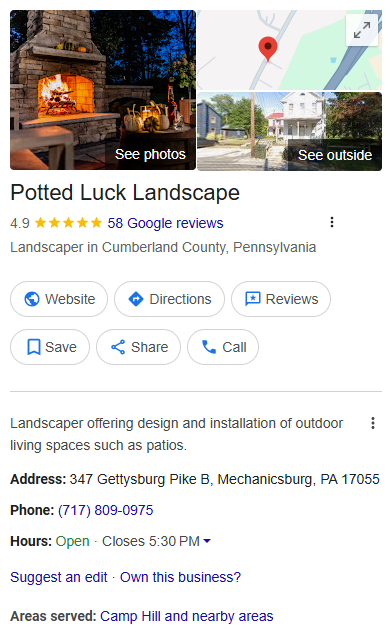
Your Google Business Profile (GBP) is the single highest-impact tool in your local SEO strategy.
When someone searches “landscaper near me,” Google displays a map pack of three local businesses before the organic results. Getting into that map pack drives more calls than almost any other SEO tactic.
Here is how to fully optimize your GBP for landscaping:
- Choose the right primary category. “Landscaper” is the correct primary category for most companies. Add secondary categories for specific services like lawn care, hardscaping, or irrigation.
- Write a keyword-rich business description. Mention your core services and the cities you serve. Keep it natural and focused on the customer.
- Upload at least 20 project photos. Before-and-after shots perform especially well. Add new photos consistently — Google rewards active profiles.
- Enable and respond to reviews. Ask every satisfied client for a review. Respond to every review, positive or negative. Review velocity is a direct ranking factor.
- Post regularly. Google Posts keep your profile active and give you another opportunity to mention seasonal services or promotions.
- Add your service areas. List every city and town you serve so Google knows where to show your profile.
According to Search Engine Journal, businesses with complete, active Google Business Profiles are significantly more likely to appear in the local map pack than businesses with incomplete profiles.
The Power of Visual Content for Landscaper SEO
Landscaping is one of the most visual industries in the home services space. Homeowners are not just looking for a service — they are imagining what their property could look like.
Before-and-after photos are your most powerful conversion tool. A visitor who sees a photo of a backyard transformation that looks like their own yard is far more likely to call than a visitor who reads a description of the same service.
Here is how to use visual content to strengthen your SEO:
- Name your image files descriptively. Instead of “IMG_4821.jpg,” use “paver-patio-installation-mechanicsburg-pa.jpg.”
- Write alt text for every image. Alt text helps search engines understand what is in the photo and contributes to image search rankings.
- Geotag your photos where possible. Photos with location data embedded reinforce your local relevance.
- Create short project videos. A one-to-two minute walkthrough of a completed landscape project builds trust quickly and keeps visitors on your page longer, which is a positive signal to search engines.
According to Semrush, pages with visual content have higher average time on page and lower bounce rates — both signals that tell Google your content is worth ranking.
Seasonal SEO Strategy for Landscapers
Search behavior for landscaping services is highly seasonal, and most landscaping companies miss this opportunity entirely.
Homeowners begin searching for spring cleanups and lawn care services in February — weeks before the weather breaks. Fall cleanup searches spike in August and September. Snow removal queries peak before the first snow in November.
The companies that publish seasonal content ahead of demand are the ones that rank when demand arrives. A blog post about spring lawn preparation published in January has six to eight weeks to rank before homeowners start converting.
Seasonal content ideas that drive leads:
- “Spring lawn care checklist for [your area]”
- “Best time to plant grass seed in Pennsylvania”
- “How to prepare your yard for winter in Central PA”
- “Fall landscaping tips: What to do before the first frost”
Publishing two to four pieces of targeted content per month — especially before peak seasons — compounds your authority over time. This is one area where consistent content marketing separates growing landscaping businesses from stagnant ones.
Building Local Authority Through Backlinks
Search engines treat links from other websites as votes of confidence. The more quality local backlinks your landscaping website has, the more authority it carries.
For landscaping companies, the best backlink sources are:
- Local business partnerships. Roofers, home remodelers, HVAC companies, and plumbers serve the same homeowners you do. Cross-referral arrangements and mutual links build authority naturally.
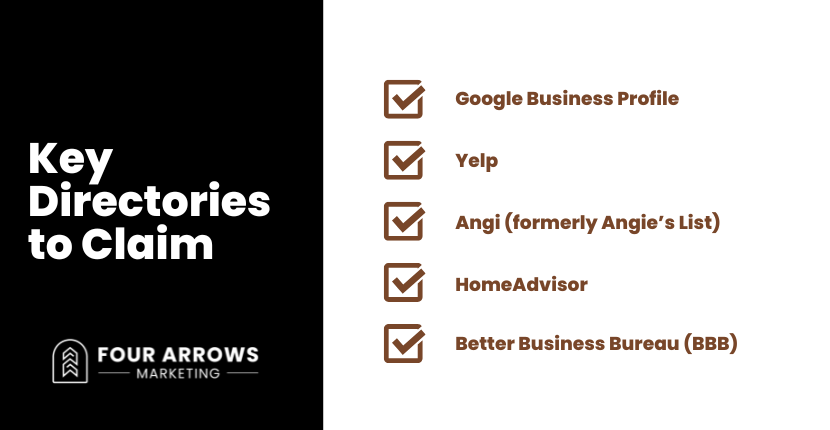
- Local directories and chambers of commerce. Getting listed in your local Chamber of Commerce, community business directories, and industry platforms like Angi and Houzz builds both citations and links.
- Industry associations. Organizations like the National Association of Landscape Professionals provide authoritative backlinks when you become a member.
- Community sponsorships. Sponsoring a local event or sports team often comes with a link from an organization’s website.
Citation consistency also matters here. Your business name, address, and phone number must be identical everywhere they appear online. Inconsistencies confuse search engines and can suppress your local rankings.
Landscaper SEO FAQ: Your Questions Answered
How long does SEO take for a landscaping company?
Most landscapers start seeing Google Business Profile improvements within four to eight weeks. Organic rankings for competitive keywords typically take three to six months of consistent effort. The results compound over time — the work you do today pays off for years.
What is the difference between local SEO and traditional SEO for landscapers?
Local SEO focuses on the Google Maps pack and location-based searches. Traditional SEO focuses on ranking in the organic blue-link results. Both matter, but local SEO tends to drive faster results for landscaping businesses because most customers want someone nearby.
Do I need a blog if I run a landscaping company?
Yes. Blog content is how you capture informational and seasonal searches before customers are ready to call. It builds trust, answers questions, and drives organic traffic that converts. Tree service companies, landscapers, and other outdoor contractors all benefit significantly from educational content.
How many reviews do I need to rank in Google Maps?
There is no magic number, but consistent review velocity matters more than a one-time burst. Aim to get a new review every week or two. Review recency, volume, and average rating all factor into your map pack ranking.
What keywords should a landscaping company target first?
Start with your highest-value service combined with your primary city. For example, “landscape design Harrisburg PA” or “lawn maintenance company Mechanicsburg.” Once those pages are ranking, expand to neighboring cities and secondary services.
Is SEO worth it for a small landscaping company?
Absolutely. Small and mid-size landscaping companies often see better ROI from SEO than larger companies because local competition is more manageable. A well-optimized profile and a handful of strong service pages can put a small company ahead of a larger competitor who is not investing in their digital presence.
Work With a Landscaping SEO Agency That Gets Results
You deserve to work with a digital marketing agency that values you and gets you a return on your investment.
Four Arrows Marketing specializes in SEO and PPC for commercial and residential contractors. We understand the landscaping industry, we understand your customers, and we know what it takes to compete online.
Here is what you get when you work with us:
- Monthly strategy calls so you always know what is happening and why
- Weekly updates so you are never left in the dark
- Monthly reports tracking leads, revenue, cost per lead, traffic, and rankings
- A team that treats you like a name, not a number
Whether you have never invested in digital marketing before or you have been burned by an agency that did not deliver, we would love to show you what it looks like when an agency actually cares about your results.
Schedule a call with Four Arrows Marketing today and let’s build a strategy that grows your landscaping business.
–
Written by Adam Gante, Founder of Four Arrows Marketing. Last updated January 2026.
–
Further Reading